Equipment & Manpower from One Supplier in KSA
Get equipment, manpower, and materials from one supplier in Saudi Arabia. Cut delays and costs, with full accountability under a single contract.
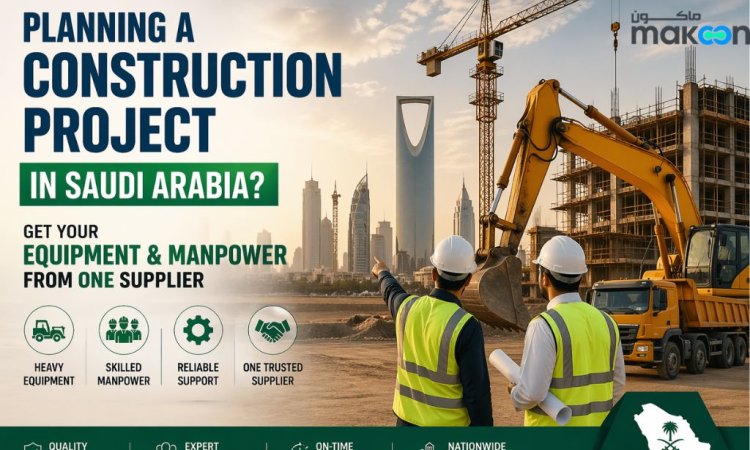
A single-source construction supplier in Saudi Arabia provides heavy equipment rental, manpower supply, and construction materials under one contract, one operations team, and one accountability structure eliminating the vendor coordination failures that cause most construction project delays and cost overruns in KSA.
What Does "Single Supplier" Mean for a Construction Project in Saudi Arabia?
A single-source construction supplier is a company that provides equipment, workforce, and materials under one contract in Saudi Arabia. Instead of signing separate agreements with a heavy equipment rental company, a manpower supply agency, and a materials vendor, the project manager works with one entity one operations contact, one invoice, one escalation path if something goes wrong.
The distinction matters because construction project failures in Saudi Arabia are rarely caused by what happens on-site. They are caused by what happens between vendors equipment arrives without operators, crews mobilise before machinery clears transport, and no individual vendor accepts responsibility for the delay in the gap between their contract and the next supplier's contract.
For projects under Saudi Arabia's Vision 2030 infrastructure programme NEOM, Red Sea Project, Diriyah Gate, and thousands of civil and industrial developments across Riyadh, Jeddah, Dammam, and the Eastern Province this coordination gap is a measurable cost, not an abstract risk. Contractors who consolidate suppliers finish faster, spend less on administration, and carry less exposure when disputes arise.
The challenge is that not every company that markets itself as a "one-stop construction supplier" in KSA operates with genuine integration across all three supply categories. Understanding what real integration looks like and what it prevents is the essential first step before signing any agreement.
The 5 Biggest Problems Contractors Face with Multiple Construction Suppliers
These problems are drawn from the operational reality of construction project management across Saudi Arabia's industrial, infrastructure, and commercial sectors. Each one carries a direct cost.
Problem 1: Equipment Arrives Late, Manpower Arrives Early Idle Time Costs Money
The most damaging mismatch on multi-vendor construction sites in Saudi Arabia is the timing gap between equipment delivery and crew mobilisation.
When construction equipment rental in KSA is sourced from one company and labour from another, both operate on separate depot schedules with no visibility into each other's timelines. A crew of thirty arrives on-site to find that excavators are still in transit delayed at a depot, held at a customs checkpoint, or returning from a previous project. At average daily labour rates in Saudi Arabia, two days of idle time on a thirty-person crew erodes project margin before a single cubic metre of earth has moved.
The reverse is equally costly. Equipment that arrives first sits idle accumulating demurrage or extended rental charges while waiting for a crew delayed by a separate agency's mobilisation paperwork.
A single-source supplier holds both sides of this equation internally. When the equipment schedule shifts, the crew deployment adjusts no external coordination call required, no delay while two separate companies negotiate whose schedule takes priority.
Problem 2: Multiple Contracts, Invoices, and Payment Cycles Drain Project Administration
Each additional vendor creates its own administrative layer: separate payment terms (30 days with one, advance with another), separate invoice formats, separate purchase order and approval chains, separate VAT documentation that must reconcile across different invoice dates.
On a mid-sized Saudi Arabia construction project with equipment rental, skilled labour, unskilled labour, and materials, a procurement team can realistically be managing six to eight separate vendor relationships simultaneously based on typical project scopes handled across KSA's industrial zones. The time cost falls on the people who should be managing site quality and progress.
The compliance dimension compounds this. Saudi Arabia's Zakat, Tax and Customs Authority (ZATCA) requires clean VAT records across all contractor transactions. Managing VAT reconciliation across multiple vendors with mismatched invoice cycles increases the risk of submission errors an audit exposure on larger projects that is simple to eliminate by consolidating to a single supplier.
Projects running SAP or Oracle ERP environments consistently report meaningful reductions in invoice processing time when they move from multi-vendor procurement to a single-source construction supply model, based on post-project procurement reviews shared with Makcon during client onboarding.
Problem 3: No Single Point of Accountability When Something Goes Wrong
A crane breaks down. The equipment came from Vendor A. The operator came from Vendor B. Each vendor attributes fault to the other one claims operator misuse, the other claims pre-existing mechanical failure. Neither has full contractual visibility into the other's scope of supply.
Saudi Arabia's construction contracts for government and semi-government Vision 2030 projects include liquidated damages clauses for delays. When liability cannot be established between two vendors, the client-facing party absorbs those costs. The accountability gap between separately contracted vendors is not a procedural inconvenience it is a financial exposure that appears directly in the project P&L.
A single-source supplier holds responsibility for both the machine and the operator under one contract. There is one escalation path, one resolution process, and no ambiguity about where the obligation sits.
Problem 4: Miscommunication Between Equipment Supplier and Manpower Agency
The communication failure between separately contracted vendors is structural, not accidental. The equipment rental company has no access to the manpower agency's crew manifests. The manpower agency has no visibility into the equipment delivery sequence or machine specifications.
In Saudi Arabia's construction sector where the workforce is truly multinational and every major project involves multiple nationalities across skilled and unskilled categories this gap creates specific, preventable failures:
A concrete pump arrives on-site requiring a certified operator with Saudi Aramco or SABIC compliance credentials. The manpower agency dispatches a qualified pump operator who does not hold those site-specific certifications. Work stops while a replacement is sourced. A lifting operation requires a rigging crew briefed on the specific crane's load chart but the operator and the rigging crew have never worked together and have received no joint safety induction. A site engineer from the equipment company speaks English and Arabic; the crew sent by the manpower agency speak Tagalog and Hindi. Safety protocols are delivered with no common language baseline.
A supplier that manages both equipment and manpower as an integrated operation pairs crews and machines deliberately, standardises certification requirements before deployment, and runs joint inductions as an internal process rather than an improvised workaround.
Problem 5: Mobilisation Delays When Different Vendors Work to Different Timelines
Saudi Arabia's construction market spans 2.1 million square kilometres. A project in NEOM's Tabuk region has fundamentally different logistics requirements than a project in Jubail Industrial City, a desalination plant in Yanbu, or a residential development in Riyadh's northern expansion zone.
When equipment and manpower are sourced from separate companies, each mobilises from its own base different depot locations, different crew staging points, different logistics contractors. If the equipment depot is in Jeddah and the manpower agency operates out of Riyadh, and your project site is in Al Qassim, you are managing two independent logistics chains that have no mechanism to coordinate when one is delayed.
A single supplier operating a coordinated logistics network moves equipment and crew as one unit. When a transport delay occurs in one stream, the operations team adjusts the other side internally not through a cross-vendor negotiation that consumes project management time.
Single-Source Supplier vs Multiple Suppliers: Side-by-Side Comparison
|
Factor |
Single-Source Supplier |
Multiple Suppliers |
|---|---|---|
|
Mobilisation coordination |
Internal – one operations team |
External – vendors coordinate independently |
|
Accountability when delays occur |
One contract, one responsible party |
Disputed between vendors |
|
Invoice and VAT management |
One invoice, one reconciliation |
Multiple formats, multiple payment cycles |
|
Equipment-operator certification match |
Managed pre-deployment |
Not guaranteed across vendors |
|
Escalation path |
Single contact number |
Multiple vendor contacts, no shared SLA |
|
Cash flow exposure |
One payment cycle |
Multiple advance payment requirements possible |
|
ARAMCO / SABIC / RC audit documentation |
Centralised, one request |
Collected from multiple vendors |
|
Mobilisation across KSA regions |
Coordinated logistics |
Each vendor manages independently |
How Makcon Delivers Equipment, Manpower, and Materials from One Call
Makcon has been operating in Saudi Arabia's construction and industrial sector , with deployments across regions of the Kingdom covering oil and gas, power, civil infrastructure, and commercial construction.
The integrated supply model combines heavy equipment rental across Saudi Arabia, skilled and unskilled manpower supply, and construction materials under a single contractual structure. The operational difference is visible at every project phase:
Mobilisation: Equipment and crew depart from coordinated logistics points managed by Makcon's operations team. Machinery and the workforce trained and certified to operate it arrive within the same mobilisation window not days apart.
Site execution: One site coordinator from Makcon is accountable for both the equipment fleet and the crew's daily deployment schedule. Breakdowns, crew absences, and scope changes are handled through a single escalation path.
Compliance documentation: Makcon maintains Iqama validity records, GOSI contribution documentation, Nitaqat compliance status, and equipment certification and third-party inspection records centrally. All documentation is available on request for ARAMCO, Royal Commission, or client-directed audit requirements.
Invoicing: One invoice per billing cycle, structured against your project cost codes, with VAT documentation that reconciles cleanly against a single supplier reference.
Makcon's supply model is designed for projects with a defined scope, timeline, and accountability requirement where the cost of vendor friction shows directly in the project financial result.
Industries and Project Types Makcon Supports Across Saudi Arabia
Oil, Gas, and Petrochemical Infrastructure Deployments in Jubail, Yanbu, Ras Tanura, and the Eastern Province's industrial zones. Makcon's equipment and manpower packages for this sector are structured around permit-to-work requirements, H2S safety protocols, confined space entry procedures, and ARAMCO or SABIC AVL compliance.
Power Generation and Utilities Saudi Arabia's investment in power infrastructure conventional and renewable requires civil construction crews, concrete works equipment, and lifting capability for both greenfield plant builds and brownfield maintenance phases. Makcon provides integrated packages across both project types.
Roads and Civil Infrastructure Earthmoving equipment excavators, motor graders, compactors paired with the corresponding civil works crew for roads, interchange, and urban infrastructure projects across Riyadh, Makkah, and the Northern Borders region. Makcon coordinates equipment type, operator certification, and crew size to the specific scope of each road works package.
Industrial and Logistics Facilities Structural steel erection, concrete works, and MEP crew deployment supported by appropriate lifting and handling equipment for manufacturing and logistics projects in King Abdullah Economic City (KAEC), Sudair Industrial City, and Riyadh's Second Industrial City.
Commercial and Residential Construction Formwork crews, concrete pump operators, tower crane operators, and finishing trades for high-rise development in Riyadh and Jeddah, with equipment and manpower coordinated under a single site management structure.
What to Look for When Evaluating a Single-Source Construction Supplier in Saudi Arabia
1. Does the Company Own Its Equipment or Broker It?
The most important question to ask any supplier claiming to offer heavy equipment rental in Saudi Arabia is whether it owns its fleet outright or sub-contracts from third-party rental companies. A broker cannot give you scheduling control, maintenance history, or mobilisation reliability. Ask for the asset register and depot locations before signing any agreement.
2. Are Workers Directly Employed or Sub-Contracted?
A manpower supply company in Saudi Arabia that sources from third-party labour contractors carries a different risk profile than one that directly employs, trains, and holds the Iqama documentation for its own workforce. Direct employment means faster mobilisation, cleaner Saudi Labour Law compliance, and clear accountability for worker conduct and GOSI contributions.
3. What Are the Company's Saudi Regulatory Credentials?
Verify current contractor classification from the Saudi Contractors Authority (SCA), HRDF registration where applicable for Nitaqat credit, and equipment compliance with Saudi Standards, Metrology and Quality Organization (SASO) requirements. For Aramco or SABIC site work, confirm Approved Vendor List (AVL) status before any mobilisation discussion.
4. Is There One Contract Covering All Three Supply Categories?
The administrative benefit of consolidating suppliers only materialises if there is truly one contract with one unified SLA. If a company issues separate contracts for equipment and manpower and describes them as "coordinated," the accountability gap has not been eliminated it has moved one step back. Require a single master contract before proceeding.
5. Does the Company Have Project References That Match Your Region and Scope?
Operational experience in Riyadh does not translate automatically to a coastal plant project in Yanbu or an industrial project in the Hail region. Request references that specifically match your project geography, sector, and regulatory environment. In Saudi Arabia, regional logistics knowledge is a genuine operational asset – not a detail.
6. What Are the Payment Terms and Credit Facilities?
Saudi Arabia's construction payment cycles are typically tied to client milestone approvals and can extend 60 to 90 days. A supplier that requires advance payment for both equipment and manpower creates direct cash flow pressure at the moments when client payment is pending. Evaluate credit terms as part of the supplier assessment, not as an afterthought.
Ready to Request a Project Quotation?
For contractors, project owners, EPC companies, and joint ventures planning construction works anywhere in Saudi Arabia, Makcon provides project-specific quotations covering equipment, manpower, and materials from a single contractual source.
Frequently Asked Questions
What is a single-source construction supplier in Saudi Arabia?
A single-source construction supplier provides heavy equipment rental, manpower supply, and construction materials under one contract and one operational management structure in Saudi Arabia. The key distinction from a general contractor is that the supplier holds direct ownership of the equipment fleet, directly employs the workforce, and operates under one SLA so there is no sub-contracting chain between the project owner and the resources deployed on-site.
Does using a single supplier for equipment and manpower actually save money on construction projects?
The direct daily rates are typically competitive with individual specialist vendors. The financial benefit is primarily in indirect costs: eliminated idle time from equipment-crew timing mismatches, reduced procurement administration hours, cleaner VAT documentation, and no exposure to liquidated damages from vendor accountability gaps. For projects lasting longer than four weeks, the combined saving on these indirect costs consistently outweighs any marginal rate premium for integrated supply based on Makcon's post-project procurement reviews with clients who transitioned from multi-vendor models.
How do I verify that a construction supplier in Saudi Arabia is properly registered and compliant?
Check for a current contractor classification certificate from the Saudi Contractors Authority (SCA). For manpower supply, verify HRDF registration and Nitaqat classification status. For equipment, confirm SASO compliance documentation for the specific machinery types required. For ARAMCO or SABIC site access, confirm the supplier holds current AVL status this is checked directly against the respective approved vendor registers, not through the supplier's own documentation.
What is the difference between equipment rental with an operator and equipment rental without one?
Bare rental (also called dry hire) provides the machine only the project is responsible for sourcing a qualified, certified operator independently. Operated rental (wet hire) includes a certified operator supplied alongside the machine. For construction projects in Saudi Arabia, operated rental reduces the risk of certification mismatches and operator liability issues, particularly on ARAMCO, SABIC, or Royal Commission sites where operator qualification requirements are specific and verified before site access is granted.
How does Saudisation (Nitaqat) work when using a manpower supply company in Saudi Arabia?
Under the Nitaqat system, the manpower supply company's own Nitaqat classification reflects in its employment ratios not in the client project's Nitaqat record. However, if a project owner requires a specific Saudi national ratio in the crew supplied for their own Nitaqat compliance, this must be specified contractually at the quotation stage. Makcon structures workforce deployments to meet client-specified Nitaqat requirements where these form part of the project contract terms.
What regions of Saudi Arabia does Makcon cover for equipment and manpower supply?
Makcon provides equipment rental and manpower supply across Saudi Arabia's major project regions: Riyadh and Central Province, the Eastern Province (Jubail, Dammam, Dhahran, Ras Tanura), Jeddah and the Western Region, Makkah and Madinah, Yanbu Industrial City, and the Northern Borders and Tabuk regions including the NEOM project zone. Mobilisation logistics and timelines are confirmed at the quotation stage based on the project location and scope.
What types of heavy equipment are available through Makcon for rental in Saudi Arabia?
Makcon's construction equipment rental fleet covers: hydraulic excavators (various bucket sizes), wheel loaders, bulldozers, motor graders, vibratory soil and asphalt compactors, concrete pumps (truck-mounted and stationary), mobile cranes (various capacity ratings), rough-terrain forklifts, and flatbed heavy transport. Availability by model, capacity, and certification status is confirmed at the project quotation stage.
How far in advance should I plan for equipment and manpower mobilisation?
For standard civil construction packages within Riyadh, Jeddah, or Dammam, mobilisation within five to seven working days from confirmed order is typical for Makcon's standard fleet and workforce categories. Specialist equipment, remote project locations, or projects requiring ARAMCO/SABIC site induction for the crew typically require ten to fourteen working days from confirmed scope. Makcon confirms a project-specific mobilisation schedule as part of the formal quotation.
What's Your Reaction?