Excavator Rental Cost in Saudi Arabia: 2026 Guide
Complete excavator rental price guide for Saudi Arabia — daily, weekly, and monthly SAR rates by size class (mini to mining), specifications, attachment costs, selection criteria, fuel consumption data, pre-rental inspection checklist, and cost-saving strategies for professionals.
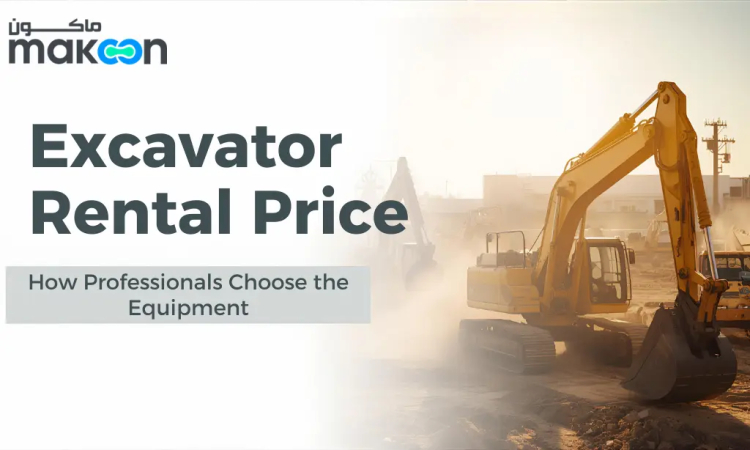
Choosing the wrong excavator for a job costs more than the rental itself. An undersized machine that cannot reach the required dig depth adds days to a foundation pour. An oversized crawler on a tight residential lot tears up finished surfaces and needs a low-bed trailer that may not fit through the access road. In Saudi Arabia, where summer ground temperatures exceed 60°C, equipment downtime caused by a poor match between machine and task is a direct hit to your project budget and your contract timeline.
This guide covers excavator rental pricing, size selection, attachment options, and the factors that separate a cost-effective rental from an expensive mistake — with current SAR rates, specifications by size class, and practical guidance for projects across Riyadh, Jeddah, Dammam, Jubail, and the broader Saudi market.
Excavator Rental Rates in Saudi Arabia (2026)
Rental rates in Saudi Arabia vary by excavator class, rental duration, region, and whether you choose dry hire (machine only) or wet hire (machine + operator). The tables below reflect current market rates across the Kingdom's major project hubs.
Mini and Compact Excavators (1–8 Tonnes)
| Size Class | Operating Weight | Daily Rate (SAR) | Weekly Rate (SAR) | Monthly Rate (SAR) |
|---|---|---|---|---|
| Micro (1–2 t) | 800–2,000 kg | 660–840 | 2,100–3,000 | 5,600–8,000 |
| Mini (2–4 t) | 2,000–4,000 kg | 990–1,300 | 3,200–4,500 | 8,400–12,000 |
| Compact (4–6 t) | 4,000–6,000 kg | 1,300–1,700 | 4,200–6,000 | 11,200–16,000 |
| Heavy compact (6–8 t) | 6,000–8,000 kg | 1,500–1,900 | 5,000–7,000 | 13,000–18,000 |
Standard and Medium Excavators (10–30 Tonnes)
| Size Class | Operating Weight | Daily Rate (SAR) | Weekly Rate (SAR) | Monthly Rate (SAR) |
|---|---|---|---|---|
| Small standard (10–15 t) | 10,000–15,000 kg | 1,700–2,100 | 5,300–7,600 | 14,000–20,000 |
| Medium (15–20 t) | 15,000–20,000 kg | 2,100–2,800 | 7,000–10,000 | 18,000–26,000 |
| Standard (20–25 t) | 20,000–25,000 kg | 3,300–4,200 | 10,600–15,100 | 28,100–39,900 |
| Large medium (25–30 t) | 25,000–30,000 kg | 3,800–4,800 | 12,000–17,000 | 32,000–45,000 |
Large and Heavy Excavators (30–90+ Tonnes)
| Size Class | Operating Weight | Daily Rate (SAR) | Weekly Rate (SAR) | Monthly Rate (SAR) |
|---|---|---|---|---|
| Large (30–50 t) | 30,000–50,000 kg | 5,000–5,900 | 15,800–21,300 | 42,100–56,100 |
| Extra-large (50–70 t) | 50,000–70,000 kg | 6,500–8,500 | 20,000–28,000 | 55,000–75,000 |
| Mining class (70–90+ t) | 70,000–90,000+ kg | 9,000–15,000+ | 28,000–45,000 | 75,000–120,000+ |
Key pricing facts:
- Monthly rentals reduce the effective daily rate by 20–35% compared to day-rate billing
- Wet hire (with operator) adds 25–40% to the base machine rate — operators typically cost SAR 150–350 per day depending on certification level
- Transportation/mobilisation adds SAR 1,500–8,000 depending on distance and machine size
- Prices vary 20–35% between suppliers for identical equipment — always get three quotes
- Aramco and SABIC projects command a 15–25% premium for certified and registered equipment
Excavator Size Classes: Specifications and Applications
Selecting the right excavator class is the single biggest factor in rental cost and project efficiency. Too small means you cannot reach the required depth; too large means you are paying for capacity you do not use, plus higher transport costs and potential site-access problems.
| Class | Weight Range | Engine Power | Dig Depth | Bucket Capacity | Best Applications in Saudi Arabia |
|---|---|---|---|---|---|
| Micro / mini | 1–4 t | 10–40 HP | 1.5–2.5 m | 0.02–0.08 m³ | Landscaping, utility trenches in compound walls, residential plumbing, cable ducting in tight urban lots |
| Compact | 4–8 t | 40–75 HP | 2.5–4.0 m | 0.08–0.25 m³ | Swimming pool excavation, small foundation pits, septic system installation, interior demolition in renovations |
| Small standard | 10–15 t | 73–100 HP | 4.0–5.5 m | 0.25–0.50 m³ | Residential villa foundations, utility main trenches, drainage channels, light road work |
| Medium (20–25 t) | 20–25 t | 130–190 HP | 5.5–6.7 m | 0.50–1.20 m³ | Commercial building foundations, road construction, sewer main installation, general earthmoving — the most rented class in Saudi Arabia |
| Large (30–50 t) | 30–50 t | 200–350 HP | 6.7–8.0 m | 1.20–2.50 m³ | Deep foundations, highway cuts, dam construction, large-scale grading, industrial site preparation |
| Extra-large / mining | 50–90+ t | 350–600+ HP | 8.0–10.0+ m | 2.50–4.50+ m³ | Mining operations, major infrastructure (NEOM, The Line), mass earthmoving, quarry loading, deep-basement excavation |
The 20–25 tonne class — models like the Caterpillar 320, Komatsu PC200, Volvo EC220, and Hyundai HX220 — dominates Saudi rental fleets because it handles the broadest range of construction tasks at a manageable transport and operating cost.
How Professionals Choose the Right Excavator
Experienced contractors evaluate seven factors before placing a rental order. Getting any one wrong leads to either an undersized machine that slows the job or an oversized machine that inflates costs without adding value.
1. Required Dig Depth
This is the non-negotiable starting point. Measure the deepest excavation your project requires — foundation footings, utility trenches, basement levels — and add a 0.5–1.0 m buffer for working clearance. Then match to the excavator class that reaches that depth. A machine rated at 5.5 m dig depth should not be assigned to a 5.5 m excavation — it will struggle at maximum extension with reduced bucket force. Select one class up.
2. Material Type and Ground Conditions
Saudi Arabia presents a wide range of ground conditions across regions:
| Ground Condition | Where Common | Equipment Implication |
|---|---|---|
| Loose desert sand | Riyadh outskirts, Tabuk, Al-Ula, NEOM | Wide tracks (600–800 mm shoes) to prevent sinking; reduced effective bucket capacity due to sand flowing back |
| Compacted sabkha (salt flat) | Eastern Province coastal areas, Jubail, Yanbu | High breakout force needed; may require ripper tooth attachment before bucket excavation |
| Limestone / rocky ground | Jeddah, Makkah, Abha, Asir highlands | Hydraulic breaker attachment essential; rock bucket with reinforced teeth; higher machine class for breakout force |
| Mixed fill / urban backfill | Riyadh, Jeddah, Dammam city centres | Standard digging bucket sufficient; watch for underground utilities — locating services recommended |
| Clay / silt (wet areas) | Agricultural zones in Al-Ahsa, Qatif, Tabuk oases | Wider bucket with side cutters; material tends to stick — consider clean-out holes in bucket design |
3. Site Access and Space Constraints
Measure three critical dimensions before ordering:
- Gate or access-road width: A 20-tonne excavator is typically 2.5–3.0 m wide. Inner-city renovation sites in Old Jeddah or Riyadh's Dira area may not accommodate anything wider than a mini excavator
- Working area footprint: The machine needs its own footprint plus swing radius plus safe clearance from structures and personnel. A 25-tonne excavator has a tail-swing radius of approximately 3.0 m — zero-tail-swing (ZTS) models reduce this to under 2.0 m at a slight rental premium
- Transport route: Machines above 25 tonnes typically require low-bed trailer transport. Routes through residential areas may need municipality permits. Machines above 50 tonnes require police escort for oversize transport
4. Attachment Requirements
The right attachment turns one excavator into multiple machines. Confirm attachment compatibility before signing the rental contract — not every excavator accepts every attachment without hydraulic-circuit modifications.
| Attachment | Application | Excavator Class | Add-On Cost (SAR/day) |
|---|---|---|---|
| Standard digging bucket | General excavation, trenching, loading | All classes | Included in base rate |
| Grading bucket (wide, flat-edge) | Surface levelling, finish grading, slope trimming | 4 t and above | 100–250 |
| Trenching bucket (300–600 mm) | Utility trenches, pipe laying, cable ducting | All classes | 100–200 |
| Hydraulic breaker / rock hammer | Concrete demolition, rock breaking, asphalt removal | 8 t and above (optimal: 15+ t) | 400–1,200 |
| Auger | Post holes, pile bores, tree planting holes | 4 t and above | 300–800 |
| Hydraulic thumb | Grabbing irregular objects — rocks, pipes, debris, tree stumps | 8 t and above | 200–400 |
| Sorting / demolition grapple | Debris separation, selective demolition, waste sorting | 15 t and above | 350–700 |
| Ripper tooth (single shank) | Frozen soil, compacted sabkha, shale, asphalt scarification | 15 t and above | 150–350 |
| Tiltrotator | Precision grading, slope work, pipe laying — 360° rotation and ±40° tilt | 8–30 t | 500–1,000 |
| Rock bucket (reinforced) | Quarry operations, hard rock handling, broken concrete | 15 t and above | 150–300 |
| Compactor plate | Trench backfill compaction without leaving the trench | 4–25 t | 200–400 |
5. Rental Duration Optimisation
The biggest pricing lever in excavator rental is duration. How long you actually need the machine determines whether daily, weekly, or monthly billing gives you the best rate:
- 1–3 days: Daily rate — expect the highest per-day cost, but unavoidable for short utility jobs or emergency excavation
- 4–6 days: Weekly rate — typically 3.0–3.5× the daily rate for a full week, meaning days 4–7 are effectively at 50–60% discount
- 2+ weeks: Monthly rate — typically 8–10× the daily rate for 30 days, making the effective daily rate 65–75% lower than the listed daily price
- 3+ months: Negotiate a long-term contract — additional 10–20% below monthly rates are standard for commitments of 90 days or longer
For projects with variable excavation needs — say, heavy digging in weeks 1–3 and occasional trenching in weeks 4–8 — consider splitting into a monthly rental for the main machine and daily rentals for a smaller unit when needed, rather than keeping the large machine on-site idle.
6. Wet Hire vs Dry Hire
| Factor | Dry Hire (Machine Only) | Wet Hire (Machine + Operator) |
|---|---|---|
| Cost | Base rate only | Base rate + 25–40% operator premium |
| Operator responsibility | Your company provides a qualified operator | Rental company provides a certified operator |
| Best for | Companies with their own certified operators and insurance | Companies without in-house operators, or Aramco/SABIC projects requiring site-specific operator certification |
| Insurance | Your company carries equipment liability | Rental company typically covers equipment insurance; you cover site liability |
| Fuel | Your responsibility | Usually your responsibility (confirm in contract) |
| Maintenance | Major repairs: rental company. Daily checks (oil, coolant, grease): your operator | Rental company handles all maintenance including daily checks |
For excavator rental in Saudi Arabia, wet hire is the safer choice for contractors who do not have MHRSD-licensed operators on staff or who are working on projects requiring specific operator certifications.
7. Saudi-Specific Compliance Requirements
Depending on the project client and location, your rented excavator may need additional documentation:
- Aramco projects: current TÜV or equivalent third-party inspection, Aramco equipment registration, operator with model-specific Aramco certification
- SABIC projects: CHSEP contractor prequalification, SABIC-specific equipment procedure compliance
- Municipal projects: MHRSD operator licence, municipality excavation permit, utility-clearance certificate
- NEOM: digital permit-to-work, QR-code equipment tracking, environmental compliance for ecological zones
- All projects: valid Istimara (vehicle registration) for wheeled excavators driven on public roads, third-party liability insurance, operator medical fitness certificate
Excavator Types: Crawler, Wheeled, and Specialised
Beyond size, the excavator's undercarriage type determines where it can work and how it gets there.
| Type | Undercarriage | Advantages | Limitations | Best Saudi Applications |
|---|---|---|---|---|
| Crawler excavator | Steel or rubber tracks | Superior stability on soft/uneven ground, higher breakout force, works on slopes up to 35° | Cannot travel on public roads, requires low-bed transport (SAR 1,500–8,000 per move), slower travel speed (5–6 km/h) | Foundation excavation, pipeline trenching, earthmoving on undeveloped sites, all Aramco/SABIC industrial projects |
| Wheeled excavator | Rubber tyres (4×4 or 6×4) | Drives on public roads at 30–40 km/h, fast repositioning between work zones, lower transport costs, gentler on paved surfaces | Less stable on slopes, lower breakout force, requires outriggers for heavy lifting, limited to firm/prepared ground | Urban utility work, road maintenance, multi-site municipal contracts where the machine moves between locations daily |
| Long-reach excavator | Crawler (extended boom/stick) | Reach of 18–24 m, dig depth up to 15 m — far beyond standard machines | Reduced bucket force at full extension, heavier than standard equivalent, specialised rental required | Canal dredging, deep foundation piling support, environmental remediation, waterfront projects in Jubail/Yanbu |
| Amphibious excavator | Pontoon tracks | Operates on water-saturated ground, marshes, and shallow water | Very limited availability in Saudi Arabia, specialised transport | Coastal projects in the Eastern Province, mangrove area work, stormwater retention basin construction |
| Zero-tail-swing (ZTS) | Crawler (compact counterweight) | Tail does not extend beyond track width — safe for work near walls, fences, traffic | Slightly reduced lifting capacity vs conventional equivalent | Urban renovation, work alongside live traffic, interior courtyard excavation in commercial buildings |
In Saudi Arabia, crawler excavators account for over 80% of rental demand because most projects are on undeveloped or industrial land where track stability matters more than road mobility.
Cost-Saving Strategies for Excavator Rental
Professional contractors use these strategies to reduce excavator rental costs without compromising productivity:
1. Right-Size the Machine for Each Phase
A 30-tonne excavator is essential for the bulk-excavation phase but wasteful for the finishing and utility-trench phase. Split the rental: use a large machine for 2–3 weeks of heavy digging, then switch to a compact or medium machine for the remaining work at a fraction of the daily rate.
2. Book Attachments Upfront
Attachments ordered with the initial rental are typically 15–25% cheaper than add-ons requested mid-rental. Know your full scope before signing the contract — if there is a rock layer at 3 m depth, include the hydraulic breaker from day one rather than waiting until the bucket bounces off limestone.
3. Match Rental Duration to Billing Breaks
If your excavation scope requires 18 days, a monthly rental is almost always cheaper than 18 daily charges. Even if the machine sits idle for the last 12 days of the month, the monthly rate (8–10× daily) still beats 18 days at the daily rate (18× daily). Use the idle days for backfill, grading, or other light tasks that utilise the same machine.
4. Negotiate Mobilisation Costs
Transport is a fixed cost that hits hardest on short rentals. A SAR 5,000 mobilisation on a 3-day rental adds SAR 1,667 per working day. On a 30-day rental, the same mobilisation adds only SAR 167 per day. For short rentals, ask the supplier if they have a machine already deployed near your site — some rental companies waive mobilisation for equipment repositioned from a nearby completed project.
5. Maintain the Machine Properly
Even on dry hire, daily maintenance is your responsibility and affects your cost. A clogged air filter in Saudi Arabia's dusty conditions reduces engine power by 10–15%, slowing cycle times and extending the rental period. Grease points missed for 3 days in 50°C heat cause accelerated pin and bushing wear — the rental company will charge you for the repair. Ten minutes of daily maintenance protects weeks of rental investment.
6. Compare Three or More Suppliers
Market data shows 20–35% price variation between suppliers for identical equipment in the same city. Smaller regional operators in Dammam and Jubail often undercut national chains by 10–15% while offering comparable equipment quality. Use the price difference to negotiate with your preferred supplier.
Saudi Arabia Excavator Market Overview
The Saudi excavator market is valued at USD 1.07 billion (2025) and is projected to reach USD 2.76 billion by 2034, growing at an 11.10% CAGR. This growth is driven by:
- Vision 2030 mega-projects: NEOM (USD 500 billion), Red Sea Global, Qiddiya, The Line, and Diriyah Gate require massive earthmoving fleets for the next decade
- Mining expansion: Saudi Arabia is developing phosphate, bauxite, gold, and rare-earth deposits across the Northern and Central regions, creating sustained demand for large and mining-class excavators
- Urban development: Riyadh alone plans to grow from 7.5 million to 15+ million residents by 2030, requiring residential, commercial, and infrastructure excavation across the capital
- Industrial expansion: new manufacturing cities in Jubail, Yanbu, and Modon industrial zones drive demand for site-preparation and utility-installation excavators
- Rental preference: the Saudi construction equipment rental market continues to grow as contractors prefer rental over ownership for fleet flexibility and reduced capital expenditure
The Eastern Province remains the highest-demand region for equipment rental, driven by the concentration of Aramco, SABIC, and Royal Commission industrial facilities in Dammam, Jubail, Dhahran, and Ras Tanura.
Common Excavator Rental Mistakes
| Mistake | What Goes Wrong | Professional Approach |
|---|---|---|
| Renting by brand preference instead of task requirements | You pay a premium for a brand name when a comparable machine from another manufacturer does the same job for 15–20% less | Specify the job requirements (dig depth, bucket capacity, breakout force) — then evaluate which available machines meet them at the best rate |
| Ignoring transport costs on short rentals | Mobilisation and demobilisation add SAR 3,000–8,000 per move, wiping out any daily-rate savings | Factor transport into total cost. For 1–3 day jobs, ask if the supplier has equipment already near your site |
| Skipping the pre-delivery inspection | You accept a machine with worn teeth, leaking cylinders, or a faulty A/C — then lose productivity from day one | Inspect the machine at delivery: bucket teeth sharpness, hydraulic leak check, A/C function (non-negotiable in Saudi summer), track/tyre condition, all safety devices |
| Not confirming attachment compatibility | You rent a hydraulic breaker that does not match the excavator's hydraulic flow rate — the breaker underperforms or does not work at all | Confirm the excavator's auxiliary hydraulic flow (litres per minute) and pressure (bar) against the attachment's requirements before signing |
| Renting monthly when you need it for 10 days | You pay for 30 days but use the machine for 10 — especially painful on large excavators at SAR 40,000+/month | Calculate the crossover point: if daily rate × actual days < monthly rate, rent daily. For a 20t excavator, the crossover is typically around 12–14 days |
| No fuel-consumption planning | A 30-tonne excavator burns 18–25 litres/hour of diesel. Over a 10-hour shift, that is 180–250 litres (SAR 200–280/day at current diesel prices). Unplanned fuel costs inflate the total rental expense by 20–30% | Get the machine's rated fuel consumption from the manufacturer or rental company. Budget fuel as a line item alongside the rental rate |
| Forgetting to check the operator's qualifications | An unlicensed operator causes an accident or is refused entry to an industrial site — your project stops | Verify: MHRSD crane/equipment operator licence, site-specific certification (Aramco, SABIC) if applicable, valid medical certificate, relevant experience on the rented model |
Fuel Consumption by Excavator Class
Fuel is the second-largest cost after the rental rate itself. Use this table to budget accurately:
| Excavator Class | Typical Fuel Consumption (litres/hour) | 10-Hour Shift (litres) | Estimated Daily Fuel Cost (SAR)* |
|---|---|---|---|
| Mini (1–4 t) | 3–6 | 30–60 | 33–66 |
| Compact (4–8 t) | 6–10 | 60–100 | 66–110 |
| Small standard (10–15 t) | 10–15 | 100–150 | 110–165 |
| Medium (20–25 t) | 15–22 | 150–220 | 165–242 |
| Large (30–50 t) | 20–30 | 200–300 | 220–330 |
| Extra-large (50–90+ t) | 30–50+ | 300–500+ | 330–550+ |
* Based on Saudi diesel price of approximately SAR 1.10/litre (subsidised rate for commercial operations). Actual consumption varies with ground conditions, operator skill, and duty cycle — hard digging in rock increases consumption by 20–40% over soft soil.
Pre-Rental Inspection Checklist
Before accepting delivery of any rented excavator, verify these items on-site:
| # | Check Item | What to Look For | Action if Failed |
|---|---|---|---|
| 1 | Bucket teeth | Sharp tips, no cracks, retaining pins secure | Request replacement teeth before signing delivery receipt |
| 2 | Hydraulic system | No visible leaks at cylinders, hoses, fittings; smooth operation without jerking | Reject machine or require immediate repair |
| 3 | Tracks / tyres | Track tension correct (25–50 mm sag), pads >50% wear remaining; tyres properly inflated, no sidewall damage | Document condition with photos; negotiate reduced rate for worn components |
| 4 | Engine | Starts smoothly, no excessive smoke (blue = oil burning, black = fuel issue, white = coolant leak), stable idle | Reject machine — engine problems worsen rapidly in Saudi heat |
| 5 | Air conditioning | Blows cold within 5 minutes, cabin temperature reaches 22–25°C | Non-negotiable in Saudi summer — reject if A/C is weak. Operator productivity drops 30–40% without functioning A/C at 48°C+ |
| 6 | Safety devices | ROPS (Roll-Over Protective Structure) intact, seatbelt functional, mirrors clean, horn works, backup alarm operational, fire extinguisher present and charged | Do not operate until all safety items are confirmed — site safety officers will shut you down |
| 7 | Boom, stick, bucket pins | No excessive play in pin joints (check by lifting and lowering bucket slowly — clunking indicates worn bushings) | Document excessive wear; worn pins reduce digging accuracy and cause premature structural fatigue |
| 8 | Swing mechanism | Smooth 360° rotation, swing brake holds position on slopes | Reject if swing is jerky or brake slips — indicates hydraulic motor or gearbox wear |
| 9 | Lights and gauges | All warning lights functional, hour meter readable, fuel gauge accurate | Note hour-meter reading at delivery — this is your baseline for billing and maintenance scheduling |
| 10 | Documentation | Third-party inspection certificate, insurance, maintenance log, load chart, operator manual | Do not accept delivery without complete documentation — especially for Aramco/SABIC sites |
Why Choose MAKCON for Excavator Rental in Saudi Arabia
MAKCON provides excavator rental across Saudi Arabia with a fleet spanning mini excavators through 90-tonne mining-class machines. Our service includes:
- Aramco and TÜV-certified fleet: third-party inspected and Aramco-registered equipment ready for industrial deployment without compliance delays
- Full attachment range: breakers, augers, grapples, tiltrotators, ripper teeth, and specialised buckets available with every rental
- Wet and dry hire: MHRSD-licensed operators available with site-specific certifications for Aramco, SABIC, and Royal Commission facilities
- Supporting equipment: cranes, boom lifts, scissor lifts, dump trucks, roller compactors, wheel loaders, and bulldozers for complete earthmoving packages
- National coverage: rapid mobilisation from depots in Dammam, Riyadh, and Jeddah to any project location in the Kingdom
- Industrial support: industrial support services, certified manpower, material supply, generator rental, and welding equipment for integrated project support
Request an excavator rental quote — specify your project location, dig depth requirement, estimated duration, and any attachments needed, and we will confirm availability and pricing within 24 hours.
Frequently Asked Questions
How much does it cost to rent an excavator in Saudi Arabia?
Excavator rental rates in Saudi Arabia range from SAR 660 per day for a micro/mini excavator (1–2 tonnes) to SAR 15,000+ per day for a mining-class machine (70–90+ tonnes). The most commonly rented class — the 20–25 tonne medium excavator — costs SAR 3,300–4,200 per day or SAR 28,100–39,900 per month. Monthly rentals reduce the effective daily rate by 20–35% compared to daily billing. Add 25–40% for wet hire (with operator) and SAR 1,500–8,000 for mobilisation depending on distance.
What size excavator do I need for my project?
Match the excavator to your required dig depth and material type. For residential landscaping and utility trenches under 2.5 m, a mini excavator (1–4 t) is sufficient. For standard foundations and general earthmoving at 5–7 m depth, a 20–25 tonne medium excavator handles most tasks. For deep foundations, highway cuts, and mass earthmoving beyond 7 m, you need a 30+ tonne large excavator. Always select one class above your minimum dig-depth requirement for working clearance and adequate bucket force.
Is it cheaper to rent an excavator monthly or daily?
Monthly rental is cheaper if you need the machine for more than approximately 12–14 days. The monthly rate is typically 8–10 times the daily rate, so for any rental period beyond that crossover point, the monthly rate saves money even if the machine is idle for some days. For example, a 20-tonne excavator at SAR 3,500/day costs SAR 49,000 for 14 days on daily billing, versus approximately SAR 34,000 on a monthly contract covering 30 days.
What attachments can I add to a rented excavator?
Common rental attachments include hydraulic breakers (SAR 400–1,200/day), augers (SAR 300–800/day), grading buckets (SAR 100–250/day), trenching buckets (SAR 100–200/day), hydraulic thumbs (SAR 200–400/day), sorting grapples (SAR 350–700/day), ripper teeth (SAR 150–350/day), tiltrotators (SAR 500–1,000/day), and compactor plates (SAR 200–400/day). Confirm that the excavator's auxiliary hydraulic flow and pressure match the attachment's requirements before ordering.
Do I need special certification to operate a rented excavator in Saudi Arabia?
Yes. All excavator operators in Saudi Arabia require an MHRSD-approved heavy equipment operator licence. For Aramco projects, operators additionally need model-specific Aramco certification, SAPMT safety induction, and a current medical fitness certificate. SABIC projects require CHSEP contractor prequalification. Municipal projects require excavation permits from the relevant municipality. The rental company can usually provide a certified operator through a wet-hire arrangement.
What is the difference between a crawler excavator and a wheeled excavator?
Crawler excavators run on steel or rubber tracks, providing superior stability on soft, uneven, and sloped ground — they account for over 80% of Saudi rental demand. Wheeled excavators run on rubber tyres and can drive on public roads at 30–40 km/h, making them ideal for urban utility work and multi-site contracts where the machine moves between locations daily. Crawlers have higher breakout force and stability but require low-bed transport between sites (SAR 1,500–8,000 per move), while wheeled units save on transport but need outriggers for heavy lifting and are limited to firm, prepared ground.
How much fuel does an excavator use per day?
Fuel consumption varies significantly by size class. A mini excavator (1–4 t) burns 3–6 litres per hour, while a large excavator (30–50 t) burns 20–30 litres per hour. Over a 10-hour shift, a commonly rented 20–25 tonne excavator consumes approximately 150–220 litres of diesel, costing SAR 165–242 per day at Saudi subsidised diesel rates. Hard digging in rock increases consumption by 20–40% compared to soft soil. Always budget fuel as a separate line item alongside the rental rate.
What should I check before accepting delivery of a rented excavator?
Inspect ten critical items: bucket teeth condition, hydraulic system for leaks, track tension and pad wear (or tyre condition), engine start-up and smoke colour, air conditioning performance (non-negotiable in Saudi summer), all safety devices (ROPS, seatbelt, mirrors, horn, backup alarm, fire extinguisher), boom and stick pin play, swing mechanism smoothness, lights and gauges, and complete documentation (inspection certificate, insurance, maintenance log). Note the hour-meter reading at delivery for your billing baseline and photograph any pre-existing damage.
What's Your Reaction?