Rent or Buy Heavy Equipment in Saudi Arabia? The 2026 Guide Every Contractor Must Read
Should you rent or buy heavy equipment in Saudi Arabia in 2026? This contractor's guide covers costs, comparisons, and when each option makes more sense.
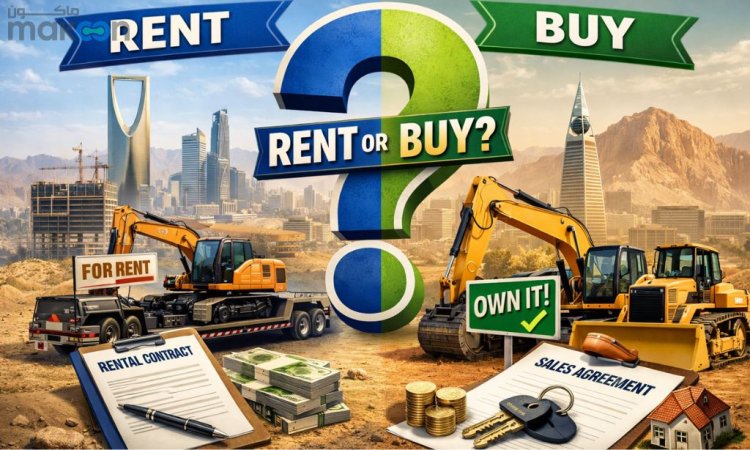
Every contractor working in Saudi Arabia right now is facing the same question should I rent heavy equipment or buy it outright? And in 2026, that question carries more weight than it ever has.
The Kingdom’s construction sector is moving at an unprecedented pace. Timelines are tight, megaprojects are operating concurrently across several countries, and the expense of a poor equipment plan can ruin a project before the foundation is even laid. If you invest too much money in your own equipment, your cash flow will be choked. If you rely solely on rentals without prior planning, you risk experiencing availability gaps at the worst possible time.
This guide is built for contractors, project managers, and procurement teams operating on the ground in Saudi Arabia. No theory. No filler. Just a practical, numbers-driven breakdown of when renting makes sense, when buying is the better call, what the real costs look like in 2026, and how to choose an equipment rental Saudi Arabia partner that actually delivers on its promises. Whether you’re a subcontractor chasing your next megaproject package or an established firm scaling operations, this is the decision framework you need before signing your next purchase order or rental agreement.
Should You Rent or Buy Heavy Equipment in Saudi Arabia in 2026?
Renting is the more sensible option for the majority of contractors operating in Saudi Arabia at the moment, unless you have steady, year-round use for a particular machine across several confirmed contracts. That's the truthful response. However, your project pipeline, cash flow, and operational setup all of which are broken down in this guide determine the overall picture.
Quick Verdict Table
|
Factor |
Rent |
Buy |
|
Upfront cost |
Low (monthly payments) |
High (full capital outlay) |
|
Maintenance responsibility |
Rental company handles it |
You handle it |
|
Best for project duration |
Under 12 months |
Over 18 months continuous use |
|
Flexibility to scale |
High — add or return units easily |
Low — you’re committed |
|
Tax & depreciation benefits |
Limited |
Significant over time |
|
Risk of idle equipment |
Zero |
High if pipeline is uncertain |
|
Access to latest models |
Always current |
Depreciates from day one |
Understanding the Saudi Market in 2026
Saudi Arabia’s construction sector in 2026 is operating at a scale the region hasn’t seen before. Vision 2030 megaprojects NEOM, The Red Sea, Diriyah Gate, Jeddah Central, the Riyadh Metro expansions — are running simultaneously, creating enormous demand for heavy machinery across excavation, lifting, earthmoving, and material handling categories.
This demand has created two parallel realities. On one side, equipment prices have climbed because global manufacturers are stretched thin supplying multiple booming markets. On the other, heavy equipment rental companies in Saudi Arabia have expanded their fleets aggressively, making rental availability better and more competitive than it was even two years ago.
For contractors, this means the rent-vs-buy calculation has shifted. Buying made straightforward sense when equipment was cheaper and rental options were limited. In 2026, the equation is more nuanced, and getting it wrong can tie up capital that you desperately need elsewhere.
When Renting Heavy Equipment Makes More Sense
Renting is the stronger choice in several common scenarios that Saudi-based contractors face regularly.
Short to medium-term projects are the obvious case. If you need a 50-ton crawler crane for eight months on a specific site in Jeddah, buying that crane outright and then figuring out what to do with it afterwards makes no financial sense. Heavy equipment rental in Saudi Arabia gives you the machine for exactly the duration you need it, with no disposal headache at the end.
Projects in remote or unfamiliar locations also favour rental. If you’ve secured a contract in Tabuk or along the NEOM coastline but your base operations are in Riyadh, shipping owned equipment across the country, arranging local maintenance, and managing logistics adds layers of cost and complexity. A regional equipment rental Saudi Arabia partner with depots closer to your site eliminates most of that friction.
Uncertain project pipelines make renting the safer bet. The Saudi contracting market moves fast — projects get delayed, scopes change, timelines shift. If you’ve bought a fleet of excavators banking on a contract that gets pushed back six months, those machines sit idle while your loan payments don’t.
Cash flow constraints are another decisive factor. Heavy equipment purchases require significant upfront capital or financing arrangements. For small and mid-sized contractors competing for subcontracts on megaprojects, preserving working capital for payroll, materials, and mobilisation costs is often more important than owning assets.
Finally, renting gives you access to newer, better-maintained machines. Reputable rental companies rotate their fleets regularly, meaning you’re often operating equipment that’s only a few years old with current safety features and emission standards something that matters increasingly as Saudi project owners tighten compliance requirements.
When Buying Heavy Equipment is Better
Buying isn’t dead it’s just more selective in 2026. There are clear situations where ownership wins.
If you have guaranteed, continuous utilisation above 60–70% annually for a specific machine type, the math tips toward buying. A mid-sized earthmoving contractor running wheel loaders and backhoe loaders across three simultaneous residential projects in Riyadh, with a confirmed pipeline stretching 24 months ahead, will almost certainly save money owning those core machines compared to renting them month after month.
Specialised equipment that defines your competitive advantage is worth owning. If your business reputation is built around heavy lift capability — say, operating 200-ton-plus mobile cranes for industrial plant construction — owning that equipment ensures availability and eliminates dependency on rental schedules. Heavy lift companies in Saudi Arabia that own their crane fleet can bid more aggressively and respond faster than those relying on third-party availability.
Purchases are often justified by long-term government contracts with secure payment conditions. Financing equipment purchases against a five-year infrastructure contract with predictable revenue is reasonable and economical throughout the course of the contract.
Tax advantages and depreciation are also important. Businesses can depreciate heavy equipment under Saudi Arabia's tax system, which lowers taxable revenue throughout the asset's useful life. This can significantly reduce the overall cost of ownership for larger contracting organisations with substantial tax exposure.
Cost Comparison: Rent vs Buy in Saudi Arabia
Let’s use a real-world example to illustrate the numbers. Consider a CAT 320 excavator, one of the most commonly used machines on Saudi construction sites.
Purchasing outright in 2026 runs approximately SAR 550,000 to SAR 700,000 depending on configuration and dealer. Add annual maintenance costs of roughly SAR 40,000 to SAR 60,000, insurance at around SAR 15,000 to SAR 25,000, and operator costs which apply regardless of rent or buy. Over five years, your total ownership cost lands somewhere around SAR 950,000 to SAR 1,200,000 before resale value.
Renting the same machine through heavy equipment rental companies in Saudi Arabia currently runs approximately SAR 18,000 to SAR 28,000 per month, depending on contract length and whether maintenance is included. Over 12 months, that’s SAR 216,000 to SAR 336,000 — with zero maintenance burden and zero residual risk.
The breakeven point, where buying becomes cheaper than continuous renting, typically falls between 18 and 30 months of sustained use. Below that threshold, renting almost always wins financially. Above it, ownership starts delivering savings — provided the machine stays busy.
How to Choose the Right Equipment Partner
Whether you rent or buy, who you work with matters as much as which option you pick. A poor rental partner can cost you more in downtime, unreliable machines, and slow response times than the savings you gained by choosing rental in the first place.
Look for fleet condition and age. Ask directly how old the machines are and what maintenance schedule they follow. Walk the yard if possible. Equipment rental Saudi Arabia providers with transparent fleet management practices are the ones worth trusting with your project timelines.
Availability and delivery speed are critical. On Saudi megaprojects, mobilisation timelines are tight. If your rental partner needs three weeks to deliver a machine to site, that’s a problem. The best companies maintain regional depots and can mobilise within days.
After-sales and breakdown support separates serious operators from everyone else. Confirm whether the rental includes on-site maintenance support, what the response time commitment is for breakdowns, and whether replacement machines are provided if repairs take extended time.
Contractual flexibility matters. Projects in Saudi Arabia change scope frequently. Your rental agreement should allow you to extend, shorten, or swap equipment without punitive charges. Rigid contracts signal a company that prioritises its own convenience over yours.
Why Choose MAKCON
MAKCON operates across Saudi Arabia with a fleet built specifically for the demands of this market — machines rated for extreme heat, desert conditions, and the heavy-duty cycles that Saudi construction projects require. Whether you need standard earthmoving equipment for a residential development or specialised heavy lift solutions for industrial projects, MAKCON provides the machinery, the maintenance, and the operational support to keep your site moving.
From single-unit rentals to full fleet solutions for megaproject subcontractors, MAKCON works as a partner rather than just a supplier — handling logistics, compliance documentation, and on-site technical support so you can focus on building.
Conclusion
The rent-or-buy decision in Saudi Arabia in 2026 isn’t about which option is universally better. It’s about which option fits your specific situation right now — your project duration, your cash position, your pipeline certainty, and your operational capacity to maintain owned assets.
For most contractors navigating the current Saudi market, renting provides the flexibility and capital efficiency needed to compete effectively. For established firms with stable, long-term workloads, strategic equipment purchases still make strong financial sense.
The worst choice is the one made on instinct rather than numbers. Run the utilisation math, assess your pipeline honestly, and partner with an equipment provider that supports both options without pushing you toward whichever one benefits them more.
FAQs
Is it cheaper to rent or buy heavy equipment in Saudi Arabia?
For projects under 18 months, renting is almost always cheaper when you account for maintenance, insurance, and idle time risk. Beyond 18–30 months of continuous high utilisation, buying typically becomes more cost-effective.
What types of heavy equipment are available for rent in Saudi Arabia?
Most heavy equipment rental companies in Saudi Arabia offer excavators, wheel loaders, bulldozers, mobile cranes, telehandlers, aerial platforms, compactors, and dump trucks. Specialised machinery like piling rigs and heavy lift cranes are also available through providers with larger fleets.
Do rental companies in Saudi Arabia provide operators with the equipment?
Some do, some don’t. Larger providers like MAKCON can supply trained operators as part of the rental package, while others offer dry hire only. Always confirm this before signing a rental agreement, as operator availability directly impacts your mobilisation timeline.
What should I look for in a heavy equipment rental company in Saudi Arabia?
Fleet condition, delivery speed, maintenance support, contract flexibility, and regional coverage are the five factors that matter most. A provider with depots near your project site and a transparent maintenance history will save you far more than one offering the lowest daily rate with unreliable machines.
Can I rent heavy lift equipment for megaprojects in Saudi Arabia?
Yes. Several heavy lift companies in Saudi Arabia offer crane and lifting solutions specifically designed for megaproject requirements, including NEOM, The Red Sea, and Diriyah Gate. These typically involve longer-term rental agreements with dedicated on-site technical support.
What's Your Reaction?