Telehandler Rental in Saudi Arabia: Uses & Specs
Telehandler rental in Saudi Arabia: uses, lifting capacities, rental costs, and safety needs, plus how to choose the right machine for your site.
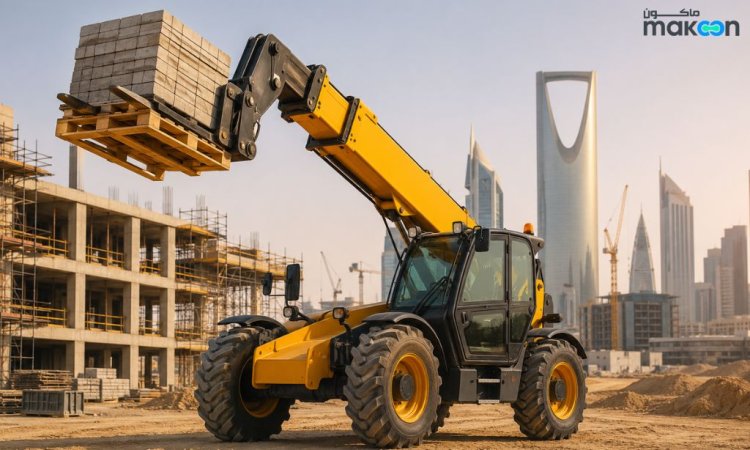
Across construction sites in Saudi Arabia from residential towers in Riyadh to petrochemical plant expansions in Jubail and giga project groundworks along the Red Sea coast one piece of equipment appears in the background of most active phases: the telehandler. Also called a telescopic handler, reach forklift, or teleforklift, the telehandler bridges the gap between a conventional forklift and a small crane. It lifts, extends, reaches, and places material at height and distance simultaneously a combination that neither a standard forklift nor a mobile crane delivers cost-effectively at the working end of a construction site.
This guide covers what a telehandler is, how it works, the four main size categories available, eight common applications on KSA project sites, how it compares to a forklift and a crane, the key specs to check before rental, and how to rent lift equipment rental in Saudi Arabia. Whether you are specifying equipment for a large infrastructure project or need a single machine for a month on a commercial build, the information below gives you what you need to make the right choice.
What Is a Telehandler and How Does It Work?
A telehandler is a rough-terrain material handling machine built around a single telescoping boom that extends both upward and forward from the machine body. At the end of the boom, a quick-attach headstock accepts a range of working attachments most commonly forks for pallet handling, but also a lifting jib (hook), a man-basket, a bucket, a pipe clamp, a truss boom, or a winch, depending on the site task.
The telescoping boom is the defining feature. Unlike a standard forklift whose forks travel only vertically the telehandler boom can extend horizontally beyond the machine's footprint while simultaneously lifting. This reach-and-lift combination allows an operator to place a pallet of blocks on the fourth floor of a building under construction, lift a steel beam over a wall to a crew working on the other side, or supply material to a point 10–15 metres forward of where the machine is standing.
The machine rides on four large-diameter tyres, all driven, with a low ground-pressure footprint designed for soft or uneven site terrain. Four-wheel steer options (two-wheel, four-wheel, and crab steer) improve manoeuvrability in confined site conditions. A rear counterweight balances the extended boom load.
3 Mechanisms That Define Telehandler Operation
1. Telescoping boom extension: hydraulic cylinders extend the inner boom section outward and upward, increasing both the horizontal reach and lift height simultaneously. Most telehandlers provide stepless (continuous) boom extension so the operator can position loads with precision.
2. Attachment quick-change system: the boom head carries a pin-and-lock headstock that accepts attachments in under a minute without tools. The operator changes from forks to a lifting jib to a bucket as the site task changes one machine covering multiple functions across a shift.
3. 4WD rough-terrain mobility: all four wheels are driven for traction on unprepared site surfaces. Depending on the model, steering modes include two-wheel (road travel), four-wheel (tight site manoeuvring), and crab (diagonal movement for confined bay access).
Types of Telehandlers: Which Size Is Right for Your Project?
Telehandlers are classified primarily by maximum lift capacity (tonnes) and maximum lift height (metres). These two figures define the machine's load chart the combination of load and reach it can safely achieve at any boom position. Selecting the right size before rental avoids both under-specifying (machine cannot reach or carry what the site needs) and over-specifying (machine too large for site access, consuming excess hire cost).
Compact / Small Telehandlers
|
Specification |
Typical Range |
|
Lift capacity |
2.5–3.5 tonnes |
|
Maximum lift height |
5–8 metres |
|
Maximum forward reach |
3–5 metres |
|
Machine width |
Under 2.0 metres |
|
Typical weight |
4–6 tonnes |
|
Typical applications |
Villa construction, interior finishing, narrow urban site access, agricultural work |
|
Saudi Arabia context |
Suitable for residential builds in Al Khobar, Jeddah, and Riyadh where site access between structures is restricted |
Compact telehandlers are the right choice when site access is the constraint. The sub-2-metre width fits through standard site gates and between structures in compound developments. For residential projects, villa complexes, and fit-out work where a standard-size telehandler cannot manoeuvre within the site boundary, this category solves the access problem without resorting to manual handling or costly crane lifts for routine material supply.
Medium Telehandlers
|
Specification |
Typical Range |
|
Lift capacity |
3–6 tonnes |
|
Maximum lift height |
8–14 metres |
|
Maximum forward reach |
5–9 metres |
|
Typical weight |
7–11 tonnes |
|
Typical applications |
Commercial construction, mid-rise residential, industrial site logistics, precast panel placement |
|
Saudi Arabia context |
The most commonly hired telehandler category on Saudi construction sites – covers the majority of general construction material handling requirements |
The medium telehandler is the general-purpose workhorse of Saudi construction. A 5-tonne, 12-metre machine covers the full range of block supply, precast panel placement, structural steel feeding, and general material distribution on mid-rise commercial and residential projects. If a project manager is unsure which size to specify, this category is almost always the right starting point, and Makcon's team will confirm suitability based on the specific site scope.
Heavy-Duty / High-Capacity Telehandlers
|
Specification |
Typical Range |
|
Lift capacity |
6–10+ tonnes |
|
Maximum lift height |
14–20+ metres |
|
Maximum forward reach |
10–15+ metres |
|
Typical weight |
14–22 tonnes |
|
Typical applications |
Large structural erection, precast element placement, industrial equipment installation, oil and gas plant construction |
|
Saudi Arabia context |
Specified for giga-project structural phases, Aramco and SABIC plant construction, and large-scale infrastructure where crane hire cost is disproportionate for the lift |
Heavy-duty telehandlers serve the category of work that sits between a standard telehandler and a small mobile crane lifts too heavy and too high for a medium machine, but not complex or heavy enough to justify crane mobilisation, rigging, and operating costs. On active construction sites in Jubail Industrial City and Ras Al Khair, this category handles the structural phase material supply that keeps cranes free for the high-value precision lifts they are needed for.
Rotating Telehandlers
|
Specification |
Typical Range |
|
Rotation |
360° continuous slew of the boom on the base machine |
|
Lift capacity |
4–6 tonnes (typical) |
|
Maximum lift height |
20–30+ metres |
|
Key advantage |
Operator can slew to any position without repositioning the machine outrigger-stabilised for full slew lifts |
|
Typical applications |
Roof truss placement, precast wall panel erection, bridge construction material supply, tight sites where machine repositioning is not possible |
|
Saudi Arabia context |
Specified where the site geometry prevents a standard telehandler from positioning correctly for each lift effectively a mobile crane alternative at lower cost |
The rotating telehandler is the highest-capability category and the one most commonly confused with a crane. The 360° slewing boom means the machine can place loads in any direction without moving much like a small crane, but mounted on a rough-terrain wheeled chassis rather than a crawler or outrigger-only base. For confined Saudi project sites where crane access is limited, this category provides genuine material lift in Saudi Arabia flexibility that neither a standard telehandler nor a conventional crane delivers.
Telehandler Size Comparison: Quick Reference
|
Category |
Capacity / Height |
Best For |
Saudi Arabia Application |
|
Compact |
2.5–3.5t / 5–8m |
Tight access, residential, villa compounds |
Urban builds in Jeddah, Al Khobar residential zones |
|
Medium |
3–6t / 8–14m |
General construction, most commercial sites |
Mid-rise commercial, standard construction phase |
|
Heavy-duty |
6–10+t / 14–20+m |
Industrial, large structural, precast |
Jubail, Ras Al Khair, giga-project structural phases |
|
Rotating |
4–6t / 20–30+m |
360° placement, confined sites, crane substitute |
Tight sites, precast erection, bridge/infrastructure |
What Is a Telehandler Used For? 8 Common Applications on KSA Sites
Understanding the range of tasks a telehandler handles is the fastest way to assess whether it is the right machine for your project. The following eight applications represent the most common uses of material lift in Saudi Arabia across construction, industrial, and infrastructure sectors.
1. Block and masonry supply to upper floors
A telehandler with forks supplies palletised blocks, tiles, or pre-mixed mortar bags to each floor level as the masonry crew works upward. One machine replaces continuous manual carrying by multiple workers, reduces fatigue-related safety risk, and maintains the pace of the masonry program. This is the single most common telehandler application on Saudi Arabia residential and commercial construction sites.
2. Precast concrete element placement
Precast wall panels, beams, columns, and staircase units require precise placement at height and distance. A telehandler with a lifting jib attachment handles most precast elements in the 2–8 tonne range, working in coordination with a ground-based rigging team. For tighter tolerance or heavier elements, a crane takes over but a large proportion of precast placement on standard commercial builds in Saudi Arabia is handled efficiently by a medium or heavy-duty telehandler.
3. Steel fabrication and structural element feeding
Structural steel sections, hollow sections, and fabricated frames are typically transported to site in bundles. A telehandler with forks or a specialised pipe clamp attachment sorts, lifts, and distributes these elements across the site logistics area, feeding the erection crane or directly placing lighter sections in position. Makcon's industrial clients at Jubail plant sites routinely use this application during the structural steel phase.
4. Material distribution across large sites
On large Saudi construction sites giga-projects, industrial city developments, and large mixed-use masterplans material is delivered to a central storage area and must be distributed to multiple work fronts. A telehandler with forks is more cost-effective than scheduling separate crane lifts for every pallet of material, and far faster than manual distribution. The machine travels between zones, lifts, places, and returns in a continuous cycle throughout the working shift.
5. Facade and cladding installation support
Facade panels, glass units, curtain wall frames, and cladding cassettes require placement at height against the building face. A telehandler with a man-basket attachment lifts two or three workers with their tools and components to the working level, where they install the facade element and signal for relocation to the next position. This eliminates the need for independent scaffolding or mast-climber systems for the material supply portion of facade work.
6. Mechanical, electrical, and plumbing (MEP) equipment installation
HVAC units, electrical distribution panels, transformer sets, and large pipe runs are bulky and heavy but below the weight threshold that typically justifies crane hire. A telehandler places these items on rooftops, in plant rooms, and at upper-floor MEP service routes directly. On petrochemical plant sites around Al Khobar and Dammam, this application is a daily activity during the mechanical fit-out phase.
7. Industrial plant maintenance and shutdown support
During plant turnarounds and shutdown maintenance campaigns at oil and gas facilities and refineries in the Eastern Province, a telehandler provides rapid, flexible material lift capability without the pre-planning and exclusion-zone requirements of crane operations. Insulation sections, equipment components, scaffolding tubes, and maintenance consumables are all handled efficiently, keeping the shutdown schedule moving.
8. Concrete formwork and falsework handling
Formwork panels, shoring towers, and falsework frames are heavy, awkward, and moved constantly as the concrete structure progresses. A telehandler handles stripping, moving, and reinstalling formwork systems faster than any manual method, and without requiring the site to schedule crane time for a non-structural task. On fast-cycle floor-by-floor construction programs typical of Saudi Arabia commercial developments, this application directly drives program speed.
Telehandler vs Forklift vs Crane: Which Do You Need?
The most common equipment selection question on Saudi construction sites is whether a task requires a telehandler, a forklift, or a crane. The wrong choice adds cost without improving capability. The comparison below is drawn from the practical equipment decisions made on construction and industrial sites across the Eastern Province, Riyadh, and Jeddah.
|
Decision Factor |
Telehandler |
Counterbalance Forklift / Reach Truck |
|
Terrain |
Designed for rough, unprepared site terrain – 4WD, high-clearance tyres |
Requires flat, hard, even surface – not suitable for outdoor site terrain |
|
Forward reach |
Boom extends 3–15+ metres beyond machine footprint |
No forward reach – lifts directly in front of machine only |
|
Lift height |
8–30+ metres depending on category |
Typically 5–7 metres maximum |
|
Attachment flexibility |
Forks, jib hook, man-basket, bucket, pipe clamp – quick change |
Forks primarily; limited attachment range |
|
Outdoor site use |
Primary application – purpose-built for site conditions |
Suitable for flat yards, warehouses, loading docks only |
|
Purchase/hire cost |
Higher hire rate – justified by multi-function capability |
Lower hire rate – single function |
|
Best for |
Construction sites, industrial plant, rough terrain, material placement at height |
Warehousing, flat yards, internal plant logistics |
|
Decision Factor |
Telehandler |
Mobile Crane (small-medium) |
|
Lift capacity |
Typically 2.5–10+ tonnes at full reach |
10–100+ tonnes – significantly higher capacity ceiling |
|
Lift precision |
Good – operator drives to position, extends, places |
High – slewing, luffing, and load line give fine control at distance |
|
Mobilisation |
Drive onto site, no setup – immediate use |
Outrigger pad setup, radius planning, exclusion zone required |
|
Cycle time |
Very fast – no setup between lifts, drives to each position |
Slower – each new lift requires repositioning or re-rigging |
|
Cost per shift |
Significantly lower |
Higher – crane, operator, riggers, signal person |
|
Best for |
Routine material supply, repetitive lifts, 2–10t range, tight sites |
Heavy structural lifts, long-radius precision placement, 10t+ loads |
|
Saudi Arabia guidance |
Use a telehandler for the 80% of site lifts that are routine. Reserve the crane for the 20% that actually require its capacity or precision. |
|
Telehandler Specs to Know Before Renting in Saudi Arabia
When requesting a material lift rental quote for a Saudi Arabia project, these are the specifications that define whether a machine is fit for your task. Specifying these correctly in your enquiry avoids receiving the wrong machine on site.
|
Specification |
What It Means |
Why It Matters |
How to Specify |
|
Rated lift capacity (tonnes) |
Maximum load the machine can safely carry at rated conditions |
Determines whether the machine can handle your heaviest material unit at the required boom position |
State the heaviest single lift you need – not average load |
|
Maximum lift height (metres) |
Highest point the forks or attachment can reach at full boom extension |
Must exceed the highest delivery point on your site plus working clearance |
State the floor level or height of highest delivery point |
|
Maximum forward reach (metres) |
Horizontal distance boom tip travels beyond machine tyres at full extension |
Must exceed the furthest horizontal distance between machine standing position and delivery point |
Measure site distance from closest machine position to required placement |
|
Load chart compliance |
Load capacity reduces as boom extends the load chart shows safe loads at each reach-height combination |
A machine may carry 5t at zero reach but only 2t at maximum reach the chart governs |
Ask provider for load chart and check your specific reach-load combination |
|
Attachment type needed |
Forks, jib hook, man-basket, bucket, pipe clamp, etc. |
Each application requires a specific attachment – confirm provider can supply |
Specify every attachment needed, not just the primary one |
|
Drive and steer configuration |
2WD/4WD; 2-wheel/4-wheel/crab steer |
Soft site ground, confined areas, and specific terrain need 4WD and crab steer |
Describe site terrain and access constraints |
|
Tyre type |
Pneumatic (air-filled) or solid foam-filled |
Pneumatic tyres puncture on debris-heavy sites; foam-filled eliminate this risk |
Specify foam-filled for demolition or heavily contaminated sites |
|
Cab type and climate control |
Open ROPS cab or fully enclosed air-conditioned cab |
Saudi Arabia summer temperatures exceed 45°C – enclosed AC cab is a safety requirement for full-shift operation |
Always specify AC cab for Saudi Arabia deployments |
How to Rent a Telehandler in Saudi Arabia: A Practical Guide
The process for renting a telehandler in Saudi Arabia follows the same stages as any heavy equipment rental but the specification step is more critical than for simpler equipment because the load chart determines whether the machine can actually do the job. Following these steps avoids the most common rental mistake: receiving a machine that cannot reach or carry what the site requires.
1. Define your lift requirement before contacting any supplier. Write down the heaviest single load you need to lift, the highest and furthest delivery point, the terrain between the machine's standing position and the delivery point, and the attachments you need.
2. Identify which telehandler category fits your requirement using the size comparison table in Section 3. If you are uncertain, note the specific lift scenario and ask the rental company to advise.
3. Contact the rental provider with your full specification: project location, required machine category, number of units, start date, duration, and whether you need a dry hire (machine only) or wet hire (machine with a qualified operator).
4. Request and review the load chart for the specific machine offered. Confirm that your most demanding lift highest load at maximum required reach falls within the safe operating envelope.
5. Confirm the following documentation before mobilisation: machine registration, insurance, most recent inspection certificate, and (for wet hire) the operator's valid Saudi Arabia licence for the equipment category.
6. Confirm site access: the machine's transport width and weight, any overhead power line or structure clearances on the delivery route, and the ground bearing capacity at the intended operating area.
7. Sign the rental agreement, confirm the mobilisation date, and ensure your site HSE team has the machine's pre-use checklist before the first shift starts.
Looking to rent a telehandler in the Eastern Province?
Contact Makcon for a quote. We supply medium, heavy-duty, and rotating telehandlers for construction, industrial, and infrastructure projects across Al Khobar, Dammam, Jubail, and Ras Al Khair – with wet hire operators experienced in Saudi Arabia site requirements.
Phone: +966 56 849 1941 | Email: sales@mak-con.com | mak-con.com/contact
Telehandler Safety on Saudi Construction Sites
Telehandlers are involved in a significant proportion of material handling incidents on construction sites globally most caused by operating outside the load chart, inadequate ground assessment, or untrained operators. On Saudi Arabia project sites, the following safety requirements are non-negotiable for any telehandler deployment.
5 Safety Requirements for Every Telehandler Deployment
1. Load chart compliance: the operator must check the load chart for every lift configuration load weight, boom extension, and height before each lift. Operating over the rated capacity at any reach-height position creates a tipping risk.
2. Ground bearing capacity assessment: before positioning the machine, the site supervisor must confirm the ground can support the machine's weight plus dynamic load. Soft fill, underground services, or recently backfilled trenches under the operating area create collapse risk.
3. Operator qualification: in Saudi Arabia, telehandler operators are required to hold a valid Saudi General Authority of Civil Aviation (GACA)-endorsed heavy equipment operating licence for the machine category. Makcon's wet hire operators meet this requirement. For dry hire, clients must confirm operator credentials before the first shift.
4. Exclusion zones: a minimum exclusion zone radius (typically 1.5× maximum boom radius) must be established and enforced around the operating area. No personnel should enter this zone during lifting operations.
5. Overhead clearance: Saudi Arabia construction sites frequently operate with overhead power lines, crane jibs, and scaffold structures at varying heights. The operator must confirm overhead clearance before every boom extension, particularly when moving between positions on site.
Heat and Fatigue Management in Saudi Arabia Climate
Saudi Arabia's Ministry of Human Resources and Social Development mandates the summer midday work ban (typically 12:00–15:00) for outdoor labour between June 15 and September 15. Telehandler operators working in enclosed air-conditioned cabs are not technically subject to the outdoor labour restriction, but operator fatigue in extreme heat remains a risk even with climate control. Makcon recommends enforcing regular cab-exit breaks in shaded areas during extreme heat periods and following any additional site-specific HSE requirements imposed by the client.
Choosing the Right Material Lift for Your Saudi Arabia Project
A telehandler is the right equipment choice when your project needs material placed at height and distance in a rough-terrain site environment – and when the volume of lifts does not justify crane mobilisation for each one. The four size categories (compact, medium, heavy-duty, rotating) cover the full range of Saudi Arabia construction requirements from villa compounds in Jeddah to heavy industrial plant construction in Jubail. The eight applications covered in this guide represent the tasks where telehandler crane in Saudi Arabia is consistently more productive and cost-effective than the alternatives.
Before any rental, confirm the load chart covers your most demanding lift, specify an AC cab for summer operations, and confirm the operator holds the required Saudi Arabia licence. For wet hire arrangements, Makcon supplies qualified operators with the machine eliminating the documentation burden from the client.
For routine site material supply, a telehandler keeps your cranes free for the lifts they are specifically needed for, keeps your programme moving without manual handling delays, and keeps your HSE exposure lower than ad-hoc manual material distribution. It is the machine most site managers on active Saudi Arabia construction projects wish they had specified earlier.
|
Rent a Telehandler in Saudi Arabia – Request a Quote from Makcon Makcon Mithaq Services General Contracting supplies compact, medium, heavy-duty, and rotating telehandlers for construction and industrial projects across Saudi Arabia. Wet hire with qualified operators. Dry hire available. Daily, monthly, and project-based contracts. Al Khobar, Dammam, Jubail, Ras Al Khair, Riyadh, Jeddah, and Kingdom-wide. Phone: +966 56 849 1941 | Email: sales@mak-con.com | mak-con.com/contact |
Frequently Asked Questions
What is the difference between a telehandler and a crane in Saudi Arabia?
A telehandler (telescopic handler) is a wheeled, rough-terrain machine with a single telescoping boom that carries attachments forks, hook, bucket, or man-basket to lift and place material at height and distance. It drives to each lift position and requires no outrigger setup. A crane is a slewing lifting device designed for heavier, longer-radius precision lifts that require more capacity or reach than a telehandler provides. Telehandlers are more cost-effective for repetitive routine lifts in the 2–10 tonne range on active construction sites. Cranes are specified for structural lifts exceeding telehandler capacity, or where long-radius precision is required. In Saudi Arabia's construction industry, the two often work together on the same site telehandler for daily material supply, crane for structural erection.
What is material lift equipment and which type is best for Saudi Arabia sites?
Material lift equipment covers any machine used to raise and move bulk materials or components on a construction or industrial site including telehandlers, forklifts, cranes, mast climbers, and hoist systems. For Saudi Arabia outdoor construction sites with rough terrain, a telehandler is typically the most versatile material lift solution: it handles multiple attachment types, requires no external power supply, operates in all site terrain conditions, and can reach heights and distances that standard forklifts cannot. For confined indoor or flat-yard environments, a counterbalance forklift or reach truck is more appropriate. For very high or very heavy lifts, a crane is the correct specification.
How much does telehandler rental cost in Saudi Arabia?
Telehandler rental rates in Saudi Arabia depend on the machine category (compact, medium, heavy-duty, rotating), the rental duration (daily, weekly, monthly, project-based), whether the contract is dry hire (machine only) or wet hire (machine with operator), and the mobilisation distance from the supplier's base. Makcon provides written quotes based on your specific project location, machine requirement, and contract duration. Contact the team at sales@mak-con.com or +966 56 849 1941 with your project details for a current quote.
Do I need a licence to operate a telehandler in Saudi Arabia?
Yes. Telehandler operators in Saudi Arabia are required to hold a valid heavy equipment operating licence endorsed by the relevant Saudi authority for the specific machine category. For clients on wet hire arrangements from Makcon, the operator supplied with the machine holds the required Saudi Arabia licence. For dry hire clients supplying their own operators, Makcon requires confirmation of operator licence validity before deployment this is a contractual condition, not an optional check. Operating heavy equipment with an unqualified operator creates both legal liability and serious safety risk on site.
Can Makcon supply a telehandler for projects at Aramco or SABIC sites?
Yes. Makcon supplies heavy equipment including telehandlers for projects at and around Aramco and SABIC facilities in the Eastern Province. Industrial facility access at these sites requires compliance with specific vehicle documentation, operator certification, and HSE pre-qualification requirements set by the facility operator. Makcon prepares the required documentation package as part of the mobilisation process. Clients should communicate the specific facility access requirements early in the quote process so that mobilisation timelines account for any pre-qualification or vendor registration steps.
What attachments are available with a rented telehandler in Saudi Arabia?
The attachments available depend on the specific telehandler model supplied. The most common attachments for Saudi Arabia construction and industrial applications include: standard pallet forks (most common application), a lifting jib or hook for crane-type lifts using the man-riding hook rating, a man-basket (personnel work platform requires specific machine rating and safety certification), a hydraulic bucket for bulk material handling, pipe clamps and crane forks for structural steel or pipe handling, and a truss boom for extended reach lifts. When requesting a telehandler rental quote from Makcon, specify every attachment type you require – not just the primary application so the correct headstock configuration is confirmed before mobilisation.
What's Your Reaction?