Construction Equipment Planning in Saudi Arabia
Get construction equipment planning right the first time in Saudi Arabia: scope, site conditions, sizing, rent-vs-buy and mobilisation, explained.
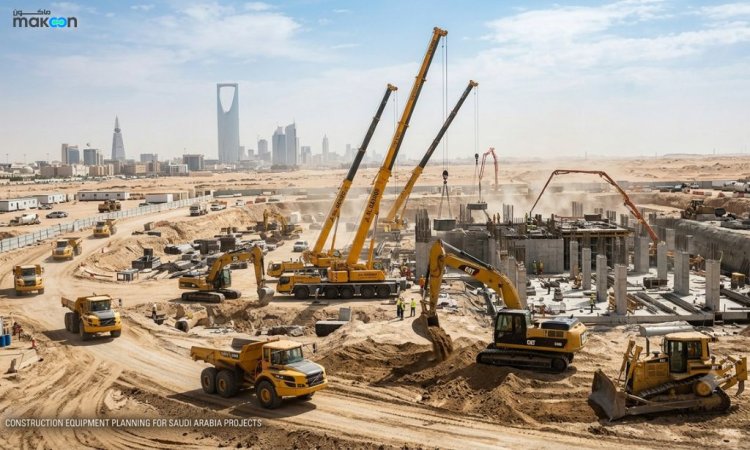
Construction equipment planning means matching machine type, capacity and rental duration to your project's actual scope, site conditions and schedule before mobilisation, not after delays start. In Saudi Arabia, that means factoring in Aramco/SABIC site access rules, summer heat derating and gate-pass lead times alongside the usual excavator, crane, generator and forklift sizing math.
A 250 kVA generator ordered for a Jubail plant shutdown clears the gate two days late because nobody accounted for Aramco documentation lead time. A crawler crane booked for a tank farm lift turns out to be one size short once the real load chart comes back. Neither failure happened on-site both happened weeks earlier, at the planning stage, when someone guessed instead of calculated. Contractors searching "heavy equipment rental near me" on a Thursday afternoon are usually solving a problem that proper planning would have caught two weeks earlier. This guide walks through the process end to end.
Why Construction Equipment Planning Decides Project Success
Equipment decisions ma de in week one shape cost and schedule outcomes for the rest of the project more than almost any other early decision. A generator sized without heat derating trips breakers on the first hot afternoon. An excavator chosen without checking dig depth against the actual foundation drawing gets swapped mid-week, losing a day of productivity. On Saudi Arabia's fast-moving Vision 2030 sites, contractors who treat equipment planning as a rental phone call rather than a technical exercise consistently spend more on emergency re-hire and idle labour than they would have spent getting the sizing right the first time.
Understand Your Project Scope Before Choosing Equipment
Before any machine gets booked, the scope needs breaking down into what will actually happen on site: structure type, built-up area, foundation type, number of stages and total project duration. A villa compound and a tank farm shutdown both need "an excavator," but the size, quantity and duration are entirely different once the scope is defined activity by activity rather than described in one sentence to a rental company.
Analyze the Construction Site Conditions
Two projects with identical scopes can need completely different equipment if their site conditions differ. Ground bearing capacity decides whether a tracked or wheeled machine is safe to use. Caliche layers common in Eastern Province soils at one to four metres depth mean a standard excavator bucket stalls and a hydraulic breaker attachment becomes mandatory, not optional. Site access width decides whether a full-size crawler crane can enter at all, or whether a compact spider crane is the only option for a confined plant interior. Ambient temperature affects generator and compressor output more than most planners expect – equipment rated at 25°C ambient loses measurable output once Eastern Province summer temperatures reach 45 to 47°C in the shade.
Identify Every Construction Activity That Requires Equipment
The most reliable way to avoid missing a requirement is to walk the project schedule activity by activity, from site clearance to final handover, and tag the equipment each activity needs. Site clearance and grading need bulldozers and graders. Foundation work needs excavators and dump trucks. Structural erection needs cranes. Vertical construction needs boom lifts and scissor lifts. MEP and fit-out need forklifts and manlifts. Testing and commissioning phases often need temporary generators and compressors that the earlier trades never touched. Skipping this activity-by-activity pass is how a project ends up mid-construction discovering it needs a telehandler nobody budgeted for.
Choose the Right Equipment for Each Stage of Construction
Equipment need is not flat across a project timeline, it moves in waves. Early civil works are earthmoving-heavy: excavators, bulldozers, wheel loaders and dump trucks dominate. Structural stages shift demand to lifting: mobile cranes, crawler cranes or tower cranes depending on building height. Finishing stages need access equipment and material handling: scissor lifts, boom lifts, forklifts and telehandlers. Matching the rental period to the stage, rather than booking one large fleet for the entire project duration, is where a lot of avoidable cost sits.
Decide Whether to Rent or Buy Equipment
A basic cost comparison explains why most contractors in Saudi Arabia lean toward renting.
|
Factor |
Buying Equipment |
Renting Equipment |
|
Upfront cost |
High capital outlay |
None |
|
Utilisation |
Idle between projects, still depreciating |
Pay only while equipment is on hire |
|
Maintenance |
Owner's workshop, parts and labour |
Rental company handles it |
|
Fleet flexibility |
Fixed once purchased |
Scale up or down monthly |
|
Best fit |
Continuous, identical-scope projects |
Most contractors, variable scope |
For a contractor running one type of project continuously for years, ownership can make sense. For most contractors in Saudi Arabia, where scope, location and duration change project to project, heavy equipment rental keeps cash tied up in the work itself rather than in depreciating machines sitting idle between contracts. Our earlier piece on single-supplier equipment and manpower sourcing covers the coordination side of this decision in more depth.
Calculate Equipment Requirements Correctly
This is the step most planning guides skip, and the one that actually prevents budget overruns. Here is how contractors estimate the five most commonly under- or over-specified categories.
1. How Many Excavators You Actually Need
Excavator count comes from volume and cycle time, not guesswork. Divide the total cubic metres of material to be moved by the machine's realistic output per hour, which depends on bucket size, soil type and operator skill, then divide by the working hours available per day. A standard 14 to 20-tonne tracked excavator handling general earthmoving in typical Eastern Province medium-dense sand is the size most project managers mean when they say "send an excavator" – bulk cut-and-fill on a large civil contract needs the 25 to 50-tonne class instead, and confined utility trenching needs a mini excavator under 6 tonnes. Road contracts typically run two to three dump trucks per excavator to keep the loading cycle continuous; fewer excavators with more trucks per machine is usually cheaper than the reverse. For a deeper cost breakdown by machine size, see our excavator rental price guide.
2. How Contractors Calculate Crane Lifting Capacity
Crane capacity is never just "the weight of the load." The calculation needs the load weight, the lift radius (how far the load sits from the crane's centre), the lift height, and the crane's load chart at that specific radius and boom configuration, since capacity drops sharply as radius increases. A crane that can lift 50 tonnes at a 3-metre radius may only manage a fraction of that at 15 metres. This is why engineered lift plans and load chart verification exist, and why Aramco and SABIC sites require the lift plan and radius/load chart to be checked before permit-to-work is issued.
3. How to Calculate Boom Lift Height
Required platform height is not the height of the work point, it is the work point height plus roughly 1.5 to 2 metres of clearance for a standing worker and their tools, since the platform floor sits below the worker's reach. A ceiling or facade point at 15 metres typically needs a boom lift rated for around 17 metres of working height, not 15. Horizontal reach matters just as much on articulating and telescopic booms, since the machine often cannot be positioned directly under the work point due to pipework, structures or ground obstructions in plant environments.
4. How to Calculate Generator Power (kVA)
List every electrical load the site will run simultaneously – lighting, tools, air conditioning, pumps, welding sets – and total the kW. Add roughly 25% headroom for motor starting surges, since motors draw two to three times their running current the moment they switch on. Then add a further 10 to 15% for Saudi Arabia's summer heat, since diesel generators lose approximately 1% of rated output for every 5°C above their 25°C test temperature, and Eastern Province summer afternoons regularly reach 45 to 47°C. A small site office with air conditioning typically needs 40 to 60 kVA at minimum; a mid-size active construction site with multiple trades and AC commonly needs 200 to 350 kVA; a large site running welding sets, pumps and full camp air conditioning can need 500 to 800 kVA. Skipping the heat margin is the single most common generator sizing mistake on Saudi sites.
5. How to Calculate Forklift Load Capacity
Capacity has to match the heaviest single load the forklift will lift, not the average load, since a machine rated below the heaviest pallet or component is a safety violation, not a productivity trade-off. A standard pallet of building materials typically weighs 800 to 1,500 kg, comfortably inside a 2.5 to 5-tonne diesel forklift's range. Heavier components, such as pipe bundles, transformer bases and structural steel sections, push the requirement into the 5 to 12-tonne range, and pressure vessels or large structural elements can require 12 to 16-tonne heavy industrial units with an engineered lift plan. When in doubt about the exact weight of what will be moved, specifying one capacity class higher costs little extra and removes the safety margin question entirely.
|
Equipment |
Typical Size Class |
Common Use |
|
Excavator |
8–25t standard / 25–50t bulk |
General earthmoving / major civil works |
|
Mobile crane |
30–500t |
General construction lifts, structural erection |
|
Generator |
200–350 kVA |
Mid-size active construction site |
|
Forklift |
2.5–5t diesel |
Standard pallet and yard work |
Plan Equipment Delivery and Mobilisation
Mobilisation time depends on equipment type, site location and site access requirements, and each factor adds independently. Standard machines – forklifts, mid-size excavators, boom trucks – typically mobilise within 24 to 48 hours from an Eastern Province supplier to an Eastern Province site. Larger crawler cranes and all-terrain cranes requiring transport planning need 48 to 72 hours. Sites inside Aramco, SABIC or Jubail Industrial City facilities add gate pass processing time on top of transport time regardless of how quickly the machine itself is ready, since vendor registration and site induction paperwork run on their own approval cycle. Building this lead time into the project schedule, rather than treating equipment as available on demand, prevents the single most common cause of first-week delays.
4 Factors That Determine Your Equipment Delivery Timeline
1. Distance from the supplier's yard to site: Eastern Province same-day or next-day delivery is common; Riyadh or Jeddah from an Eastern Province-based fleet needs transport planning.
2. Equipment size and transport method: anything requiring a low-bed trailer needs more lead time than a road-legal machine that can self-travel.
3. Site access restrictions: Aramco, SABIC and Jubail Industrial City gate passes are the most common cause of delay beyond the machine's own readiness.
4. Documentation completeness: TUV certificates, operator licences and insurance paperwork prepared in advance prevent equipment sitting outside the gate on mobilisation day.
Ensure Equipment Meets Saudi Safety Standards
Three separate frameworks apply to equipment operating in Saudi Arabia, and confirming all three before mobilisation prevents a machine being turned away at the gate. TUV or an approved equivalent body issues third-party mechanical inspection certificates, typically valid for 12 months. Saudi Aramco equipment approval is a separate vendor registration confirming the specific unit is cleared for entry to Aramco-operated facilities. The Saudi Standards, Metrology and Quality Organization (SASO) sets the baseline product compliance standard manufacturers must meet before their equipment can legally operate in the Kingdom. Beyond the machine itself, operators need valid Saudi government licences and, for restricted sites, current Aramco or SABIC operator certifications.
Saudi Arabia's climate adds a scheduling dimension to safety planning that most equipment checklists miss. The Ministry of Human Resources and Social Development enforces an annual ban on outdoor work under direct sunlight between 12 noon and 3pm from mid-June to mid-September, which affects crane lift scheduling, generator-powered lighting for shifted night work, and the case for renting tower lights and temporary cooling rather than treating them as optional extras.
7 Equipment Planning Mistakes Contractors Make in Saudi Arabia
1. Sizing a generator for a 25°C spec sheet and running it on a 45°C afternoon.
2. Booking a crane by tonnage alone without checking the load chart at the actual working radius.
3. Choosing a tracked excavator for a site where ground bearing pressure cannot support it.
4. Assuming a hydraulic breaker attachment is optional in Eastern Province caliche soil.
5. Forgetting gate pass lead time for Aramco, SABIC or Jubail Industrial City sites.
6. Renting one large fleet for the whole project instead of matching equipment to each construction stage.
7. Treating operator certification as the rental company's problem rather than confirming it before the machine arrives.
12-Point Equipment Planning Checklist Before Project Starts
1. Project scope broken down by structure type, area and duration
2. Site conditions assessed: ground bearing, access width, subsurface soil type
3. Every construction activity mapped against the equipment it needs
4. Equipment matched to project stage, not booked as one fixed fleet
5. Rent-vs-buy decision made per equipment category, not as a blanket policy
6. Excavator size and count calculated from volume and cycle time
7. Crane capacity checked against load chart at actual working radius
8. Boom lift height calculated with clearance allowance, not just work-point height
9. Generator kVA sized with motor-start and Saudi heat-derating headroom
10. Forklift capacity matched to heaviest single load, not average load
11. Mobilisation lead time confirmed, including gate pass processing for restricted sites
12. TUV, Aramco approval, SASO compliance and operator certification verified before mobilisation day
Why Professional Equipment Planning Improves ROI
Equipment cost is rarely the line item that damages a budget; idle time and emergency re-hire are. A generator undersized by one class trips breakers and forces an emergency same-day replacement at a premium rate. A crew of thirty standing idle for two days because the wrong excavator arrived costs more in lost labour hours than the correct machine would have cost for the entire project. Sourcing heavy equipment in Saudi Arabia without this calculation is how budgets slip. Planning properly the first time, with real load calculations and a realistic mobilisation timeline, consistently costs less than the combination of a slightly cheaper machine and the disruption that follows when it turns out to be wrong for the job.
How MAKCON Helps Contractors Plan Equipment Efficiently in Saudi Arabia
MAKCON's technical review step exists specifically to catch the sizing and timing mistakes above before a machine leaves the yard. When a contractor shares site location, load data and schedule, MAKCON's team checks ground conditions and access against fleet options, verifies crane capacity against the actual lift radius rather than tonnage alone, and applies the heat-derating margin to generator sizing as standard practice rather than an afterthought. Every unit dispatched carries current TUV inspection, Aramco approval documentation and SASO compliance records prepared before mobilisation, which is what keeps equipment moving through Aramco, SABIC and Jubail Industrial City gates on the first attempt rather than the third. Whether the requirement is construction machinery or industrial equipment rental for a plant shutdown, MAKCON applies the same sizing process across a fleet spanning excavators, cranes, forklifts, generators and access equipment based in Al Khobar, coordinating delivery timing across the equipment mix a project actually needs rather than leaving a contractor to plan each machine separately.
Get the Calculation Right Before You Call for a Quote
Equipment planning that works is built from the project scope outward: understand the work, assess the site, map every activity to its equipment, size each machine against real load and volume data, and build mobilisation lead time into the schedule rather than assuming equipment appears on demand. The contractors who lose the least time on Saudi Arabia's fastest-moving projects are rarely the ones with the biggest fleet on call, they are the ones who did this calculation before the first machine left the yard.
Plan Your Equipment Requirement with MAKCON
Share your project scope, site location and load data, and MAKCON's team will size the right mix of cranes, excavators, generators and access equipment before you commit to a rental. Call +966 56 849 1941, email sales@mak-con.com, or request a quote.
Frequently Asked Questions
How do I calculate how many excavators I need for a construction project?
Divide the total volume of material to be moved by the excavator's realistic hourly output for the soil type and bucket size, then divide by the working hours available per day. Standard 14 to 20-tonne excavators handle most Eastern Province earthmoving; bulk civil works need the 25 to 50-tonne class, and confined sites need machines under 6 tonnes.
What kVA generator do I need for a construction site in Saudi Arabia?
Total the connected electrical load, add roughly 25% headroom for motor starting surges, then add a further 10 to 15% for Saudi summer heat derating. A small site office needs 40 to 60 kVA; a mid-size active site needs 200 to 350 kVA; a large site with welding and full camp air conditioning can need 500 to 800 kVA.
How long does it take to mobilise heavy equipment in Saudi Arabia?
Standard equipment typically mobilises within 24 to 48 hours from an Eastern Province supplier to an Eastern Province site. Crawler cranes and large all-terrain cranes need 48 to 72 hours. Sites inside Aramco, SABIC or Jubail Industrial City add gate pass processing time on top of transport time.
Is it better to rent or buy heavy equipment for a construction project?
For most contractors with variable project scope and location, renting keeps cash available for the work itself and avoids depreciation on machines sitting idle between contracts. Buying only makes sense for a contractor running the same type of project continuously for years.
What certifications does equipment need to work on an Aramco or SABIC site in Saudi Arabia?
A current TUV or approved third-party inspection certificate, Saudi Aramco equipment approval on file, SASO compliance, and operators holding valid Saudi government licences plus current Aramco or SABIC operator certification where required.
How do I calculate the right boom lift height for a job?
Add roughly 1.5 to 2 metres of clearance to the actual work point height to account for the platform floor and a standing worker with tools, then confirm horizontal reach separately if the machine cannot be positioned directly under the work point.
What is the most common mistake in construction equipment planning in Saudi Arabia?
Sizing equipment, particularly generators, against a standard 25°C specification sheet without adding the 10 to 15% margin for Saudi Arabia's summer heat derating, which causes voltage drops and trips on the first hot afternoon.
Written by Asif
Asif is the Founder and Director of OneCity Technologies Pvt Ltd, a Bangalore-based digital marketing and SEO agency established in 2004. With over two decades of experience in B2B industrial and heavy equipment content for the Saudi Arabia and Gulf markets, Monu has delivered SEO campaigns for equipment rental providers, construction firms, and logistics operators across the Kingdom. Author profile
What's Your Reaction?