10 Types of Construction Equipment Used in Saudi Arabia
The 10 key types of construction equipment used in Saudi Arabia: excavators, cranes, bulldozers, forklifts, and more, with uses and rent-vs-buy tips.
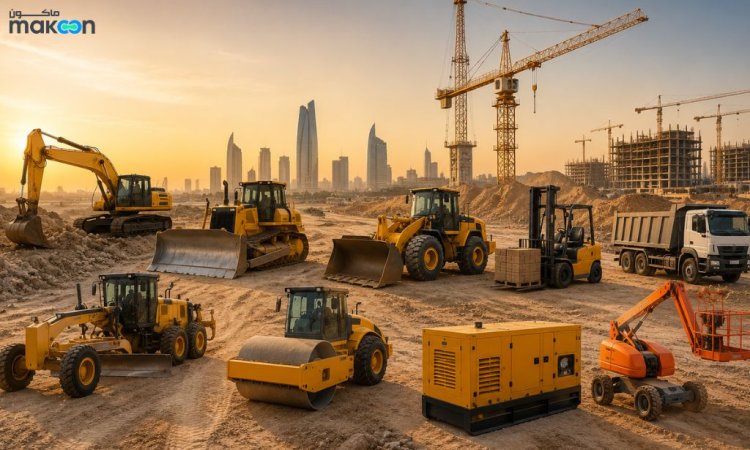
The Saudi Arabian construction sector contracted for over SAR 1.4 trillion in active projects as of 2024, driven by Vision 2030's giga-projects, industrial city expansions, and infrastructure upgrades from NEOM to the Red Sea Project. On every one of those sites, project outcomes are shaped before a single structure rises by which machines are present, in what condition, and whether they show up on time.
This guide covers the 10 categories of equipment used in construction on large-scale industrial projects: what each machine does, the specifications that matter for industrial-scale work, and the practical differences between renting and owning in the Saudi market. Makcon provides all 10 equipment types on daily, monthly, or project-based rental contracts across Saudi Arabia.
|
# |
Equipment |
Primary Use |
Makcon Rental Available |
|
1 |
Excavator (wheeled & crawler) |
Digging, trenching, demolition |
Daily / monthly / project-based |
|
2 |
Bulldozer |
Land clearing, earthmoving |
Daily / monthly / project-based |
|
3 |
Crane (mobile, tower, crawler) |
Heavy lifting at height |
Project-based, operator support |
|
4 |
Wheel Loader |
Material loading, site cleanup |
Daily / monthly / project-based |
|
5 |
Forklift |
Warehouse and outdoor material handling |
Daily / monthly / project-based |
|
6 |
Dump Truck / Tipper Truck |
Bulk material haulage |
Daily / monthly / project-based |
|
7 |
Motor Grader |
Surface levelling and finishing |
Monthly / project-based |
|
8 |
Compactor / Road Roller |
Ground and surface compaction |
Daily / monthly / project-based |
|
9 |
Diesel Generator |
Temporary and emergency site power |
Daily / monthly / project-based |
|
10 |
AWP / Boom Lift / Scissor Lift |
Elevated access work |
Daily / monthly / project-based |
1- Excavators: The Backbone of Every Industrial Site

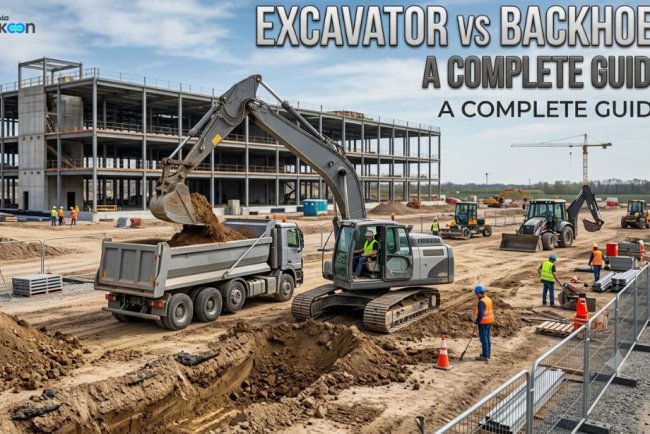
Excavators are the most universally present machines on industrial construction sites. Their primary functions digging, trenching, material handling, demolition, and pipe-laying support make them indispensable from day one of ground preparation through to final site drainage work. On Saudi industrial sites, excavators operate in conditions ranging from compacted desert hardpan to rocky desert substrate, requiring both machine power and appropriate bucket selection.
Wheeled vs Crawler Excavator: Which for Saudi Industrial Sites?
The two principal configurations differ in mobility and stability. A crawler excavator runs on steel tracks, providing superior digging force and stability on rough or unstable ground – the default choice for foundation excavation, deep trenching, and earthmoving on large Saudi sites. A wheeled excavator runs on rubber tyres, offering faster repositioning across paved or finished surfaces, making it more suited to urban projects or sites where the machine must move frequently between work zones without a low-loader transport.
|
🔧 Excavator – Industrial Site Specifications Operating weight range: 15 to 90 tonnes (standard industrial); 100+ for mining-class Bucket capacity: 0.5 to 4.5 m³ depending on class and application Dig depth (standard 30T class): Up to 7.2 m Saudi application: Foundation work, utility trenching, bulk earthmoving, demolition |
2 – Bulldozers: Earthmoving Power for Large Surface Areas

Bulldozers are the primary land-clearing machine on large industrial projects. A bulldozer's front-mounted blade pushes soil, rock, and debris across wide surface areas faster than any wheeled alternative. On Saudi industrial sites – where site preparation can involve clearing hundreds of thousands of square metres before any construction begins – bulldozer availability in the first weeks of a project directly sets the earthmoving schedule for everything that follows.
Saudi terrain presents the full range of bulldozer applications: soft sand grading, rocky desert clearing, and compacted site levelling ahead of road base and concrete work. Larger bulldozers (CAT D8 and D9 class, or Komatsu D275 equivalent) are standard on industrial-scale projects; smaller machines handle finishing and contouring work.
|
🔧 Bulldozer – Industrial Site Specifications Operating weight range: 15 to 105 tonnes (D6 to D11 class) Blade type: S-blade (spreading), U-blade (pushing), SU-blade (combination) Track type: Steel track standard; LGP (low ground pressure) for soft sand Saudi application: Site clearing, land levelling, stockpile forming, road base preparation |
3 – Cranes: Lifting Heavy at Height and Distance

Cranes are the critical path machine on industrial construction projects involving structural steel, prefabricated modules, heavy machinery installation, and high-rise or tank farm construction. A delayed crane mobilisation delays every dependent task – structural erection, mechanical equipment setting, roof installation. On major Saudi industrial sites (petrochemical plants, power stations, desalination facilities), crane selection and scheduling is part of the project's critical path analysis from the planning stage.
3 Main Crane Types Used on Saudi Industrial Sites
1. Mobile crane (truck-mounted):
2. Fast to mobilise and demobilise, moves on public roads under permit, lifting capacities from 30 to 500 tonnes. Best for projects requiring frequent repositioning.
3. Crawler crane:
4. Mounted on tracks, provides high lifting capacity and stability on uneven ground. Cannot self-mobilise on roads – requires heavy transport. Best for long-duration lifts and heavy industrial equipment setting.
5. Tower crane:
6. Fixed-position, maximum height capability, constant use during high-rise or large-footprint structural construction. Requires foundation preparation and extended mobilisation/demobilisation time.
|
🔧 Crane – Industrial Site Specifications Mobile crane capacity: 30T to 500T+ (Liebherr, Tadano, Grove, Manitowoc) Crawler crane capacity: 100T to 3,000T+ for heavy industrial lifts Lift planning requirement: Formal lift plan required for all lifts >5T per Saudi Aramco and SABIC site safety standards Saudi application: Structural steel erection, vessel and tank installation, mechanical equipment setting |
|
Makcon provides crane rental in Saudi Arabia with operator support and lift planning assistance across industrial, oil & gas, and infrastructure projects. |
4 – Wheel Loaders: The Material-Handling Workhorse

Wheel loaders handle the continuous material movement that keeps every other site process running: loading dump trucks, moving aggregate stockpiles, feeding concrete batching plants, clearing site debris, and distributing fill material across the site. On large industrial projects in Saudi Arabia, wheel loaders typically operate in parallel with excavators and dump trucks as part of an integrated earthmoving fleet.
|
🔧 Wheel Loader – Industrial Site Specifications Bucket capacity: 1.5 to 10 m³ depending on class Operating weight range: 8 to 55 tonnes Tyre type: Radial – standard; foam-filled available for rocky/debris-heavy sites Saudi application: Aggregate loading, concrete plant feeding, bulk material redistribution
|
5 – Forklifts: Indoor and Outdoor Material Movement

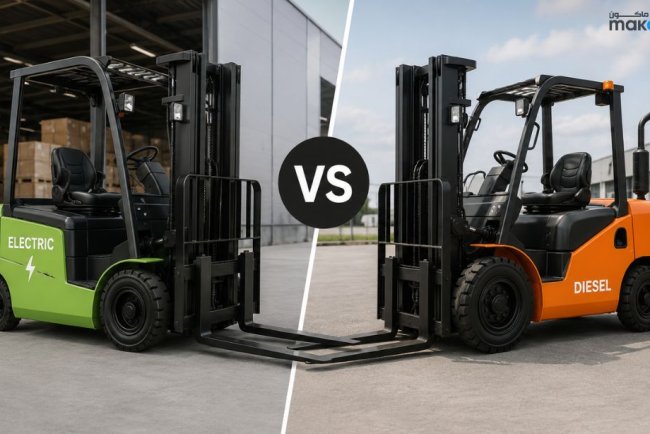
Forklifts are essential on any industrial project site that involves palletised materials, equipment crates, steel sections, or prefabricated components. On large Saudi industrial sites, both counterbalance forklifts and rough terrain forklifts are in regular use. Rough terrain forklifts – with their larger tyres and higher ground clearance – are the standard choice for outdoor use on unfinished site surfaces.
|
🔧 Forklift – Industrial Site Specifications Counterbalance forklift capacity: 2.5T to 16T; suitable for paved warehouse/yard surfaces Rough terrain forklift capacity: 2.5T to 10T; pneumatic or foam-filled tyres Telehandler (telescopic handler): 3T to 6T lift, 10–17 m reach – preferred for construction sites needing height reach Saudi application: Materials warehousing, prefab component placement, crate and pallet handling
|
6 – Dump Trucks / Tipper Trucks: Bulk Material Haulage

Dump trucks – also called tipper trucks – move the bulk volumes of soil, sand, gravel, rock, and demolition debris that large industrial projects generate. On major Saudi construction sites, dump truck fleets are sized against the excavator fleet: a typical ratio is one excavator supported by three to five dump trucks to maintain continuous cycle time without queuing.
Articulated dump trucks (ADTs) handle off-road haulage on soft or rough ground where rigid chassis trucks lose traction. Rigid body dump trucks carry higher payload on stable roads and haul routes. Site haul road design – gradient, width, compaction – directly affects dump truck cycle times and fuel costs on large Saudi projects.
|
🔧 Dump Truck – Industrial Site Specifications Rigid dump truck payload: 15T to 100T+ (highway haul trucks); 40T–90T typical on Saudi sites Articulated dump truck payload: 20T to 45T; 6×6 drive for soft/sloped terrain Fleet sizing guide: 3–5 trucks per excavator for continuous cycle; adjust for haul distance Saudi application: Excavated material removal, fill delivery, aggregate and rock haulage
|
7 – Motor Graders: Precision Surface Finishing

Motor graders provide the precision levelling and surface finishing that no other machine replicates. After bulk earthmoving by excavators and bulldozers, graders produce the precise grade, slope, and surface tolerance required for road base, haul roads, airstrips, and any flat concrete slab pour. On Saudi industrial sites, motor graders prepare access roads across the project footprint and finish subgrades ahead of compaction and paving operations.
|
🔧 Motor Grader – Industrial Site Specifications Blade length: 3.7 to 7.3 m; longer blades for wide road grading Engine power range: 100 to 300+ hp depending on class Grading tolerance: ±10 mm achievable with skilled operator; ±5 mm with GPS/3D machine control Saudi application: Haul road maintenance, subgrade preparation, shoulder finishing, site levelling
|
8 – Compactors / Road Rollers: Ground and Surface Preparation

Compactors – including vibratory soil compactors, padfoot rollers, and smooth drum road rollers are used at multiple stages of every industrial project: subgrade compaction after earthmoving, base course and sub-base compaction for roads and paved areas, and final asphalt compaction. Insufficient compaction is one of the most common causes of pavement failure and ground settlement on Saudi construction sites, where subsurface conditions vary widely across project footprints.
|
🔧 Compactor – Industrial Site Specifications Vibratory soil compactor (padfoot): Soil and fill compaction; drum weight 7–12T Smooth drum roller: Subbase and asphalt compaction; 8–14T Plate compactor: Trench backfill and confined area compaction Compaction testing: Proctor test required to verify achieved density per Saudi MOMRA standards Saudi application: Subgrade compaction, road base, backfill, asphalt paving
|
9 – Diesel Generators: Uninterrupted Power for Remote Sites

Diesel generators are not optional on large industrial construction sites in Saudi Arabia – they are infrastructure. Grid connection at remote project sites in the Kingdom (NEOM, KAEC, industrial city expansions outside major urban areas) may not be available for the first 12–24 months of a project. Generators power site offices, lighting systems, water pumps, compressed air systems, welding equipment, and safety systems throughout construction.
Generator sizing errors are the most common cause of preventable site power failures. The calculation starts with total connected load (kVA), applies a diversity factor for simultaneous usage, and adds a 20–25% reserve margin. Undersizing – typically caused by underestimating peak load during shift changeover or welding operations causes voltage fluctuations that damage sensitive equipment and trip safety systems.
|
🔧 Diesel Generator – Industrial Site Specifications Capacity range for industrial sites: 50 kVA to 2,500 kVA; multiple units in parallel for very large sites Common Saudi site sizes: 250 kVA (medium site), 500–750 kVA (large), 1,000+ kVA (mega-site) Fuel consumption (500 kVA at 75% load): Approximately 115–125 litres/hour of diesel Paralleling capability: Multiple units synchronised for load-sharing and redundancy Saudi application: Remote site power, backup power, temporary construction supply
|
|
Makcon provides diesel generator rental in Saudi Arabia – single units and parallel configurations – sized for temporary construction, remote site power, and backup supply. |
10 – Aerial Work Platforms: Safe Elevated Access

Aerial work platforms (AWPs) – including boom lifts, scissor lifts, and articulating lifts provide safe elevated access for installation, inspection, maintenance, and painting work that traditional scaffolding cannot address efficiently. On large Saudi industrial sites, AWPs are required for structural steel connection work, process pipe installation at elevation, electrical panel installation, HVAC unit placement, and façade and cladding installation on tall structures.
AWP Types: Boom Lift vs Scissor Lift
Boom lifts (articulating and telescopic) provide outreach capability the platform can extend horizontally away from the base, making them essential for work over obstacles or in areas where vertical-only access is insufficient. Working heights from 12 to 56 metres are standard in the Saudi rental market. Scissor lifts are vertical-only, with a stable large platform area suitable for multi-person work at heights up to 18 metres. Both types are available in diesel (outdoor) and electric (indoor, zero-emission) configurations.
|
🔧 AWP – Industrial Site Specifications Articulating boom lift height: 12 to 30 m; outreach up to 15 m horizontal Telescopic boom lift height: 18 to 56 m; greater outreach than articulating Scissor lift height: Up to 18 m; platform width 0.75 to 1.5 m Weight capacity (standard): 230 to 500 kg platform rated load Saudi application: Structural connections, pipe rack installation, electrical work at height, cladding
|
Rent vs Buy: How to Choose the Right Equipment Approach
The rent vs buy decision for construction equipment in Saudi Arabia is primarily a capital allocation and fleet utilisation question. The decision matrix below applies across all 10 equipment categories covered in this guide:
|
Factor |
Renting |
Buying |
|
Upfront capital |
None – pay per day/month/project |
High – full purchase price upfront |
|
Maintenance cost |
Included or shared with rental company |
Full owner responsibility |
|
Fleet flexibility |
Scale up/down per project requirement |
Fixed – use what you own |
|
Equipment availability |
Access to latest models immediately |
Limited to owned inventory |
|
Downtime risk |
Replacement unit typically available |
Owner bears full downtime cost |
|
Best for |
Project-specific, short-to-medium term |
High-utilisation, long-term owned fleets |
|
Saudi Vision 2030 context |
Preferred model for contractors scaling fast |
High capital lock-in on project durations |
Saudi Arabia's Vision 2030 project pipeline creates a specific market dynamic: contractors are scaling rapidly to win project packages, but project durations are finite. Equipment purchased for one giga-project may sit idle between awards. Heavy equipment rental in Saudi Arabia allows contractors to match their fleet exactly to each project's scope without carrying idle capital between contracts.
5 Factors That Favour Renting in Saudi Arabia
7. Project duration under 24 months rental amortises better than purchase for most equipment categories.
8. Multi-phase projects with variable equipment requirements a single rental contract covers fleet adjustments as phases change.
9. Equipment requiring specialised operation (cranes, AWPs) rental typically includes operator option, avoiding hiring and certification costs.
10. Remote site locations rental company handles mobilisation, maintenance, and demobilisation logistics.
11. Foreign contractors new to the Saudi market avoids import duty, customs clearance, and re-export requirements on purchased equipment.
Selecting Your Equipment Fleet: A Practical Starting Point
Every large industrial project in Saudi Arabia starts with a site preparation phase that requires the same core fleet: excavators, bulldozers, dump trucks, and compactors. From that foundation, the project-specific requirements layer in cranes for structural work, generators for remote power, forklifts for materials management, AWPs for elevated installation, and motor graders for haul road maintenance.
The practical planning step is to map each project phase against its equipment dependency, then identify which equipment types will be in continuous use (ownership candidates) versus periodic or phase-specific use (rental candidates). For most contractors in Saudi Arabia's current project environment, the answer is a hybrid a small owned core fleet supplemented by rental for peaks and specialised requirements.
Getting that mix right particularly on equipment categories where availability constraints exist, like large cranes and specialised generators requires early coordination with your rental provider. Equipment reserved 4–8 weeks before mobilisation date avoids the availability gaps that delay project starts.
|
Need heavy equipment rental in Saudi Arabia? Makcon provides all 10 of these equipment types on daily, monthly, or project-based rental contracts across Saudi Arabia – including excavators, cranes, bulldozers, forklifts, diesel generators, and aerial work platforms. Fast mobilisation, operator support available. Visit mak-con.com to discuss your equipment requirement. |
Frequently Asked Questions
What is the most commonly used equipment in large-scale industrial construction?
The most universally present machines are excavators, bulldozers, cranes, wheel loaders, and dump trucks. These five form the core fleet on virtually every large industrial site. Forklifts, motor graders, compactors, diesel generators, and aerial work platforms are then added based on project type, phase, and site conditions.
What is the difference between a wheeled and a crawler excavator in Saudi Arabia?
A crawler excavator uses steel tracks for superior stability and digging force on rough or unstable ground the standard choice for foundation work and heavy earthmoving. A wheeled excavator uses rubber tyres for faster repositioning on paved or finished surfaces, better suited for urban projects or sites where the machine moves frequently between work zones without a transport carrier.
Is it better to rent or buy construction equipment in Saudi Arabia?
Renting is the practical choice for project-specific requirements. It eliminates upfront capital expenditure, includes maintenance in most agreements, and allows fleet scaling per project phase. Buying makes financial sense only when a single equipment type will run continuously across multiple projects for three or more years. Saudi Arabia's Vision 2030 project cycle makes rental the dominant model for most contractors.
What types of cranes are available for rental in Saudi Arabia?
Mobile cranes (30T–500T+) for fast mobilisation and repositioning. Crawler cranes (100T–3,000T+) for high-capacity and long-duration lifts on uneven ground. Tower cranes for fixed-position high-rise or large structural construction. Makcon provides crane rental across these types with operator support and lift planning assistance.
Why are diesel generators critical on industrial construction sites in Saudi Arabia?
Remote project locations frequently have no grid connection for the first 12–24 months of construction. Generators power all site systems offices, lighting, pumps, compressed air, welding, and safety equipment. Undersizing is the most common cause of preventable site power failures; generator selection must be based on calculated total connected load plus a 20–25% reserve margin.
|
About the Author Mohammad Asif is a content specialist at OneCity Technologies with experience in construction equipment, crane and heavy equipment rental, and industrial project services across the GCC region. Reviewed by Asif, Chief Strategist at OneCity Technologies, with 20+ years of SEO experience across 650+ client campaigns in India and UAE. Makcon / Mithaq Services: mak-con.com |
What's Your Reaction?