Electric vs Diesel Forklift Rental in KSA
Electric or diesel forklift rental in Saudi Arabia? Compare capacity, environment, cost and site conditions to choose the right forklift for your project.
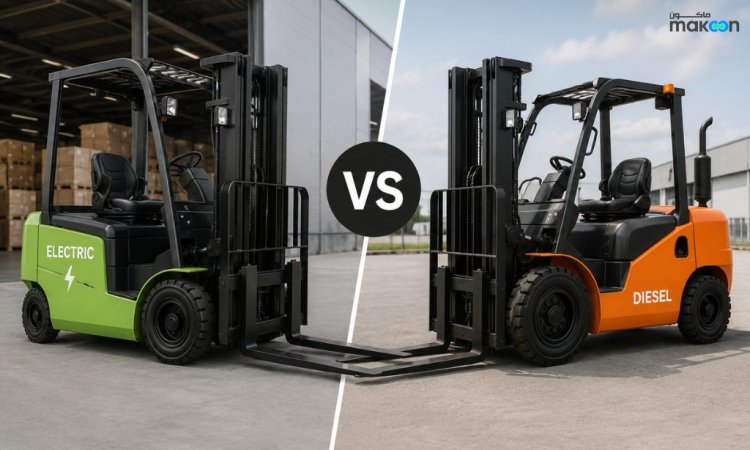
Saudi Arabia's forklift market reached USD 738.9 million in 2025, with electric forklifts commanding 55 per cent of market value and growing faster than any other segment. Yet diesel forklifts continue to dominate outdoor construction yards, petrochemical facilities, and heavy industrial operations across the Kingdom. The choice between electric and diesel is not a matter of which technology is superior — it is a matter of which technology matches your specific operating environment, load requirements, site regulations, and total cost structure.
This guide provides a data-driven comparison of electric and diesel forklifts for Saudi Arabia's operating conditions — where ambient temperatures routinely exceed 50 degrees Celsius, sandstorm exposure degrades equipment faster than global averages, Aramco and SABIC sites impose strict emissions and safety requirements, and the rental market offers both types across the full capacity spectrum. Whether you manage a temperature-controlled distribution centre in Riyadh, an open-air construction material yard in Dammam, or a petrochemical maintenance operation in Jubail, the right choice depends on the specific factors examined below.
Electric vs Diesel Forklifts: How They Work
Electric Forklifts
An electric forklift draws power from a rechargeable battery pack — either lead-acid or lithium-ion — that drives an electric motor connected to the hydraulic pump and traction system. There is no combustion, no exhaust, and no fuel tank. The battery stores energy that is converted directly into hydraulic pressure for lifting and electrical power for travel and steering. Modern lithium-ion electric forklifts achieve 95–98 per cent charging efficiency, meaning nearly all the electricity drawn from the grid reaches the wheels and forks.
Diesel Forklifts
A diesel forklift uses an internal combustion engine burning diesel fuel to drive a hydraulic pump and torque converter. The engine produces exhaust gases containing nitrogen oxides, carbon monoxide, and particulate matter. Diesel engines deliver sustained high torque across a wide RPM range, which gives them an advantage in continuous heavy-duty applications. However, combustion efficiency is lower — roughly 35–40 per cent of fuel energy reaches the drivetrain, with the remainder lost as heat and exhaust.
Head-to-Head Comparison: 12 Critical Factors
| Factor | Electric Forklift | Diesel Forklift | Winner (Saudi Context) |
|---|---|---|---|
| Exhaust emissions | Zero at point of use | NOx, CO, particulate matter | Electric — mandatory for indoor/enclosed spaces |
| Noise level | 60–75 dB (conversation level) | 85–100 dB (hearing protection territory) | Electric — critical in multi-shift warehouses |
| Operating cost per hour | SAR 8–15 (electricity) | SAR 35–60 (diesel fuel only) | Electric — 50–70% lower energy cost |
| Maintenance cost | Service every 1,000+ hours; fewer moving parts | Service every 250–500 hours; oil, filters, belts, exhaust | Electric — up to 85% lower maintenance |
| Capacity range | 1.5–5 tonnes (standard); up to 8 t specialist | 2.5–16 tonnes | Diesel — wider heavy-duty range |
| Terrain capability | Smooth, paved surfaces only | Rough, unpaved, uneven ground | Diesel — essential for outdoor Saudi sites |
| Heat performance (50 C+) | Li-ion: minimal derating; lead-acid: 10–15% capacity loss | Engine derates 5–8% at extreme heat | Draw — both affected, diesel slightly more resilient outdoors |
| Shift endurance | Lead-acid: 5–6 hours; Li-ion: 8+ hours with opportunity charging | Unlimited — refuel in 5 minutes | Diesel for continuous 24/7; Li-ion electric competitive for standard shifts |
| Indoor air quality | No impact on air quality | Requires mechanical ventilation; prohibited in food/pharma/cold storage | Electric — only option for enclosed environments |
| Fire/explosion risk | Lower ignition risk — no open combustion | Higher ignition risk from hot exhaust and fuel | Electric — required in hazardous atmosphere zones |
| Operator comfort | Less heat, vibration, and noise in cab | More heat, vibration, louder — significant in Saudi summer | Electric — operator fatigue reduction over long shifts |
| Environmental compliance | Aligns with Vision 2030 sustainability goals | Increasing regulatory pressure on emissions | Electric — green procurement advantages in tenders |
Operating Cost Breakdown: The Numbers That Matter
The operating cost gap between electric and diesel forklifts is the single largest factor driving Saudi Arabia's market shift toward electric. Here is a detailed breakdown for a standard 3-tonne forklift operating 8 hours per day, 22 days per month:
| Cost Category | Electric (Li-ion) | Diesel | Annual Difference |
|---|---|---|---|
| Energy/fuel per hour | SAR 10 | SAR 45 | — |
| Monthly energy/fuel (176 hours) | SAR 1,760 | SAR 7,920 | SAR 73,920 saved |
| Maintenance per month | SAR 400–600 | SAR 1,200–2,000 | SAR 9,600–16,800 saved |
| Operator productivity loss (refuelling/charging) | Opportunity charging during breaks — zero downtime | 2–3 refuelling stops per day at 10–15 min each | SAR 5,000–8,000 in recovered labour |
| Annual total operating cost | SAR 30,000–35,000 | SAR 110,000–130,000 | SAR 75,000–100,000 saved per unit per year |
For a warehouse operating five forklifts, the annual operating cost difference reaches SAR 375,000–500,000 — a figure that exceeds the purchase price of most individual electric forklifts within a single year.
Rental Cost Comparison in Saudi Arabia
For contractors and warehouse operators who rent forklifts rather than purchase, the rental rate difference between electric and diesel is narrower than the operating cost gap suggests, because the rental company absorbs maintenance and certification costs:
| Capacity | Electric Daily (SAR) | Electric Monthly (SAR) | Diesel Daily (SAR) | Diesel Monthly (SAR) |
|---|---|---|---|---|
| 1.5–2.5 t | 300–450 | 5,000–8,000 | 250–400 | 3,500–5,500 |
| 3.0–5.0 t | 450–700 | 8,000–12,000 | 400–650 | 6,000–9,500 |
| 5.0–8.0 t | 700–1,200 | 12,000–18,000 | 650–1,000 | 9,000–15,000 |
| 8.0–16.0 t | Typically unavailable electric | — | 900–1,800 | 12,000–25,000 |
Electric rental rates run 10–20 per cent higher than diesel at the same capacity, but the renter pays for energy separately. When energy cost is included, electric rental becomes 30–40 per cent cheaper on a total monthly basis for indoor warehouse operations with grid power available.
When Electric Is the Clear Choice
Electric forklifts are not merely preferred but effectively mandatory in these Saudi operating environments:
Indoor Warehouses and Distribution Centres
Any enclosed space where workers share air with the forklift requires electric power. Diesel exhaust in an enclosed warehouse creates health hazards (carbon monoxide, nitrogen dioxide), triggers fire suppression systems, and contaminates products. Saudi Arabia's rapidly growing e-commerce fulfilment sector operates almost exclusively on electric material handling equipment.
Cold Storage and Food Processing
Chilled warehouses (0–5 degrees Celsius) and frozen storage (-18 to -25 degrees Celsius) prohibit diesel forklifts entirely. Beyond emissions, diesel exhaust condensation accelerates ice build-up on racking, floors, and product surfaces. Electric forklifts with cold-rated lithium-ion batteries maintain 95 per cent of rated capacity even in sub-freezing conditions, compared with lead-acid batteries that lose 30–50 per cent capacity in cold environments.
Pharmaceutical and Clean-Room Environments
Pharmaceutical warehousing, medical device storage, and electronics manufacturing require controlled air quality that diesel combustion products would compromise. Electric forklifts produce no particulate matter and generate minimal heat, maintaining the controlled environment these industries require.
Aramco and SABIC Indoor Process Areas
Many Aramco and SABIC indoor process areas, particularly those classified as hazardous atmosphere zones (Zone 1 or Zone 2 under IEC 60079), mandate electric forklifts as a standard HSSE requirement. Diesel engine hot surfaces and exhaust sparks create ignition risk in environments with flammable vapours or combustible dust. Specialised explosion-proof (Ex-rated) electric forklifts are available for the most stringent zone classifications.
Multi-Storey Warehouses and Mezzanine Floors
Facilities with mezzanine levels or multi-floor layouts served by freight elevators require electric forklifts — diesel emissions would accumulate in upper-floor spaces with limited ventilation, and the weight of a diesel forklift often exceeds mezzanine floor load ratings.
When Diesel Is the Clear Choice
Diesel forklifts remain the standard in operating environments where electric technology cannot match their performance:
Outdoor Construction Material Yards
Unpaved, sandy, or gravel surfaces are standard at Saudi construction sites. Electric forklifts with small, hard wheels struggle on loose material and uneven ground. Diesel rough-terrain forklifts with large pneumatic tyres and higher ground clearance operate on these surfaces without difficulty. Heavy equipment rental for construction sites almost always means diesel power.
Continuous 24/7 Heavy-Duty Operations
Port container yards, steel stockholding operations, and large manufacturing plants that run three shifts without pause need forklifts that refuel in five minutes rather than charge for 30–60 minutes. While lithium-ion opportunity charging has narrowed this gap significantly, diesel remains the default for continuous heavy-duty above 5 tonnes where charging infrastructure is impractical or unavailable.
Remote Project Sites
Construction camps, pipeline corridors, and remote industrial projects in Saudi Arabia often lack reliable grid power. A diesel forklift operates wherever diesel fuel can be delivered — which is effectively anywhere in the Kingdom. Electric forklifts at remote sites require generator-powered charging, which adds complexity and cost (running a diesel generator to charge an electric forklift partially negates the emissions and cost advantage).
Heavy Capacity Above 8 Tonnes
The electric forklift market currently tops out at approximately 8 tonnes for standard models. Loads requiring 10–16 tonne capacity — pipe spools, pressure vessels, transformer bases, heavy structural steel — have no practical electric alternative. Aramco and SABIC plant maintenance shutdowns requiring heavy material movement default to diesel for this reason.
Mixed Indoor-Outdoor Routes
Facilities where forklifts regularly transition between indoor warehouse space and outdoor loading yards face a decision: electric forklifts struggle on outdoor surfaces, and diesel forklifts cannot operate indoors. The practical solution is often a diesel forklift for the outdoor leg and an electric unit for indoor operations, with load transfer at the dock door. LPG forklifts offer a compromise for light mixed-use scenarios where ventilation is adequate.
Battery Technology: The Factor Changing the Equation
The speed of Saudi Arabia's shift toward electric forklifts is driven primarily by lithium-ion battery technology, which has eliminated most of the operational disadvantages that kept facilities on lead-acid or diesel:
| Battery Characteristic | Lead-Acid | Lithium-Ion |
|---|---|---|
| Cycle life | 1,000–1,500 cycles | 2,500–4,000 cycles |
| Charging efficiency | 75–80% | 95–98% |
| Full charge time | 8 hours charge + 8 hours cool-down | 1–2 hours to 100% |
| Opportunity charging | Damages battery; not recommended | Designed for it — 80% in 30–60 minutes during breaks |
| Batteries needed for 24/7 | 3 per forklift (one in use, one charging, one cooling) | 1 per forklift (opportunity charge during breaks) |
| Weight | Heavy — acts as counterweight (advantage) | Lighter — may need additional counterweight on some models |
| Maintenance | Weekly watering, equalisation charging, cleaning | Zero maintenance |
| Cold storage performance | Loses 30–50% capacity below 0 degrees Celsius | Retains 95% capacity in sub-zero conditions |
| Initial cost | SAR 18,000–30,000 | SAR 37,000–95,000 |
| Lifespan cost per cycle | SAR 12–30 | SAR 10–24 |
For rental customers, battery type affects equipment availability and rental rate but not direct battery cost — the rental company owns the battery and absorbs the capital and replacement cycle. When renting a forklift, specify lithium-ion if your operation requires multi-shift use, opportunity charging, or cold-storage deployment.
Saudi Arabia Heat Performance: A Critical Differentiator
Both electric and diesel forklifts are affected by Saudi Arabia's extreme summer temperatures, but in different ways:
Diesel in Extreme Heat
- Engine power derates 5–8 per cent at 50 degrees Celsius ambient
- Cooling system runs at near 100 per cent capacity, leaving zero margin for radiator blockage or coolant issues
- Hydraulic fluid thins at elevated temperatures, reducing lifting precision
- Engine oil degrades faster — service intervals should be shortened by 20–30 per cent in summer months
- Operator cab temperature exceeds 60 degrees Celsius without functioning air conditioning
Electric in Extreme Heat
- Lithium-ion batteries: Battery Management Systems (BMS) throttle output above 45 degrees Celsius to protect cell life, potentially reducing available power by 10–15 per cent during peak afternoon heat
- Lead-acid batteries: Electrolyte evaporation accelerates, requiring more frequent watering; capacity loss of 10–15 per cent at elevated temperatures
- Electric motor efficiency remains high — electric motors are less heat-sensitive than combustion engines
- Reduced A/C load benefit — electric A/C systems draw less power than diesel-driven compressors
- Charging in direct sunlight or in non-ventilated spaces should be avoided — charge in shaded or ventilated areas during Saudi summer
Practical recommendation: For outdoor operations in direct Saudi summer sun (May–September), diesel forklifts remain more resilient. For indoor or shaded operations, lithium-ion electric forklifts perform at near-full capacity because the building envelope controls ambient temperature.
Aramco and SABIC Site Requirements
Forklift selection for Aramco and SABIC sites is not purely a performance decision — it is a compliance decision with specific regulatory requirements:
- Indoor process areas: Electric forklifts mandatory in enclosed plant buildings and process areas where hydrocarbon vapours may be present
- Hazardous zones (IEC 60079): Zone 1 and Zone 2 areas require explosion-proof (Ex-rated) electric forklifts with flameproof enclosures on motors and controllers
- Outdoor plant areas: Diesel forklifts permitted with spark arrestors on exhaust systems and fire extinguisher mounted in the operator cab
- Operator certification: All operators must hold valid certifications recognised by Aramco, with separate endorsements for electric and diesel equipment classes
- Third-party inspection: Both electric and diesel forklifts require valid TUV, SGS, or Bureau Veritas inspection certificates for site access, renewed annually
- Equipment age limit: Most Aramco sites restrict forklift age to 10 years from manufacture date
Makcon's entire forklift rental fleet is Aramco and TUV certified, covering both electric and diesel units from 1.5 to 16 tonnes. For contractors unfamiliar with the specific requirements of their assigned Aramco or SABIC facility, Makcon's industrial support team can confirm which forklift type and certification package the site requires before mobilisation.
Quick Decision Guide: Which Forklift Do You Need?
| Your Situation | Recommended Type | Why |
|---|---|---|
| Indoor warehouse, paved floor, palletised goods up to 2.5 t | Electric (Li-ion) | Zero emissions, lowest operating cost, quiet multi-shift operation |
| Cold storage or food processing facility | Electric (Li-ion, cold-rated) | Diesel prohibited; Li-ion retains 95% capacity in sub-zero |
| Outdoor construction site, rough ground, loads up to 5 t | Diesel rough-terrain | Pneumatic tyres and sustained power on unpaved surfaces |
| Aramco/SABIC indoor plant area | Electric (possibly Ex-rated) | Mandatory HSSE requirement in enclosed process areas |
| Port or container yard, 24/7 operation, 8–16 t loads | Diesel heavy industrial | No electric option above 8 t; instant refuelling for continuous shifts |
| Mixed indoor/outdoor facility | Both — electric indoors, diesel outdoors | No single type handles both environments optimally |
| Remote project site without grid power | Diesel | Charging requires generator; diesel is simpler and cheaper at remote locations |
| Short-term rental (under 2 weeks) | Diesel (unless indoor-only) | No charging infrastructure investment needed for short deployments |
| Seasonal warehouse peak (Ramadan, Hajj logistics) | Electric (Li-ion) for indoor facilities | Opportunity charging supports surge demand without fleet expansion |
Why Makcon for Forklift Rental in Saudi Arabia
Makcon's forklift rental fleet spans the full electric and diesel spectrum — 1.5-tonne electric counterbalance forklifts for warehouse picking through to 16-tonne diesel industrial forklifts for heavy lifting operations and everything in between. Every unit carries current Aramco and TUV certification, available as dry hire or wet hire with a certified operator holding the endorsements your site requires.
What distinguishes Makcon from single-type forklift suppliers is the integrated equipment ecosystem: when the job needs both electric forklifts for indoor material handling and diesel rough-terrain units for the yard, Makcon deploys both from a single rental agreement with coordinated delivery. When loads exceed forklift capacity, mobile cranes, boom trucks, and elevated work platforms are available from the same fleet. When the project needs certified operators, material supply, or on-site maintenance support, Makcon provides those as well.
Service centres in Dammam, Jubail, Riyadh, and Jeddah provide same-day mobilisation for standard forklifts and 24–48 hour delivery for specialist units across the Eastern Province and the Kingdom. Contact Makcon with your load specifications, operating environment, and certification requirements for a forklift rental quotation tailored to your exact needs.
Frequently Asked Questions
Is an electric forklift cheaper to run than a diesel forklift?
Yes. An electric forklift costs SAR 8–15 per operating hour in electricity, compared with SAR 35–60 per hour in diesel fuel. Maintenance costs are up to 85 per cent lower due to fewer moving parts and longer service intervals (1,000+ hours vs 250–500 hours). Annual operating cost savings of SAR 75,000–100,000 per unit are typical for a 3-tonne forklift operating standard warehouse hours.
Can I use a diesel forklift inside a warehouse?
Only in warehouses with full open-air ventilation (no enclosed walls or roof). Enclosed warehouses prohibit diesel forklifts due to carbon monoxide and nitrogen dioxide exhaust hazards. Food, pharmaceutical, and cold-storage facilities never allow diesel forklifts regardless of ventilation. Aramco and SABIC indoor areas mandate electric forklifts as an HSSE standard.
How long does an electric forklift battery last per charge?
Lithium-ion batteries provide 8+ hours of operation on a single charge under standard warehouse loads, with opportunity charging during breaks extending this to continuous multi-shift use. Lead-acid batteries provide 5–6 hours of operation and require 8 hours charging plus 8 hours cooling, effectively needing three batteries per forklift for 24-hour operations.
What is the maximum capacity for electric forklifts?
Standard electric counterbalance forklifts top out at approximately 5 tonnes. Specialist heavy-duty electric models reach 8 tonnes but are less commonly available in the Saudi rental market. Above 8 tonnes, diesel is currently the only practical option. This is the primary reason heavy industrial sites, ports, and petrochemical plants maintain diesel forklift fleets alongside electric units.
Which forklift type does Aramco require?
Aramco requires electric forklifts in indoor process areas and hazardous atmosphere zones, and permits diesel forklifts with spark arrestors and fire extinguishers in outdoor plant areas. Both types must carry valid third-party inspection certificates from TUV, SGS, or Bureau Veritas. Operators need Aramco-specific certifications with separate endorsements for the equipment class being operated.
Should I rent electric or diesel for a short-term project?
For indoor-only projects, rent electric regardless of duration — the operating cost savings begin on day one. For outdoor projects under two weeks, diesel avoids the need to set up charging infrastructure. For outdoor projects exceeding one month, calculate whether installing a temporary charging station (SAR 3,000–8,000) and renting electric would save more in fuel costs than the infrastructure investment.
Can I rent a forklift with an operator in Saudi Arabia?
Yes. Makcon provides certified forklift operators alongside rented equipment through wet hire arrangements. Operators hold the certifications required for your specific site, including Aramco and SABIC endorsements. Wet hire eliminates operator recruitment, training, and certification management from your side.
What is the best forklift for Saudi Arabia's extreme heat?
For outdoor operations in 50 degrees Celsius ambient, diesel forklifts are more resilient — engine derating is 5–8 per cent, manageable with proper cooling system maintenance. For indoor or shaded operations, lithium-ion electric forklifts perform at near-full capacity because the building controls ambient temperature. Lead-acid batteries are the weakest performer in heat, losing 10–15 per cent capacity and requiring more frequent electrolyte maintenance.
What's Your Reaction?