Rough Terrain vs Mobile Crane in Saudi Arabia
Compare rough terrain and mobile cranes by lifting capacity, mobility, terrain, applications and project suitability in Saudi Arabia.
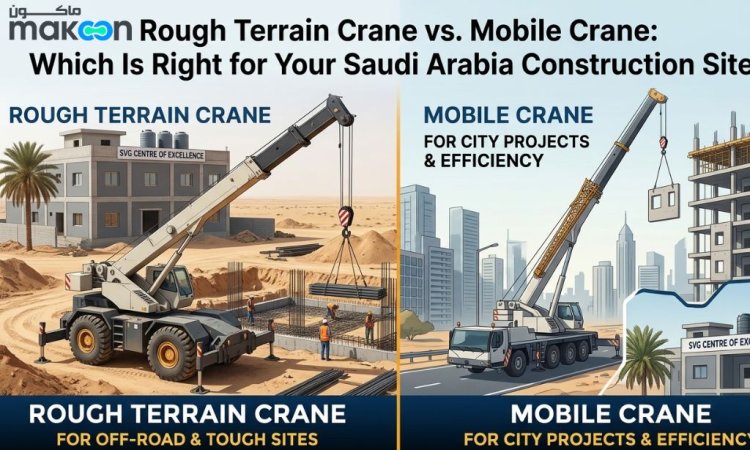
Saudi Arabia added over SAR 1.3 trillion in active construction contracts to its pipeline in 2024 petrochemical expansion, mega-tourism infrastructure, and industrial city development, all running simultaneously. On every one of those sites, crane selection is a procurement decision with direct consequences for project schedule and budget. Choose the wrong crane type and you lose mobilization days, fail a compliance audit, or watch a hydraulic system shut down at 46°C in July. This guide breaks down exactly how rough terrain cranes and mobile cranes perform against the specific demands of KSA jobsites, so the next rental decision is defensible on paper and efficient on the ground.
What Is a Rough Terrain Crane?
A rough terrain crane is a self-propelled lift machine built on a four-wheel-drive, rubber-tyred carrier specifically engineered for unprepared ground. Its single-engine system drives both travel and lifting functions from one power source. The boom telescopes hydraulically and the machine stabilises on sandy, rocky, or uneven surfaces without requiring a separate transport vehicle to reach the lift point.
Rough terrain cranes in the KSA market typically range from 30 to 130 tonnes lifting capacity. Their wide, low-pressure tyres spread ground load across a larger footprint directly relevant to soft desert substrates common across the Eastern Province, the Haradh gas corridor, and early-phase civil sites where road compaction is still in progress. Setup time on a prepared pad runs 30–60 minutes; on soft sand with outrigger mats, add 30–45 minutes for matting placement.
Key manufacturers represented in Saudi Arabia's heavy equipment rental fleet include Tadano, Manitowoc Grove, and Liebherr RT models. Tadano's GR-1000XL-4 (100-tonne class) is widely used on Aramco field maintenance contracts in the Eastern Province.
Enquire Rough Terrain Crane Now
What Is a Mobile Crane?
A mobile crane in KSA context, almost always an all-terrain (AT) model is a multi-axle machine capable of highway travel at full speed between sites without a low-loader for hauls under 200 km. All-terrain designs combine cross-country tyre performance with road-legal axle configurations, making them the preferred choice when a single crane must service multiple work fronts during the same project cycle.
Mobile cranes available in the KSA market span 50 to 500+ tonnes. The Liebherr LTM 1200-5.1 (200-tonne class) and Grove GMK6300L (300-tonne class) are regularly deployed on NEOM and Red Sea Global structural steel packages. Larger all-terrain models require more complex site assembly: outrigger deployment, boom section erection, and counterweight placement typically extends setup to 2–4 hours on a fresh site compared to a rough terrain crane's 30–60 minutes.
For heavy industrial lifts heat exchanger placement at Jubail petrochemical plants, module setting on offshore topsides construction, or structural frame erection on multi-storey building projects in Riyadh the mobile crane's capacity headroom and boom reach are operationally decisive.
Key Differences Head-to-Head Comparison
The table below compares both crane types across the factors that matter most on Saudi Arabia construction and oil-and-gas sites.
|
Factor |
Rough Terrain Crane |
Mobile Crane (All-Terrain) |
|
Road travel speed |
20–35 km/h (off-road only) |
75–90 km/h (highway-legal) |
|
Lifting capacity range |
30–130 tonnes |
50–500+ tonnes |
|
Setup time (prepared site) |
30–60 minutes |
2–4 hours |
|
Ground pressure |
Low – wide low-pressure tyres |
Higher – requires stable base or mats |
|
Engine configuration |
Single engine (travel + lift) |
Dual engine (travel separate from crane) |
|
Multi-site self-mobilise |
No – needs low-loader transport |
Yes – highway speed between sites |
|
Ideal terrain |
Sandy / rough / unprepared ground |
Prepared pads, industrial facilities |
|
Confined space performance |
Compact footprint – strong here |
Larger footprint – challenging |
|
Operator cert. complexity |
Standard crane licence + Aramco cert |
AT/HT endorsement + Aramco cert |
|
Daily wet rental in KSA |
SAR 3,500–9,000 (50–100T class) |
SAR 6,500–16,000 (50–100T class) |
Saudi Arabia-Specific Factors That Affect Your Choice
Deploying cranes in the Kingdom involves variables that no equipment spec sheet fully captures. Four KSA-specific conditions routinely determine which crane type performs and which fails.
1. Desert Terrain and Sand Stability
Saudi Arabia's ground conditions range from compacted gravel plains (sabkha) near the Arabian Gulf coast to deep, unconsolidated sand in interior regions and construction sites where earthworks are still in progress. Rough terrain cranes carry a clear advantage on these surfaces: their oversized, low-pressure tyres distribute load across a wider contact area, reducing the risk of sinking on soft substrates. This is operationally significant on sites like well pad construction in the Haradh-Hawtah corridor or early-stage civil works on Vision 2030 tourism sites where road compaction has not occurred.
Mobile cranes on soft sand require engineered outrigger pads typically crane mats or fabricated steel spreader plates to achieve the bearing pressure specifications stated in the lift plan. Without proper matting, outrigger legs punch through and the lift is grounded. Procurement teams on sandy sites regularly underestimate this additional mobilisation cost, which can add SAR 800–2,000 per day per crane in mat hire and placement labour. That cost differential narrows the mobile crane's apparent advantage on pure price comparison.
2. Extreme Heat and Hydraulic Performance
KSA summer temperatures routinely exceed 45°C in the shade, with surface temperatures on concrete pads reaching 65–70°C during afternoon hours between June and September. Hydraulic fluid viscosity drops under sustained heat, increasing internal leakage past seals and reducing lift precision and load-holding reliability a critical safety consideration on any certified lift over 5 tonnes.
Rough terrain cranes – with their single-engine architecture run a combined hydraulic circuit that simultaneously manages travel, boom extension, and slewing. Under continuous operation in peak summer heat, this integrated system builds thermal load faster than the dual-engine configuration of an all-terrain mobile crane, which can isolate the crane hydraulic system from travel loads during a lift. For sustained picks on petrochemical construction sites where the crane remains under load for extended periods, mobile cranes with active hydraulic cooling systems offer a measurable operational margin.
Both crane types require mandatory hydraulic fluid viscosity checks and cooling system inspections every shift during summer operations under Saudi Aramco Construction Standard SAES-A-202. Operators must also observe mandatory rest periods and crane cool-down protocols during afternoon peak heat windows.
3. Aramco & SABIC Site Requirements
Operating any crane on Saudi Aramco or SABIC facilities concentrated in the Eastern Province cities of Jubail, Dammam, and Al Khobar involves compliance requirements that go significantly beyond standard crane certification under SASO.
Operators must hold a current Aramco Contractor Qualification certificate. All lifts above 5 tonnes require a written Lift Plan reviewed and approved by a TÜV SÜD or TPI-certified third party before rigging begins. The crane itself must pass SASO inspection under Technical Regulation TR 1084 for lifting equipment and display a valid inspection sticker. Imported equipment documentation must align with SASO and Saudi Customs import compliance for heavy machinery.
Both rough terrain and mobile cranes can meet these requirements when properly maintained and documented. The differentiator in practice is the rental company's compliance infrastructure – specifically whether the operator holds a current Aramco Contractor Qualification and whether full TPI inspection records are available at mobilisation. This distinction is worth confirming in writing before committing to any rental agreement on an Aramco or SABIC site. Makcon's fleet documentation and operator certifications are maintained to Aramco standard and available for review prior to dispatch.
4. Vision 2030 Project Types and Crane Mobility
Saudi Arabia's Vision 2030 megaproject portfolio – NEOM, Red Sea Global, Diriyah Gate Development Authority, and Qiddiya is structurally different from traditional petrochemical construction. These projects are geographically distributed across large land areas, with sequential work fronts advancing through site rather than concentrated at a fixed plant location.
For multi-front megaprojects, mobile cranes hold a decisive advantage: they self-mobilise between work areas on hardstand roads without a low-loader and can be repositioned overnight to meet next-day programme demands. A contractor running structural steel on NEOM's THE LINE, for example, needs a crane that follows the advancing work front weekly not one that requires transport logistics co-ordination for every 15 km move.
Conversely, rough terrain cranes are the standard choice for single-site, fixed-facility projects: oil field well pad construction, industrial plant erection, and equipment installation inside confined petrochemical facilities where the crane works in one location for weeks. The compact footprint and fast setup between lifts on a single site outweigh the mobile crane's highway capability when there is nowhere else to go.
Which Crane Is Right for Your Project Type?
Use this reference to match your KSA project profile to the correct crane type.
|
Project Type |
Recommended Crane |
Primary Rationale |
|
Oil field well pad / pipeline construction |
Rough Terrain |
Unprepared sand, single site, compact footprint |
|
NEOM / Red Sea Global (multi-front) |
Mobile Crane (AT) |
Self-mobilisation, high capacity, highway speed |
|
Aramco plant turnaround |
Both (capacity-dependent) |
Certification compliance is the deciding factor |
|
Industrial facility erection – Jubail |
Both (sequence-dependent) |
RT for confined areas; AT for heavy structural steel |
|
Offshore marine construction support |
Mobile Crane (AT) |
Reach and capacity requirements exceed RT range |
|
Remote desert site – no haul road |
Rough Terrain |
No low-loader dependency; tyres perform on sand |
|
SABIC chemical plant maintenance |
Rough Terrain (low capacity) |
Access constraints favour compact RT footprint |
|
Multi-storey building – Riyadh / Jeddah |
Mobile Crane (AT) |
Height, radius, and capacity demands require AT |
Cost Comparison – Rough Terrain vs Mobile Crane Rental in Saudi Arabia
Crane rental pricing in KSA is quoted as either wet rental (crane + certified operator + fuel, all-in) or dry rental (crane only; client supplies operator and fuel). Most Aramco and SABIC-compliant projects are effectively required to use wet rental, because it places operator certification liability on the rental provider not the contractor.
|
Cost Factor |
Rough Terrain Crane |
Mobile Crane (All-Terrain) |
|
Daily wet rental – 50T class |
SAR 3,500–5,500 |
SAR 6,500–10,000 |
|
Daily wet rental – 100T class |
SAR 6,000–9,000 |
SAR 10,000–16,000 |
|
Mobilisation (Eastern Province) |
SAR 1,500–3,000 |
SAR 3,000–6,000 |
|
Outrigger matting (sandy site) |
SAR 600–1,200/day |
SAR 1,000–2,500/day |
|
Operator overtime (>8 hrs) |
SAR 250–400/hour |
SAR 350–550/hour |
|
Monthly contract discount |
15–25% typical |
10–20% typical |
For budget planning: a 30-day rough terrain crane rental at 50-tonne capacity on an Aramco-compliant wet basis typically runs SAR 110,000–140,000 all-in including mobilisation and matting. An equivalent 50-tonne mobile crane wet rental for 30 days ranges from SAR 165,000–220,000 justified when multi-site flexibility or higher daily lift throughput reduces overall project duration.
Safety and Compliance Requirements in Saudi Arabia
Crane operations in KSA are governed by overlapping regulatory frameworks. Understanding which applies to your project prevents delays at the permit and mobilisation stage.
SASO TR 1084 covers technical requirements for lifting equipment sold or operated in Saudi Arabia, including mandatory inspection intervals and load-testing documentation. All cranes must carry a current SASO inspection certificate before operating on any KSA site.
Saudi Aramco Engineering Standard SAES-A-202 governs construction equipment on all Saudi Aramco-controlled facilities. It specifies operator qualifications, lift plan approval processes, and equipment inspection requirements above and beyond the SASO baseline. Non-compliance results in immediate stand-down and potential removal from Aramco's Approved Vendor List.
Ministry of Human Resources summer work suspension regulations mandate work stoppage for outdoor heavy equipment operations between 12:00 PM and 3:00 PM from June 15 to September 15 each year. This directly affects crane productivity planning: on a 10-hour shift day, the effective crane operating window in peak summer is 7 hours, not 10. Daily rental cost per completed lift rises accordingly a factor that project planners routinely underestimate when scheduling summer construction programmes.
Third-party inspection bodies accepted for lift plan sign-off on major KSA industrial projects include TÜV SÜD, Bureau Veritas, and Lloyds Register. Operators on megaproject sites increasingly require LEEA (Lifting Equipment Engineers Association) certified riggers alongside the crane operator a requirement that should be confirmed with the principal contractor before fleet mobilisation.
The Operational Reality: Site Conditions Decide
Choosing between a rough terrain crane rental in Saudi Arabia and a mobile crane comes down to three variables: where the crane needs to go, how long it stays there, and what it must lift. Rough terrain cranes win on sandy, unprepared sites where fast setup and low ground pressure matter more than capacity or road speed. Mobile cranes win when the project spans multiple fronts, demands tonnage above 130T, or must self-mobilise without transport logistics.
For projects on Aramco or SABIC facilities, the rental company's compliance infrastructure matters as much as the crane specification certified operators and current TPI documentation are non-negotiable requirements at mobilisation. Select your heavy equipment rental provider accordingly, and confirm operator qualifications in writing before the crane arrives on site.
|
Ready to mobilise a certified crane on your KSA site? Makcon operates a fully certified fleet across Saudi Arabia – Aramco-qualified operators, current TPI documentation, and round-the-clock dispatch from our Eastern Province depot. Visit mak-con.com to request a quote or speak with our equipment team. |
Frequently Asked Questions
What is the difference between a rough terrain crane and a mobile crane?
A rough terrain crane runs on a single-engine, four-wheel-drive rubber-tyred carrier designed for unprepared and sandy ground, with lifting capacities typically from 30 to 130 tonnes. A mobile crane usually an all-terrain model uses a multi-axle configuration capable of highway travel at 75–90 km/h, with capacities reaching 500+ tonnes. The core trade-off is ground pressure and setup speed versus road mobility and lifting capacity headroom.
Can rough terrain cranes travel on roads in Saudi Arabia?
Rough terrain cranes can travel on internal site roads and unprepared haul tracks, but they are not highway-legal in KSA for long-distance moves without a transport permit and low-loader escort. For relocations more than 10–15 km, contractors typically transport rough terrain cranes on a flatbed low-loader to prevent tyre damage and comply with Saudi Transport Authority road regulations for heavy equipment.
Which crane is better for oil and gas sites in Saudi Arabia?
For single-site oil field locations with unprepared ground – well pad construction, pipeline crossings, field equipment installation rough terrain cranes are the standard choice due to their performance on sandy substrates and compact setup footprint. For refinery and petrochemical plant turnarounds requiring high-capacity picks in structured industrial facilities, mobile all-terrain cranes are typically preferred. All cranes on Aramco and SABIC facilities must meet SAES-A-202 operator certification and lift plan requirements regardless of crane type.
How much does crane rental cost in Saudi Arabia?
Rough terrain crane wet rental in KSA ranges from approximately SAR 3,500 to SAR 9,000 per day for the 50–100 tonne capacity range. Mobile crane wet rental for the same range runs SAR 6,500 to SAR 16,000 per day. Monthly contracts typically attract 10–25% discounts versus daily rates. Mobilisation, outrigger matting on sandy sites, and operator overtime are billed separately and should be included in project cost planning from the outset.
What is wet rental vs dry rental for cranes in KSA?
Wet rental means the crane is supplied with a certified operator and fuel included in the daily rate – the rental company is responsible for the operator's qualifications and compliance documentation. Dry rental means the crane only is supplied; the contracting company provides its own operator and fuel. On Aramco and SABIC projects, wet rental is strongly preferred because it places operator certification liability on the rental provider rather than the main contractor.
Do I need an Aramco-certified operator for crane rental in Saudi Arabia?
Yes. Any crane operation on Saudi Aramco-controlled facilities including contractor-operated sites within Aramco's Eastern Province complex requires the crane operator to hold a current Aramco Contractor Qualification certificate. Lifts above 5 tonnes additionally require a TPI-reviewed and approved lift plan before the crane is rigged. Rental companies supplying uncertified operators on Aramco sites face immediate stand-down orders and can be removed from the Aramco Approved Vendor List.
What's Your Reaction?