What Is an RT Crane? Specs, Uses & Rental
Understand what a rough terrain crane is, how it works, its key specs, and when to use one. Explore RT crane rental in Saudi Arabia from Makcon today.
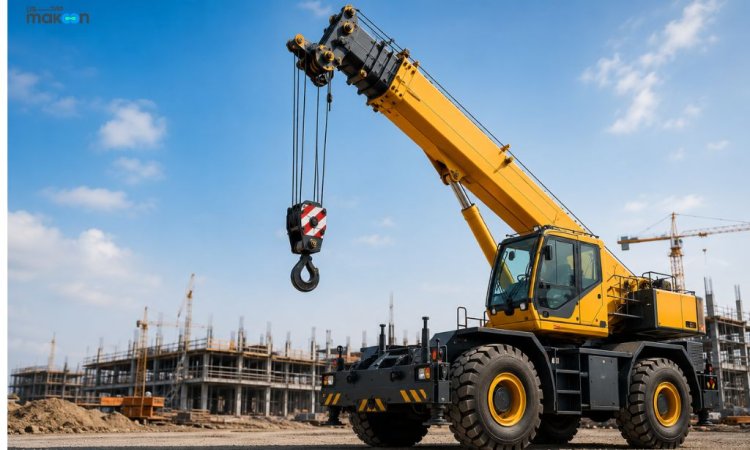
On Saudi Arabia's oil and gas sites, port construction projects, and desert infrastructure corridors, one piece of equipment shows up repeatedly wherever the ground is uneven, access is restricted, and a conventional crane cannot safely operate the rough terrain crane. Understanding what an RT crane is, how it differs from other crane types, and when it is the right choice for a project is practical knowledge for every construction project manager and site engineer working in the Kingdom.
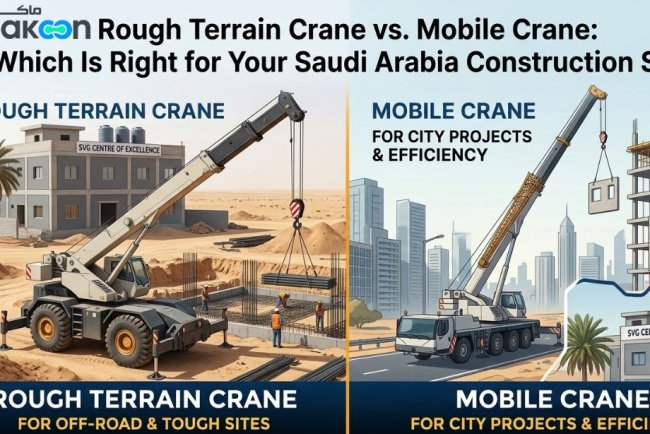
A rough terrain crane is a self propelled crane mounted on a rubber-tyred, four-wheel-drive undercarriage purpose-built for off-road operation. Unlike truck-mounted cranes that travel on public roads and set up at site, or all-terrain cranes that attempt to do both, the RT crane is optimised for a single environment: difficult, uneven ground where stability and manoeuvrability matter more than road speed.
This guide covers the full picture RT crane meaning, key components, specifications, how it works, common applications, and the critical comparison against all-terrain and truck-mounted cranes. It also covers what to consider before renting one in Saudi Arabia and where Makcon fits as a crane rental company in the Kingdom.
What Does RT Crane Mean?

RT stands for Rough Terrain. An RT crane is a mobile crane designed and built specifically for operation on soft, uneven, or unprepared ground the conditions most commonly found on active construction sites, oilfield developments, port expansion projects, and industrial plant construction.
The defining characteristic is the undercarriage: four large rubber tyres on a compact, single-engine chassis with four-wheel drive and often four-wheel steering. The crane operator works from a cab mounted on the upper rotating structure (superstructure), and the entire machine carrier and superstructure is powered by a single engine. This single-engine design is what separates RT cranes from all-terrain cranes, which typically use separate engines for travel and for crane operation.
RT cranes are not designed for highway travel. They are transported between project sites on lowboy trailers. Once on site, they operate independently, typically requiring no outrigger setup on firm ground (though outriggers are always deployed for maximum-rated lifts), and their four-wheel steering allows them to navigate tight site conditions that larger crane types cannot manage.
Key Components of a Rough Terrain Crane
Understanding the major components of an RT crane helps project teams specify the right machine for their lift requirements and anticipate what the crane needs to operate safely.
|
Component |
Function |
Key Specification |
|
Boom |
Primary lifting structure – telescoping for reach and height adjustment |
Length: typically 10–50 m depending on class |
|
Hook block |
Connects the load to the hoist line; the primary load-bearing point |
Rated by ton-capacity matching the crane class |
|
Hoist system |
Wire rope drum and winch that raises and lowers the load |
Single or double drum depending on capacity class |
|
Outriggers |
Four hydraulic stabilising legs that extend to increase the crane's base for maximum lifts |
Must be fully extended and on firm ground for rated lifts |
|
Superstructure |
Rotating upper section containing the crane cab, boom, hoist, and counterweight |
Typically 360° rotation |
|
Carrier |
Four-wheel-drive rubber-tyred lower chassis that provides mobility on rough terrain |
Axle count: 2 (one front, one rear, both driven) |
|
Counterweight |
Ballast mounted at the rear of the superstructure to balance the load moment |
Weight varies by crane class and configured lift |
|
Cab |
Operator control station – typically a single cab on the superstructure for on-site operation |
Air-conditioned on modern RT cranes |
RT Crane Specifications Explained
Rough terrain crane specifications vary significantly by class. The five figures that matter most for project planning are: maximum capacity, maximum boom length, maximum lift height, maximum radius, and ground bearing pressure. Understanding each helps project teams select the correct machine without over-specifying (which increases cost) or under-specifying (which creates safety risk).
|
Specification |
What It Means |
Typical Range |
|
Maximum capacity (rated load) |
Maximum weight the crane can lift at a specific radius – always falls rapidly as radius increases |
25 tonnes to 130+ tonnes depending on class |
|
Maximum boom length |
Maximum reach of the telescoping boom at full extension |
10 m to 52 m across typical classes |
|
Maximum lift height |
Highest point the hook can reach with boom and jib fully extended |
Up to 75 m with main boom + jib configuration |
|
Maximum radius |
Horizontal distance from crane centre to load at rated capacity – longer radius means lower capacity |
3 m to 18 m at rated capacity; more at reduced capacity |
|
Ground bearing pressure |
Pressure the crane exerts on the ground per unit area – critical for soft or prepared sites |
Lower than truck cranes due to large tyre contact area |
|
Travel speed |
On-site mobility speed – not for road use |
Typically 1–5 km/h on rough terrain |
On Saudi Arabia's petrochemical and industrial projects, the most commonly requested RT crane classes run from 40 to 80 tonnes maximum capacity sufficient for the majority of plant maintenance lifts, structural steel placement, and equipment installation tasks at oil and gas facilities in the Eastern Province.
How Does a Rough Terrain Crane Work?
An RT crane operates through a hydraulic system powered by its single diesel engine. The same engine that drives the wheels also powers all crane functions – boom extension, hoist operation, superstructure rotation, and outrigger deployment – through hydraulic circuits.
5 Steps From Arrival to Lift
• Positioning: The crane is driven to the lift position under its own power on four-wheel drive. On very soft ground, mats or timber pads may be placed under the outrigger pads first
• Outrigger deployment: Four hydraulic outriggers extend laterally and down to lift the rubber tyres clear of the ground. This creates a stable, level platform for the rated lift capacity
• Boom configuration: The telescoping boom is extended to the required length and angle. A jib extension may be added for height or offset reach requirements
• Rigging and load attachment: The rigger attaches the load to the hook block using slings, shackles, or a spreader bar appropriate for the load geometry
• Lift execution: The operator raises, slews, and places the load at the required position. Throughout, the load chart (which specifies maximum permitted load at each radius and boom angle) governs what the crane can safely handle
Common Uses of RT Cranes
Heavy lifting equipment in Saudi Arabia is deployed across a wide range of industrial and construction applications, and the RT crane appears in more varied site conditions than any other mobile crane type. Common applications include:
• Oil and gas plant maintenance: Lifting and replacing pressure vessels, heat exchangers, pump sets, and compressor modules at petrochemical facilities where ground conditions are often prepared but access corridors are tight
• Pipeline and infrastructure construction: Placing concrete pipe segments and lifting valves and fittings at desert and coastal pipeline projects where the ground surface is uncompacted
• Structural steel erection: Placing steel columns, beams, and trusses during the erection of industrial buildings and warehouses on new construction sites before the ground is prepared
• Port and logistics facility construction: Placing precast concrete elements, lifting heavy plant, and supporting structure erection in coastal environments where tidal activity affects ground stability
• Power plant and utility construction: Lifting transformer units, generator sets, turbine components, and condenser modules at utility construction sites across the Kingdom
• NEOM and giga-project site support: Saudi Arabia's Vision 2030 projects involve construction across challenging terrain – desert, mountain, and coastal – where RT cranes provide the mobility that fixed and highway-dependent cranes cannot
Advantages of Using an RT Crane
|
Advantage |
Why It Matters on Saudi Sites |
|
Off-road mobility |
Operates on soft sand, gravel, and unprepared ground common on KSA construction and oilfield sites |
|
No road transport licence required for on-site movement |
Once delivered by lowboy, moves independently under its own power across the project site |
|
Compact footprint |
Smaller turning radius and shorter overall length than all-terrain cranes, making it practical in congested site areas |
|
Fast setup |
Outrigger deployment and lift readiness achieved faster than crawler cranes, which require tracked assembly |
|
Single-operator machine |
One certified crane operator manages all crane and travel functions from the single cab |
|
Cost-effective for site work |
Lower mobilisation cost than crawler cranes for medium-capacity lifts where on-site mobility is required |
|
Excellent ground clearance |
High undercarriage clearance allows operation over drainage channels, berms, and rough site obstacles |
RT Crane vs All Terrain Crane: What's the Difference?
The RT crane and all-terrain crane are frequently confused because both use rubber tyres and both operate on difficult ground. The distinction is fundamental:
|
Factor |
RT Crane |
All-Terrain Crane |
|
Axle count |
2 axles (one front, one rear) |
4–9 axles depending on class |
|
Road travel |
Not designed for public roads – requires lowboy transport |
Licensed for highway travel – self-propelled between sites |
|
Engine configuration |
Single engine for travel and crane operation |
Typically two engines – one for road travel, one for crane ops |
|
Maximum capacity |
Up to 130 tonnes (common classes 25–80 t) |
Up to 1,200 tonnes for the largest models |
|
Terrain capability |
Optimised for off-road and soft ground |
Capable off-road but optimised for versatility |
|
Site manoeuvrability |
Shorter wheelbase, tighter turning radius |
Longer wheelbase limits tight-area access |
|
Mobilisation cost |
Lower – smaller, lighter, easier to transport |
Higher – requires heavier lowboy transport at larger classes |
|
Typical KSA application |
Oil and gas plant sites, pipeline corridors, early-stage construction sites |
Multi-site projects, large lifts requiring road mobility between sites |
RT Crane vs Truck-Mounted Crane
Truck-mounted cranes (also called hydraulic truck cranes) mount the crane superstructure on a standard commercial truck carrier. They differ from RT cranes in one critical way: they are road vehicles first, cranes second.
|
Factor |
RT Crane |
Truck-Mounted Crane |
|
Carrier type |
Dedicated rough terrain carrier – four-wheel drive, off-road optimised |
Commercial truck carrier – road-optimised |
|
Ground suitability |
Soft, sandy, uneven, and unprepared ground |
Hard, level ground – poor performance off-road |
|
Road travel |
Not permitted on public roads |
Fully road-legal – self-propelled to site |
|
Setup time |
Faster on uneven ground – tyres absorb initial levelling |
Requires level, firm surface before setup |
|
Stability |
Four-wheel drive and high tyre profile provide better soft-ground stability |
Road tyres provide less traction and stability off-road |
|
Typical KSA use |
Remote and off-road project sites, oilfield access roads, desert construction |
Urban construction, port areas, road projects with paved access |
Factors to Consider Before Renting an RT Crane
Rough terrain crane rental decisions in Saudi Arabia should be driven by the specific lift requirements and site conditions, not by cost alone. The wrong crane class for a lift creates safety risk and often costs more in project delay than the price difference between classes.
• Maximum lift weight at the required radius: The load chart, not the crane's maximum rating, governs what a specific crane can safely lift at a specific distance from its centre. Always calculate the lift at the actual working radius
• Required boom length and lift height: Structural clearances, power line heights, and the vertical distance from ground to placement point all affect which boom configuration is needed
• Ground conditions at the lift position: Soft ground may require outrigger mats. Rock or hardpan surface may allow smaller crane classes. Site soil reports help avoid surprises during mobilisation
• Site access corridors: The crane must physically reach the lift position. Width restrictions, overhead clearances, drainage channels, and existing structures all affect which crane class can access the work area
• Wet hire vs dry hire: Wet hire (crane plus certified operator) is typically the appropriate choice for Saudi Arabia projects due to local licensing requirements and the importance of operator familiarity with the specific machine
• Contract duration: Daily rates are available for spot lifts; monthly and project-term contracts reduce the per-day cost significantly and are preferred for projects with recurring lift requirements
RT Crane Rental Services in Saudi Arabia by Makcon
Makcon (Mithaq Services General Contracting) operates as a crane rental company in Saudi Arabia from its base in Al Khobar, Eastern Province – serving construction, oil and gas, and industrial projects across the Kingdom. Our heavy equipment fleet includes rough terrain cranes available on daily, monthly, and project-term contracts with both wet hire and dry hire options.
|
Service Detail |
Makcon Offering |
|
Fleet coverage |
RT cranes across standard capacity classes – confirm availability and current fleet spec at booking |
|
Coverage area |
Eastern Province, Riyadh, Jeddah, Jubail, Ras Al Khair, NEOM corridor, and all major KSA regions |
|
Hire type |
Wet hire (crane + certified Saudi-licenced operator) and dry hire (crane only with maintenance SLA) |
|
Contract terms |
Daily, monthly, or project-term – no forced minimum commitment beyond project requirements |
|
Regulatory compliance |
Saudi-registered company, Iqama-compliant – full documentation for ARAMCO, SABIC, and government projects |
|
Mobilisation |
Low-loader transport to site arranged by Makcon – pre-delivery inspection certificate issued |
|
Response time |
Standard availability confirmation within 2–4 hours; deployment within 24–48 hours for Eastern Province sites |
|
RT Crane Rental in Saudi Arabia – Get a Written Quote 📞 Call: +966 56 849 1941 ✉ Email: sales@mak-con.com |
Safety Tips for Operating a Rough Terrain Crane
RT crane accidents in Saudi Arabia's construction and industrial sectors consistently trace to the same root causes: operating beyond the load chart, inadequate ground preparation, and poor rigging practice. The safety protocols below are not optional guidelines they are the operational standard on every ARAMCO, SABIC, and public sector project in the Kingdom.
• Pre-lift planning: Prepare a written lift plan for every non-routine lift specifying load weight, rigging method, crane positioning, outrigger ground conditions, and exclusion zone radius
• Load chart compliance: Never exceed the rated capacity for the configured radius and boom angle. The load chart is a safety document, not a starting negotiation
• Outrigger ground assessment: Verify ground bearing capacity at each outrigger pad position before deployment. Use crane mats on soft or suspect ground – under-specified ground support is a leading cause of RT crane tip-over incidents
• Pre-operation inspection: Complete a documented pre-lift inspection covering wire rope condition, hook latch, hydraulic connections, outrigger extension locks, and boom pin condition before each shift
• Exclusion zone enforcement: No personnel under the suspended load at any time. Physical barriers and a dedicated flagman are required on all Saudi industrial project sites
• Wind speed monitoring: Wind speed exceeding the manufacturer's operating limit for a given configuration requires the lift to be suspended. Saudi Arabia's coastal and desert sites experience sudden wind events that affect RT crane stability more than site managers often anticipate
• Certified operator requirement: All RT crane operators on Saudi construction and industrial sites must hold a valid Saudi-recognised crane operator licence. Wet hire from Makcon includes licenced, experienced operators as standard
Conclusion
The rough terrain crane occupies a specific and important place in Saudi Arabia's heavy lifting equipment ecosystem. Where ground conditions are unprepared, where site access is restricted, and where a conventional mobile crane cannot safely position and operate, the RT crane is typically the right tool. Its single-engine simplicity, off-road capability, and faster setup cycle make it the practical choice for the majority of medium-capacity lifts at oil and gas, pipeline, and early-stage construction sites across the Kingdom.
Choosing the correct RT crane class requires accurate lift data – load weight, working radius, required height, and ground conditions. Makcon's equipment team can assist in specifying the appropriate crane class for your project requirements before a contract is signed. Contact us with your project details for a written quotation and availability confirmation.
|
Plan Your Lift – Talk to Makcon's Equipment Team Makcon provides rough terrain crane rental across Saudi Arabia with certified operators, pre-delivery inspection, and full regulatory compliance for ARAMCO, SABIC, and government project requirements. 📞 +966 56 849 1941 ✉ sales@mak-con.com 📍 Al Khobar, Eastern Province | Request a Quote → |
Frequently Asked Questions
What is an RT crane?
An RT crane (Rough Terrain crane) is a self-propelled mobile crane mounted on a four-wheel-drive rubber-tyred carrier built specifically for off-road operation. It uses a single diesel engine to power both its travel functions and all crane operations – boom extension, hoist, rotation, and outrigger deployment. RT cranes are not road-legal and are transported between sites on lowboy trailers.
What is the difference between an RT crane and an all-terrain crane?
An RT crane has two axles, a single engine, and is optimised purely for off-road site operation – it cannot travel on public roads. An all-terrain crane has multiple axles (typically four or more), two engines, and is designed for both highway travel and off-road operation. All-terrain cranes are generally larger and more expensive per day; RT cranes are more cost-effective for single-site, rough-ground applications.
What is the typical capacity range for rough terrain cranes?
Common rough terrain crane classes range from 25 tonnes to 130 tonnes maximum rated capacity. The rated capacity always refers to the maximum load at the minimum working radius – capacity falls significantly as the working radius increases. For most Saudi Arabia plant maintenance, structural steel, and equipment installation lifts, the 40–80 tonne class covers the majority of requirements.
Can Makcon provide RT crane rental with an operator in Saudi Arabia?
RT crane rental in Saudi Arabia from Makcon is available as wet hire (crane plus a certified, Saudi-licenced operator) or dry hire (crane only with a maintenance SLA). Wet hire is recommended for most site applications as it includes operator accountability, pre-shift inspection, and compliance with Saudi site safety requirements. Contact Makcon at +966 56 849 1941 or sales@mak-con.com for availability.
What safety requirements apply to RT crane operations in Saudi Arabia?
Saudi Arabia's industrial project sites – particularly ARAMCO, SABIC, and government projects – require a written lift plan for all non-routine lifts, documented pre-operation inspection, exclusion zone enforcement, certified operator with valid Saudi licence, outrigger ground assessment, and wind speed monitoring throughout the lift. Makcon's wet hire operators are trained to these standards and are familiar with the documentation requirements of major Saudi contractors.
What's Your Reaction?