Lifting Equipment Rental: How to Select for Heavy Loads
Lifting equipment rental for heavy industrial components: size the crane from the hook load, check radius, ground and rigging, then decide rent or buy.
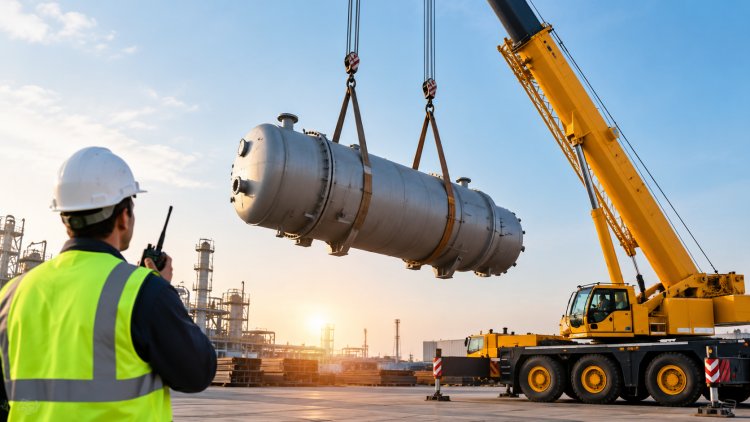
To select lifting equipment rental for a heavy industrial component, start with the real hook load: the component plus rigging and hook block. Check the crane's load chart at the working radius, confirm the ground can carry the outriggers, and match the rigging to the load. Then have a competent person approve the lift plan before the unit arrives.
A 40-tonne pressure vessel can wait a day for the right crane. It cannot be lifted by a nearly right one. Pressure vessels, generators, steel structures and plant machinery are heavy, awkward and costly to damage, so a wrong choice shows up as an unstable lift, a blocked access road or a crane booked twice. Equipment choice drives load stability, site access, lifting efficiency and project cost. Six inputs decide it: load weight, dimensions, lifting height, working radius, ground conditions and rigging. A competent person must select the equipment and plan the lift.
What Is Lifting Equipment for Heavy Industrial Components?
It is the machines and accessories that raise, position and move loads too heavy or awkward for manual handling or a forklift: cranes, boom trucks, rigging gear and, on restricted sites, specialist lifting systems. Construction, manufacturing, oil and gas and maintenance crews all rely on it. Heavy component handling always involves two parts. The lifting machine carries the load; the rigging, meaning slings, shackles and spreaders, joins the load to the hook. Either can be the weak link. SASO's Technical Regulation for Machinery Safety, Part 3: Lifting Equipment treats slings and their components as lifting fittings, and requires each fitting to show its working load limit.
How to Select the Right Lifting Equipment for Heavy Industrial Components
Selecting heavy industrial lifting equipment is a sequence, not a catalogue search. Work through the six inputs in order; each one narrows the next.
1. Establish the Real Load Weight
Use a weighed or certified weight, not a figure read from a drawing. Then add the hook block, slings, shackles and any spreader beam. As Makcon's 50 to 200 ton crane page puts it, “the crane must carry the total, not the load alone.”
An illustration with made-up figures: a 42.0 t vessel, 1.2 t of rigging and a 1.5 t hook block give a 44.7 t hook load. A crane sold as 50 t must show at least 44.7 t on its chart at your radius, not at its shortest one. Your lifting capacity requirements start from that total.
2. Measure Dimensions and Find the Centre of Gravity
Length, width and height set the lifting points, the sling lengths and the clearance past other structures. An off-centre load tilts as it leaves the ground, so confirm the centre of gravity from the manufacturer's drawing, especially for generators and skid-mounted plant.
3. Work Out the Lifting Height
Add the load height, the rigging length under the hook, the clearance above the landing point and the height of the hook block. The boom must clear that total. A longer boom can reduce what the crane lifts at a given radius, so height and radius cannot be checked separately.
4. Fix the Working Radius
Radius runs from the crane's centre of rotation to the load, and it applies at both pick-up and set-down; the larger of the two controls the choice. Capacity falls as radius grows. A crane that lifts the vessel beside it may fall short at a foundation across a pipe rack. Makcon's page also says to pick the capacity class from the heaviest lift, then check the load chart at the real radius.
5. Check Ground Conditions and Access
Outrigger loads concentrate on small pads, so the ground, not the crane, often sets the limit. Sabkha, the salt-flat ground found along parts of the Gulf coast, can look firm on a dry crust and be soft beneath it. Ask for a ground assessment, plan crane mats, and check the access road and gate against the crane's transport size. UK Health and Safety Executive guidance lists overturning and derating among the risks a lifting plan must address.
6. Match the Rigging and the Lift Method
Choose slings, shackles and beams after the crane, and weigh them as part of the load. Decide the method too: one crane, two cranes in a tandem lift, or jacking. The HSE page uses a tandem lift with several cranes as its example of complex work that needs a written plan by a person with significant and specific competencies.
Which Type of Crane Is Best for Heavy Industrial Lifting?
Industrial crane selection depends on the site, not on a favourite machine. The table uses the capacity ranges Makcon lists on its crane page. They are Makcon's own figures.
|
Crane type |
Suits |
Watch for |
Range Makcon lists |
|
Rough terrain |
Uneven or unpaved sites; a crane that stays on one site |
Slow between sites; longer moves usually need a low-loader |
25 to 130 t |
|
Mobile and all-terrain |
Several sites; road moves; high-reach lifts |
Outriggers need firm, matted ground |
Mobile 30 to 500 t; all-terrain 60 to 1,200 t |
|
Crawler |
Very heavy or repeated lifts in one area |
Assembly and transport planning |
50 to 1,500 t |
|
Boom truck and truck-mounted |
Lighter loads, quick set-up, short jobs |
Limited capacity and reach |
Boom truck 5 to 35 t; truck-mounted 10 to 80 t |
|
Spider crane |
Tight spaces and indoor lifts |
Small capacity |
1.3 to 8 t |
For many industrial lifts the working choice sits between rough terrain and mobile cranes in the 50 to 200 tonne band. Makcon splits that band into four classes: 50 to 75, 75 to 100, 100 to 150 and 150 to 200 tonnes. Choose the class that clears the heaviest lift on the chart, not the one whose label matches the component weight. See also the post on rough terrain and mobile cranes in Saudi Arabia.
When Should You Consider Specialised Lifting Equipment?
Look at specialist gear when a standard crane cannot satisfy one of the six inputs. Restricted access or low headroom points to a spider crane, a gantry or a skidding system; a load beyond practical crane size points to jacking or heavy-transport systems; a long or flexible item may need a spreader or lifting beam. Heavy load lifting methods such as tandem lifts also belong here. The method comes before the hire, and an engineer should confirm it.
Rigging Equipment, Accessories and Safety Checks Before the Lift
Crane and rigging equipment are rated as a pair. A strong crane on weak rigging is still a weak lift.
How do you choose the correct rigging equipment and accessories?
Choose by working load limit, marked on the fitting and backed by a current certificate. SASO's regulation requires that marking, and for multi-legged slings it bases the maximum working load on the weakest leg, the number of legs and a reduction factor.
Sling angle changes the numbers faster than most buyers expect. For a two-leg sling, the tension in each leg equals the load divided by twice the sine of the angle to the horizontal.
|
Angle of each leg to the horizontal |
Tension in each leg, as a share of the load |
|
90 degrees (vertical legs) |
0.50 |
|
60 degrees |
0.58 |
|
45 degrees |
0.71 |
|
30 degrees |
1.00 |
At 30 degrees each leg carries the full load, so legs chosen for half the weight each are overloaded. Many lift plans set a minimum angle; ask what your site requires. Makcon lists rigging supervisors, signalmen and banksmen as add-on crew on its crane rental page.
Which safety checks come before the lift?
1. A written lift plan, prepared by a competent person and sized to the risk.
2. The crane's current third-party inspection certificate and the load chart for the exact configuration.
3. Operator licence and training records for that crane class, with the rigger and signaller named.
4. Rigging gear marked with its working load limit, certified and inspected, and counted in the hook load.
5. Ground assessed, mats laid, the exclusion zone marked and overhead hazards cleared.
6. A weather limit and a signalling method agreed. In summer, allow for the 12:00 to 15:00 ban on work in direct sunlight from 15 June to 15 September (Ministry of Human Resources and Social Development, as reported by DLA Piper in June 2026).
These checks follow ISO 12480-1:2024, which covers task planning, crane selection, operation, maintenance and the selection of operators, slingers and signallers. Makcon's post on Aramco crane rental requirements lists the documents sites ask for.
Lifting Equipment Rental or Purchase for Industrial Projects?
Lifting equipment for industrial projects is rarely a pure cost question. It is a question of how often the unit works and who carries the compliance load.
|
Question |
Renting suits you when |
Buying suits you when |
|
How often will it lift? |
Lifts are occasional or tied to projects |
One unit works most of the year |
|
How varied are the loads? |
Weights span several capacity classes |
Loads stay within one class |
|
Who carries compliance? |
You want the supplier to hold inspection, operator and site documents |
You can keep inspections, records and certified operators in-house |
|
Where will it work? |
Sites are spread across regions |
It stays at one plant |
Hire type matters too. On Makcon's 50 to 200 ton page, rental normally includes a certified operator, with riggers on request, which moves operator risk to the supplier. Makcon's post on reducing project costs through equipment rental covers the cost side. Compare the machine, operator, transport and mats together, not the day rate alone.
How Makcon Supports Industrial Equipment Rental Requirements in Saudi Arabia
Makcon works from an Al Khobar base, serves the Eastern Province daily and covers Riyadh, Jeddah and other regions by arrangement, according to its 50 to 200 ton page. For heavy lifts it offers 50 to 200 ton rough terrain and all-terrain cranes, normally with a certified operator. For Aramco and industrial sites it lists a third-party inspection certificate, operator and rigger records, signalman certificates, lift plan and risk assessment support, and insurance papers. These are the company's statements; the site's inspectors decide acceptance.
Makcon also rents manlifts and forklifts for access and material handling, and lists the wider fleet under heavy equipment rental. Office: 4615 Khalid Ibn AL Waleed, 8011 Ar Rakah Al Janubiyah Dist., Al Khobar 34226.
Conclusion: Select Lifting Equipment Based on the Entire Job
A crane is chosen by the job around it: the true hook load, the radius, the ground, the rigging and the paperwork the site will ask for. Get those right and the machine nearly selects itself. Get one wrong and the cheapest day rate becomes the costliest lift. Industrial lifting solutions work when planning comes before hire.
Request a lifting equipment quote from Makcon. Share the load weight, dimensions, radius and site on +966 56 849 1941 or sales@mak-con.com.
Frequently Asked Questions
What factors determine the right lifting equipment for a heavy load?
Load weight including rigging, dimensions and centre of gravity, lifting height, working radius, ground conditions and the rigging method decide the choice. Site access, weather and site rules add limits. Work through them in that order.
How do I calculate the crane capacity required for an industrial lift?
Add the component weight, the rigging weight and the hook block weight to get the hook load. Then read the crane's load chart for the boom length and the larger of the pick and set radii. The chart must show more than the hook load there. A competent person confirms any margin.
Why are ground conditions important when selecting a crane?
Outriggers and tracks pass the weight of the crane and the load into small areas of ground. If the ground gives way, the crane can lose level or tip, even when the chart capacity is adequate. Assess the ground, use mats and check for buried services first.
What rigging equipment is needed to lift heavy industrial components?
Slings, shackles and, where the load needs it, a spreader or lifting beam. Each item needs a marked working load limit and a current certificate. Rate slings for the angle in use and count their weight in the hook load.
Is it better to rent or buy heavy lifting equipment?
Rent when lifts are occasional, vary in size or move between sites. Buy when one unit works most of the year at one plant and you can keep inspections, records and certified operators in place. Compare the full cost of ownership, not the purchase price.
What documents should a rented crane arrive with in Saudi Arabia?
Expect a current third-party inspection certificate, the load chart, operator licence and training records, and rigger and signaller certificates. Makcon lists these for Aramco and industrial sites, with lift plan support and insurance papers. Final approval rests with the site's inspectors.
General information only. Capacities, standards and site rules vary. Every lift needs a plan prepared by a competent person and approved under your site's safety procedures.
About the Author
• Sheik Mohammed works in industrial support and equipment rental across Saudi Arabia, with hands-on experience in construction, oil and gas, and Aramco-related projects. He advises contractors on equipment selection, mobilisation and site compliance in the Eastern Province and beyond. Sheik Mohammed's profile
• Reviewed by L K Monu Borkala, a digital marketing strategist with 20+ years of SEO experience and over 650 client campaigns across India and UAE. As a founding member of OneCity Technologies, Bangalore, he oversees content strategy, editorial compliance, and SEO frameworks across education, business services, and
What's Your Reaction?