Indoor vs Outdoor Manlifts: Which Type Should You Choose?
Indoor vs outdoor manlifts compared: power source, ground suitability, 7 key factors, and how to choose the right unit for your Saudi Arabia project.
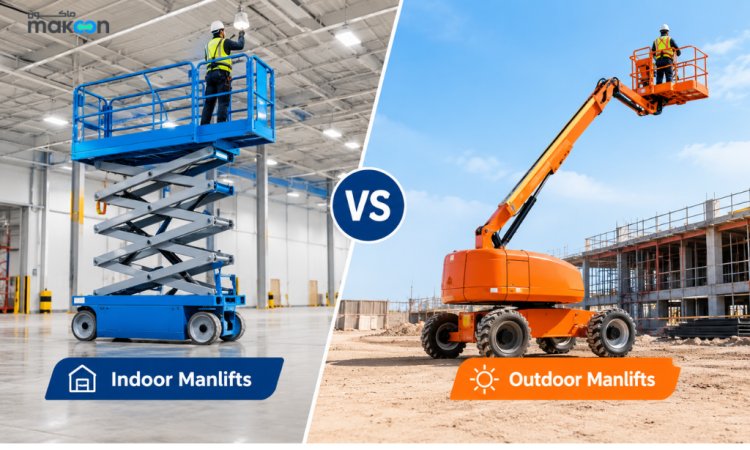
Indoor manlifts are typically electric, compact and designed for smooth, level floors where zero exhaust emissions and quiet operation matter. Outdoor manlifts are usually diesel or rough-terrain rated, built for uneven ground and outdoor weather exposure. The right choice for a Saudi Arabia project depends on working environment, ground conditions, required height, power source and project duration.
Choosing the wrong manlift for a job site is a common, costly mistake. An electric scissor lift meant for a warehouse floor has no business on a gravel yard, and a diesel boom lift brought into an enclosed facility can run into ventilation or emissions problems before the job even starts. Working at height only stays safe and efficient when the machine actually suits the environment it's used in.
What follows compares indoor and outdoor manlifts directly: what separates them, which factors should drive the decision, and how to match the right unit to a specific project, with manlift rental in Saudi Arabia support from Makcon. Makcon supplies scissor lifts, boom lifts, mast lifts and towable manlifts for construction, maintenance and industrial projects across Saudi Arabia, matched to the specific site rather than whatever unit happens to be free.
What Is a Manlift?
A manlift, also called an aerial work platform, lifts a worker and their tools to a specific height and position that a ladder or scaffold can't safely or efficiently reach. The category covers several distinct machine types, scissor lifts, boom lifts and mast lifts, each suited to different environments and tasks rather than one single design:
|
Manlift Type |
Power Source |
Typical Environment |
|
Electric scissor lift |
Battery/electric |
Indoor, level floors |
|
Rough-terrain scissor lift |
Diesel |
Outdoor, uneven ground |
|
Articulating boom lift |
Diesel or electric |
Indoor or outdoor, obstacles to reach around |
|
Telescopic boom lift |
Diesel |
Outdoor, long straight-line reach |
|
Vertical mast lift |
Electric |
Indoor, narrow aisles and low ceilings |
|
Towable manlift |
Diesel or electric |
Outdoor, temporary or infrequent access |
What Is an Indoor Manlift?
An indoor manlift is generally electric, chosen for zero exhaust emissions, quiet operation and a compact, narrow footprint that fits through standard doorways and tight aisles. Vertical mast lifts and electric scissor lifts are the most common indoor man lift rental choices, built for smooth, level flooring rather than rough or uneven ground. For a closer comparison between scissor lifts and boom lifts, see Makcon's dedicated equipment-type guide.
What Is an Outdoor Manlift?
Outdoor manlifts are typically diesel-powered or rough-terrain rated, built with larger tyres, greater ground clearance and more stability on uneven or sloped surfaces. Telescopic and articulating boom lifts, along with rough-terrain scissor lifts, handle wind exposure and rougher ground that an indoor unit isn't designed for. On a Saudi construction or industrial site, that usually means compacted sand, gravel yards, unfinished concrete or sloped access roads, conditions an indoor unit's smaller wheels and lower ground clearance simply aren't built to handle.
Diesel power also matters for outdoor jobs that run for a full shift or longer without an easy place to recharge a battery. A telescopic boom lift can typically hold a charge or fuel load through extended runtime on a remote site, while an electric indoor unit would need charging access that outdoor sites don't always have.
Indoor vs Outdoor Manlifts: Key Differences
|
Factor |
Indoor Manlift |
Outdoor Manlift |
|
Power source |
Electric or battery |
Diesel, or rough-terrain electric |
|
Ground suitability |
Smooth, level floors |
Uneven, sloped or rough terrain |
|
Emissions and noise |
Zero exhaust, quiet |
Combustion exhaust, louder |
|
Tyres |
Non-marking, solid |
Rough-terrain, pneumatic |
|
Typical footprint |
Compact, narrow |
Larger, wider stance |
|
Weather exposure |
Not rated for outdoor wind |
Rated for outdoor conditions |
An indoor lift rental provider will typically recommend an electric unit for exactly these reasons: no exhaust in an enclosed space, quieter operation around other workers, and a footprint that fits standard doorways and aisles.
7 Factors to Consider Before Choosing a Manlift
Matching the right manlift to a project comes down to seven practical factors:
1. Required Working Height
Confirm the actual height the task needs, with reasonable margin, since both indoor and outdoor manlifts range widely in maximum platform height. Underestimating height means a second mobilisation once the first unit turns out too short; overestimating pays for reach the job never uses.
2. Indoor or Outdoor Working Environment
This is the single biggest factor. An electric indoor unit brought outdoors, or a diesel outdoor unit brought into an enclosed space, creates real safety and compliance problems, exhaust building up where ventilation is limited, or a smooth-floor unit struggling for traction on rough ground.
3. Ground and Surface Conditions
Smooth concrete flooring suits standard tyres; gravel, sand or uneven ground needs rough-terrain capability. Slopes and soft ground also affect stability limits, which is worth checking against the manufacturer's rated specification rather than assuming any outdoor unit handles any terrain equally well.
4. Available Working Space
Narrow aisles, low doorways and tight corridors call for a compact vertical mast lift or narrow scissor lift rather than a wider outdoor unit. Measuring doorway width and ceiling height before booking avoids arriving with a machine that physically can't reach the work area.
5. Load and Platform Capacity
Confirm platform capacity for workers, tools and any materials being carried up, not just the number of people. A platform rated for one worker and hand tools isn't the right choice for two workers carrying sheet material or heavier equipment.
6. Power and Fuel Requirements
Electric units need charging access and suit emission-sensitive indoor sites; diesel units run longer without recharging but need fuel logistics and ventilation outdoors. Sites with strict emissions or noise rules, hospitals, occupied offices, food facilities, generally require electric regardless of other factors.
7. Project Duration and Rental Requirements
Short-term jobs and long-term projects can call for different rental terms; confirm this upfront when requesting a quote. A single-day maintenance task and a multi-month construction programme are priced and scheduled differently, and sharing the expected duration upfront avoids renegotiating terms partway through.
Indoor or Outdoor Manlift: Which One Is Right for Your Project?
For enclosed spaces, warehouses, indoor construction, retail fit-outs, an electric indoor manlift is generally the right choice. For open construction sites, industrial yards or rough terrain, an outdoor-rated diesel or rough-terrain unit is the better fit. Some projects need both: an indoor phase followed by outdoor site work, or a facility with both enclosed and open areas.
A practical middle case is a partly enclosed site, a building under construction with a finished ground floor but an open upper structure, or a warehouse with an unpaved loading yard outside. These sites often need both an indoor-suited unit for the finished areas and an outdoor-rated unit for the rest, rather than one machine trying to cover both. Where a project doesn't fit neatly into either category, sharing the site layout and task details lets Makcon confirm the right combination rather than guessing from a general description.
Common Applications for Manlift Rental in Saudi Arabia
Indoor and outdoor manlifts show up across very different parts of the same project, often within a single site:
● Warehouse racking, shelving and indoor maintenance work, typically electric mast lifts or scissor lifts
● Facade, cladding and structural work on outdoor construction sites, usually boom lifts
● Oil, gas and industrial plant maintenance and shutdown work, often outdoor rough-terrain units on unpaved yards
● Signage, lighting and exterior building maintenance
● Indoor facility fit-outs and event setup in enclosed halls and venues
● Retail and commercial fit-out projects with tight aisles and finished flooring
A single construction programme can move through several of these applications in sequence: an outdoor boom lift for structural and facade work, followed later by indoor electric units for interior fit-out once the building is enclosed.
Why Choosing the Right Manlift Matters
The wrong manlift on site isn't just inefficient, it's a real safety and compliance risk. An outdoor-rated diesel unit running inside an enclosed space raises exhaust and ventilation concerns; an indoor electric unit on rough or sloped outdoor ground risks instability. Getting the match right the first time also avoids downtime from a unit that can't actually do the job it was brought in for.
On Aramco, SABIC and similar industrial sites, equipment selection also intersects with site safety and permit-to-work requirements. A unit that doesn't match the declared work environment can hold up a gate pass or inspection before it ever reaches the work area, adding delay that a correct equipment match avoids entirely.
Why Rent a Manlift for Your Project?
Renting avoids the upfront capital cost, maintenance burden and storage of owning equipment used only for specific projects. It also means access to a range of indoor and outdoor units, matched to each project's actual requirements. For current rates, see Makcon's manlift rental pricing guide rather than assuming a fixed cost applies to every job.
Manlift Rental Services from Makcon
Makcon supplies electric scissor lifts, rough-terrain scissor lifts, articulating and telescopic boom lifts, vertical mast lifts and towable manlifts for construction, maintenance and industrial projects across Saudi Arabia's Eastern Province and beyond. Equipment is matched to working height, environment, ground conditions and project duration, available dry hire or with a certified operator. Searches for indoor lift rental near me usually mean looking for a provider stocking the right indoor-suited units within a manageable service radius; confirm Makcon's coverage for your exact location directly. For the full equipment range, see Makcon's dedicated manlift rental service page.
|
Need Help Choosing the Right Manlift? Share your site details, indoor or outdoor, working height, ground conditions, and Makcon will confirm the right unit for your project. Call +966 56 849 1941, email sales@mak-con.com, or see the full manlift rental range. |
Frequently Asked Questions
What is the difference between an indoor and outdoor manlift?
An indoor manlift is generally electric, compact and built for smooth, level flooring, while an outdoor manlift is typically diesel or rough-terrain rated, built for uneven ground and outdoor weather exposure.
Can an electric manlift be used outdoors?
Generally not on rough or uneven outdoor ground. Electric units are built for smooth, level surfaces and lack the tyres and stability rough terrain requires. Confirm suitability for your specific site before booking.
What type of manlift is best for warehouse work?
A vertical mast lift or electric scissor lift is typically best for warehouse work, since both are compact, emission-free and suited to smooth flooring and narrow aisles.
Does Makcon provide manlift rental with an operator?
Yes. Makcon supplies manlift rental as dry hire or with a certified operator, depending on site requirements.
What areas of Saudi Arabia does Makcon serve for manlift rental?
Makcon is based in Al Khobar and serves the Eastern Province, the Central Region, the Western Region, and other project sites across Saudi Arabia on a project-specific basis.
About the Author
Sheik Mohammed works in industrial support and equipment rental across Saudi Arabia, with hands-on experience in construction, oil and gas, and ARAMCO-related projects. He advises contractors on equipment selection, mobilisation, and site compliance in the Eastern Province and beyond.
Reviewed By
Mohammad Asif is a Senior SEO Executive at OneCity Technologies with experience in content strategy and digital marketing for construction, equipment rental, and B2B industrial sectors.
What's Your Reaction?