Excavator vs Backhoe: Which to Rent in KSA
Confused between excavator rental in Saudi Arabia and a backhoe loader? Compare dig depth, cost and use cases to pick the right machine for your project
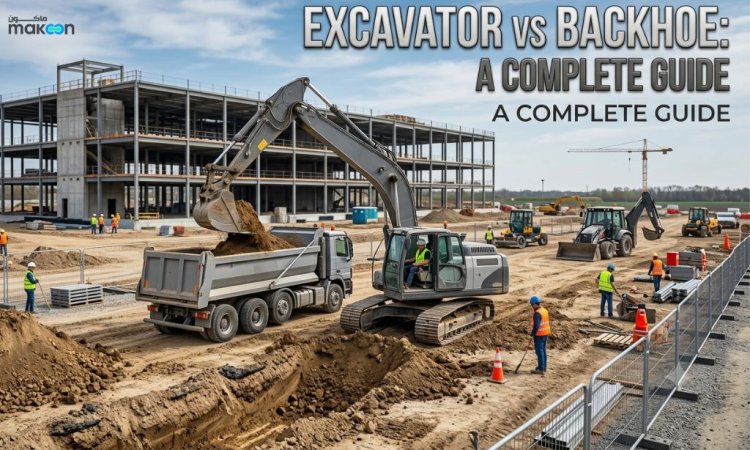
Choosing the wrong earthmoving machine does not just slow a job down; it shows up directly in fuel burn, labour hours, and how many days a site sits behind schedule. Contractors mix up excavators and backhoes constantly, mostly because both machines dig, and from a distance they can look similar on a job site. In practice, each is built for a different kind of work: one is a single-purpose digger that rotates a full circle on tracks or wheels, the other is a wheeled machine that combines loading and digging in a single chassis built for moving between tasks. Getting this choice wrong before signing a heavy equipment rental Saudi Arabia agreement is an easy way to add cost and delay to a project that neither machine caused. This guide covers what separates an excavator rental in Saudi Arabia from a backhoe rental, and exactly when each one is the right call.
What Is an Excavator?

An excavator is a single-purpose digging machine built around a rotating platform, a boom, an arm (or stick), and a bucket, mounted on either crawler tracks or wheels. The cab and boom assembly can rotate a full 360 degrees independently of the undercarriage, which lets the machine dig, swing, and dump material without repositioning between cycles.
Excavator size in Saudi Arabia's rental market typically runs from around 1.5 tonnes for a mini excavator up to 50 tonnes for large machines used on bulk earthworks, with dig depth scaling from roughly 3.5 metres on the smallest units to 8 metres or more on the largest, and past 10 metres on long reach configurations built for canal and drainage work. A crawler excavator, meaning one running on steel or rubber tracks rather than wheels, is the standard choice on uneven or unprepared ground because the tracks spread the machine's weight over a wider footprint than tyres can.
Most excavators run on tracks, but wheeled versions exist for road work, since a wheeled excavator can travel between sites under its own power without a low-loader, at the cost of some stability on soft ground compared to a tracked machine.
Contact For Excavator
What Is a Backhoe?

A backhoe, more precisely a backhoe loader, is a dual-purpose machine built on a wheeled tractor chassis: a front-mounted loader bucket for material handling on one end, and a rear-mounted digging arm, the actual "backhoe," on the other. One operator and one machine cover two distinct jobs without switching equipment.
A typical backhoe loader used on Saudi construction and utility sites weighs somewhere around 7.5 to 8.5 tonnes, with a loader bucket capacity of roughly 1.0 to 1.3 cubic metres and a rear digging depth in the range of 4.2 to 4.5 metres. Unlike an excavator's full rotation, the digging arm on a backhoe typically swings through around 180 to 200 degrees, since the machine is designed to dig from a fixed position facing forward or backward rather than spin freely.
The wheeled chassis is the backhoe's other defining feature. It can drive on public roads at speeds up to around 40 km/h, which means it moves between job sites or work fronts on its own power instead of needing a trailer, something a tracked excavator generally cannot do.
Contact For backhoe
Excavator vs Backhoe – What's the Difference?
Set side by side, the two machines separate cleanly along a handful of practical measures that actually decide which one fits a given job.
|
Factor |
Excavator |
Backhoe Loader |
|
Function |
Digging only (single-purpose) |
Digging and loading (dual-purpose) |
|
Rotation |
Full 360 degrees |
Roughly 180 to 200 degrees |
|
Typical size range |
1.5 to 50 tonnes |
Around 7.5 to 8.5 tonnes |
|
Typical dig depth |
3.5m (mini) to 8m+ (large), 10m+ long reach |
4.2 to 4.5 metres |
|
Mobility |
Tracked (needs low-loader) or wheeled |
Wheeled, road-legal, self-drive between sites |
|
Best ground type |
Soft, uneven, or unprepared ground (tracked) |
Firm or paved ground, urban sites |
|
Typical use case |
Deep, large-scale, or specialised excavation |
Smaller, mixed dig-and-load jobs, utility work |
The single biggest practical difference is what each machine replaces. An excavator on a large site replaces the need for maximum digging power and reach. A backhoe on a smaller or scattered site replaces the need for two separate machines, since it digs and loads from the same chassis.
When Should You Choose an Excavator?
An excavator earns its place on a job when any of the following apply.
The Dig Is Deeper Than a Backhoe Can Reach
Once a trench or foundation needs to go deeper than roughly 4 to 4.5 metres, a backhoe loader is working past its practical limit. Standard and large excavators reach well beyond that, and long reach configurations extend it further for drainage or marine work.
The Site Needs Continuous, High-Volume Digging
Bulk earthmoving, cut-and-fill on infrastructure projects, and continuous loading of dump trucks all favour an excavator's higher digging force and full rotation, which keeps the loading cycle faster than a backhoe's more limited swing arc allows.
Ground Conditions Rule Out a Wheeled Machine
Soft sand, freshly disturbed fill, or uneven terrain typically calls for a crawler excavator, since tracks distribute weight over a larger area and stay stable where a wheeled backhoe would struggle for traction or sink.
The Job Needs a Specific Attachment Class
Hydraulic breakers for rock or caliche, long-reach booms, and heavy grapples are generally excavator-class attachments, built for a machine with the hydraulic power and stability to run them productively.
When Should You Choose a Backhoe?
A backhoe loader is the more efficient choice in a different set of situations.
The Job Mixes Digging and Loading
Trenching a utility line and then loading the spoil or backfill material is exactly what a backhoe is built for. One machine and one operator cover both halves of the task without a second piece of equipment standing by.
Site Access Is Tight or Urban
Backhoes manoeuvre well in confined municipal and residential sites, and their wheeled chassis lets them travel on paved roads between scattered work points across a town or urban project without disrupting the surface.
The Project Moves Between Several Small Sites
Since a backhoe can self-drive at road speed, it suits contractors working several small utility or landscaping jobs across a city in the same week, where mobilising a tracked excavator to each site would add cost and time that the job does not justify.
Budget Favours a Single Versatile Machine
For smaller-scale work, renting one backhoe usually costs less than renting an excavator and a separate loader, and needs only one operator instead of two.
Excavator Applications Across Different Industries
Excavators show up across nearly every construction and industrial sector in Saudi Arabia, though the specific task changes by industry.
● Construction and real estate: foundation excavation for residential, commercial, and industrial buildings, plus site grading before other trades begin work on the plot.
● Oil, gas, and petrochemical: groundworks for plant units, pipe rack foundations, and underground service trenches on Aramco and SABIC-linked sites, typically requiring certified machines and operators.
● Roads and infrastructure: sub-base preparation, cut-and-fill grading, and side drainage excavation, typically running two to three dump trucks per excavator to keep the loading cycle moving without the machine standing idle.
● Utilities: water, gas, electrical conduit, and telecoms trenching, usually with standard-size machines on open sections and mini excavators for tight urban runs where access is restricted.
● Demolition and site clearance: breaking existing structures and concrete with a hydraulic breaker attachment, then clearing debris with a grapple before the site is handed over for new construction.
● Drainage and stormwater: channel excavation, culvert installation, and outfall construction using ditch-cleaning buckets for a finished profile a standard bucket cannot produce as efficiently.
Can an Excavator Replace a Backhoe?
For pure digging, yes: an excavator generally out-digs a backhoe on depth, power, and rotation speed. What it cannot replace on its own is the backhoe's front-end loading function. Pairing an excavator with a separate wheel loader recreates what a backhoe does in one chassis, but that means two machines, two operators, and two rental lines instead of one.
On a small or scattered job, that trade rarely makes sense; the backhoe's dual function is the more efficient setup. On a large or deep job, the excavator's added capability outweighs the convenience of having a loader bucket built onto the same machine. The honest answer is that neither machine replaces the other everywhere; each replaces it in the situations it was designed for.
Factors to Consider Before Choosing Between an Excavator and a Backhoe
Run through these points before booking either machine.
1. Required Dig Depth
Measure or confirm the actual depth needed rather than estimating from experience on a different site. Anything beyond 4 to 4.5 metres moves the decision toward an excavator by default, since that is roughly where a backhoe loader's reach runs out.
2. Site Access and Ground Conditions
Narrow gates, soft ground, or a site inside an existing facility often rule out a large tracked excavator, while a paved or firm urban site suits a backhoe's wheeled mobility. Check gate width and turning space before assuming either machine will fit.
3. Whether the Job Needs Loading as Well as Digging
If material has to be dug and then loaded onto a truck or moved elsewhere on site, a backhoe's dual function may remove the need for a second machine entirely, which also means one operator instead of two for the same task sequence.
4. Attachment Requirements
Confirm whether the job needs a hydraulic breaker, auger, grapple, or ditch-cleaning bucket, and check that the specific machine class you are booking can run it, since not every attachment is available on every size or type of machine.
5. Number and Spread of Work Sites
A contractor moving between several small sites in the same week benefits from a backhoe's self-drive mobility more than from an excavator's extra digging power at any single site, since transport time between locations adds up quickly.
6. Total Cost, Not Just the Daily Rate
Factor in mobilisation and transport for a tracked machine, the number of operators needed, and rental duration, not only the headline day rate for either machine. A lower day rate on paper can still be the more expensive option once transport is added in.
Common Attachments for Excavators
A bare bucket handles general digging, but the right attachment can double productivity on a specific task or remove the need for a second machine.
|
Attachment |
What It Is For |
|
Standard bucket |
General earthmoving, loading dump trucks, rough grading and stockpiling |
|
Hydraulic breaker (rock hammer) |
Breaking compacted caliche, concrete, and rock without blasting |
|
Grading and ditch-cleaning bucket |
Cleaning and profiling drainage channels and waterways to a smooth finish |
|
Hydraulic thumb or grapple |
Handling irregular material such as rubble, scrap steel, or tree stumps |
|
Auger drill |
Drilling holes for fence posts, piles, and pole bases faster than manual methods |
|
Compaction plate |
Compacting backfill inside trenches where a separate compactor cannot fit |
Common Mistakes Contractors Make When Choosing Equipment
A handful of avoidable errors show up repeatedly when contractors book the wrong machine for a job.
● Booking whichever machine is available fastest rather than the one matched to the actual dig depth and task.
● Underestimating dig depth, then discovering mid-job that a backhoe cannot reach the required level and a second mobilisation is needed.
● Overlooking site access constraints, such as a narrow gate or soft ground, until a tracked excavator is already en route.
● Requesting an attachment after the machine has already left the yard, rather than confirming breaker, auger, or grapple needs at the time of booking.
● Comparing only the daily rental rate without factoring in mobilisation cost, operator count, and how long the job actually takes with each machine option.
● Assuming a backhoe can substitute for an excavator on deep or high-volume work simply because it is cheaper to rent.
Cost Comparison – Excavator vs Backhoe Rental
Rental cost for both machines depends on size, attachment needs, rental duration, and whether an operator is included. As one published reference point, Makcon's excavator rental guidance puts standard 14 to 20-tonne excavators on dry hire at roughly SAR 800 to 1,600 per day, with mini excavators costing less and 30 to 50-tonne machines costing more. Monthly rates run substantially lower per day than daily or weekly hire for both machine types.
Because a backhoe loader sits in a single, smaller size class and covers two functions in one chassis, it commonly costs less per day than a mid-size excavator, and it avoids the cost of renting a separate loader for the loading half of a job. An excavator becomes the more cost-effective option once the job's depth, volume, or ground conditions would otherwise need a backhoe plus a second machine to get the same work done.
The only reliable way to compare true project cost is a written, itemised quote for the specific machine, attachment, and duration involved, since mobilisation charges and operator rates vary by site location and machine size.
Rental duration also changes the comparison. A short one or two-day job rarely justifies the mobilisation cost of a large excavator if a backhoe can complete it, while a multi-week or multi-month contract tends to favour whichever machine matches the work most directly, since the daily rate advantage compounds over the length of the hire.
What Makcon Offers for Excavator Rental in Saudi Arabia
Makcon's excavator rental fleet in Saudi Arabia spans mini excavators from 1.5 tonnes through large 50-tonne machines, alongside long reach and wheeled configurations, operating from an Al Khobar base with Aramco and TUV certification maintained across the fleet.
Attachments including hydraulic breakers, grapples, augers, and ditch-cleaning buckets are available to fit before a machine leaves the yard, and every unit goes through a mechanical inspection covering undercarriage wear, bucket teeth, and hydraulic condition before deployment.
For jobs that need both digging and loading, Makcon also supplies backhoe loaders, dump trucks, and wheel loaders from the same contract, so a contractor is not managing separate vendor agreements for machines that work the same site. Both dry hire and wet hire with certified operators are available, and a technical review of the job's dig depth, site conditions, and attachment needs happens before a specific machine is confirmed.
Conclusion
The choice between an excavator and a backhoe comes down to three questions: how deep the job needs to go, whether it requires loading as well as digging, and how the site's ground conditions and access constraints treat a tracked versus a wheeled machine. Get those three answers before requesting a quote, whether the search was for crawler excavator rental, mini excavator rental, or general construction machinery rental, and the equipment that arrives on site will match the work waiting for it.
|
Makcon supplies excavators, backhoe loaders, and heavy equipment for construction and industrial projects across Saudi Arabia. Call +966 56 849 1941 or email sales@mak-con.com, or submit a project enquiry for a written quote. |
Frequently Asked Questions
What is the main difference between an excavator and a backhoe?
An excavator is a single-purpose digging machine with a full 360-degree rotation, available from 1.5 to 50 tonnes. A backhoe loader combines a front loader bucket and a rear digging arm on one wheeled chassis, rotates roughly 180 to 200 degrees, and typically weighs around 7.5 to 8.5 tonnes.
Can a mini excavator do the same work as a backhoe loader?
A mini excavator can often match a backhoe's digging depth in confined spaces and causes less ground disturbance, but it lacks a front loader bucket, so it cannot handle the material-loading side of a job the way a backhoe can from the same chassis.
Which is cheaper to rent, an excavator or a backhoe?
A backhoe loader commonly costs less per day than a mid-size excavator, since it sits in a single smaller size class and covers two functions in one machine. Larger or specialised excavators cost more, but may still work out cheaper overall than renting a backhoe plus a second loader for high-volume jobs.
Do I need a crawler excavator or a wheeled excavator for my project?
A crawler excavator suits soft, uneven, or unprepared ground, since tracks spread the machine's weight over a wider area. A wheeled excavator suits paved or urban sites, since it can travel between locations under its own power without a low-loader.
What attachments can I use with a rental excavator?
Common attachments include a standard bucket, hydraulic breaker for rock and caliche, grading and ditch-cleaning buckets, hydraulic thumb or grapple for irregular material, an auger drill for post holes and piles, and a compaction plate for backfill work.
How deep can an excavator dig compared to a backhoe?
A backhoe loader typically reaches 4.2 to 4.5 metres. Standard excavators reach 4.5 to 7 metres, large excavators reach up to 8 metres or more, and long reach excavators can exceed 10 metres of dig depth from the machine's position.
Is a backhoe loader road-legal in Saudi Arabia?
Backhoe loaders are wheeled machines capable of travelling on roads at speeds up to around 40 km/h, which lets them move between job sites without a low-loader trailer, unlike most tracked excavators.
Can I rent an excavator with an operator in Saudi Arabia?
Yes. Excavator rental is typically available as dry hire, machine only, or wet hire, which includes a certified operator. For Aramco and SABIC sites, wet hire with a certified operator is generally the more practical option for gate clearance and site compliance.
What's Your Reaction?