What to Check Before Renting an Excavator
A contractor's checklist for renting an excavator in Saudi Arabia: size, condition, certification, attachments, and rental terms to verify before signing.
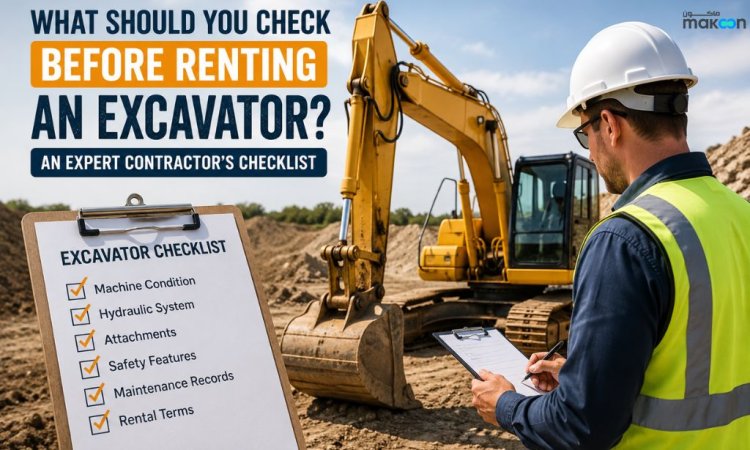
An excavator that arrives on site without the right bucket, with expired third-party certification, or with a hydraulic system on the edge of failure does not just slow a project down — it stops it entirely. In Saudi Arabia's construction equipment market, valued at USD 2.40 billion in 2025 and growing at 3.26 per cent CAGR toward USD 3.20 billion by 2034, excavators account for the largest share of rental demand across earthmoving, trenching, demolition, and utility installation work. The difference between a productive rental and a costly one often comes down to what the contractor checks — or fails to check — before the machine leaves the yard.
This guide provides a complete pre-rental inspection framework built for Saudi Arabia's operating conditions: extreme heat that pushes cooling systems and hydraulic seals beyond normal limits, sandstorm exposure that accelerates air filtration wear, Aramco and SABIC certification requirements that can block non-compliant equipment at the gate, and project scales ranging from single-villa foundations to multi-billion-riyal giga-project earthworks. Whether you are renting a 1.5-tonne mini excavator for a confined utility trench or an 80-tonne crawler for a pipeline corridor, these checks ensure the machine you receive performs safely, legally, and efficiently from the first hour on site.
Why a Pre-Rental Inspection Matters More Than You Think
Contractors who skip pre-rental checks typically discover problems after the excavator has been transported to site — at which point the transport cost (SAR 1,500–8,000 depending on machine size and distance) has already been incurred, the project schedule has allocated a start date around that machine, and any replacement unit requires a fresh mobilisation cycle of 24–72 hours. The financial impact cascades quickly:
- Idle crew costs: A four-person excavation crew sitting idle while waiting for a replacement machine costs SAR 2,000–3,500 per day in wages alone, before overhead and subcontractor delay penalties
- Schedule compression: Every lost day on a critical-path excavation activity compresses the schedule for concrete, structural, and finishing trades that follow
- Safety incidents: Equipment with worn bucket teeth, leaking hydraulic lines, or malfunctioning backup alarms creates site hazards that can trigger Aramco HSSE stop-work orders affecting the entire project
- Certification rejection: An excavator without valid third-party inspection certificates cannot pass Aramco or SABIC gate entry — the machine sits outside the fence while the project waits
A thorough pre-rental inspection takes 30–60 minutes and prevents thousands of riyals in downstream costs. Treat it as the first productive hour of the rental period, not administrative overhead.
Step 1: Match the Excavator Size to the Job Scope
The most common rental mistake is not a mechanical defect — it is renting the wrong size machine. An undersized excavator extends timelines and fuel consumption; an oversized one wastes rental spend and may not fit the working area. Before contacting a rental company, define these project parameters:
| Parameter | What to Measure | Why It Matters |
|---|---|---|
| Maximum dig depth required | Deepest trench, foundation, or excavation in metres | Each size class has a fixed maximum dig depth — exceeding it means the bucket cannot reach the bottom |
| Required reach at grade | Horizontal distance from machine centreline to furthest dig point | Determines whether the excavator can work from its current position or must reposition repeatedly |
| Material type | Sand, clay, compacted fill, rock, or mixed | Harder materials require higher breakout force — a larger bucket cylinder and heavier machine |
| Working area dimensions | Width, length, and overhead clearance of the excavation zone | Mini and compact excavators fit spaces where a 20-tonne machine cannot physically operate |
| Load-out requirements | Truck size and loading height | The excavator must reach over the truck bed to load — insufficient reach means repositioning for every cycle |
| Daily production target | Cubic metres of material to move per shift | Drives bucket size selection and therefore machine class |
Step 2: Understand Excavator Size Classes and Specifications
Saudi Arabia's excavator rental market serves five distinct size classes. Each class has specific applications, and choosing correctly prevents both underpowered and overspent scenarios:
| Size Class | Operating Weight | Engine Power | Max Dig Depth | Bucket Capacity | Typical Saudi Applications |
|---|---|---|---|---|---|
| Mini | 1–6 tonnes | 10–45 HP | 2.0–3.5 m | 0.02–0.15 m³ | Utility trenching, landscaping, indoor demolition, confined urban plots |
| Compact | 6–10 tonnes | 45–75 HP | 3.5–4.5 m | 0.15–0.30 m³ | Residential foundations, cable laying, small road works, compound grading |
| Medium | 14–25 tonnes | 95–170 HP | 5.5–7.0 m | 0.50–1.10 m³ | Commercial building excavation, road construction, pipeline trenching, industrial site prep |
| Large | 25–50 tonnes | 170–350 HP | 7.0–8.5 m | 1.10–2.50 m³ | Deep foundations, large infrastructure, Aramco plant earthworks, dam construction |
| Extra-Large | 50–90 tonnes | 350–530 HP | 8.0–9.5 m | 2.50–5.50 m³ | Mining, quarry operations, major highway cuts, mega-project mass earthworks |
Saudi-specific note: At 50 °C ambient temperature, engine power derates by approximately 8 per cent at sea level and up to 15 per cent at altitude locations like Taif or Abha. When sizing an excavator for summer work (May–September), factor this derating into your production calculations — a 162 HP machine effectively delivers around 149 HP at peak summer temperatures in Dammam or Jubail.
Step 3: Inspect the Undercarriage — The Most Expensive Component
The undercarriage accounts for 40–50 per cent of an excavator's total maintenance cost over its lifetime, and it is the component most affected by Saudi Arabia's abrasive sand and high-temperature ground conditions. A rental excavator with worn undercarriage components will track poorly, consume more fuel, and potentially throw a track mid-operation — shutting down production for hours.
Undercarriage Inspection Checklist
- Track tension: Press the top of the track between the front idler and the first upper roller. Sag should be 25–50 mm for standard excavators. Over-tight tracks accelerate wear on sprockets and rollers; loose tracks risk de-tracking on uneven Saudi terrain
- Track shoes/pads: Measure remaining grouser height. New grousers are typically 30–35 mm; below 10 mm indicates end-of-life. On rubber-tracked minis, check for cracks, missing lugs, and steel cord exposure
- Rollers and idlers: Spin each roller by hand — it should turn freely without grinding or clicking. Frozen rollers cause flat spots in tracks and increase fuel consumption by 8–12 per cent
- Sprocket teeth: Look for hooked, sharpened, or broken teeth. A worn sprocket chews through new tracks rapidly
- Track frame and guards: Check for cracks, bends, and missing rock guards. Saudi sites with rocky substrata (common in the Hejaz and Asir regions) destroy unprotected undercarriage components quickly
- Final drive seals: Look for oil weeping around the final drive housing. A leaking final drive seal leads to gear damage within 50–100 operating hours if not addressed
Step 4: Evaluate the Hydraulic System — The Heart of Every Excavator
An excavator is essentially a hydraulic machine mounted on a chassis. Every movement — boom raise, stick extension, bucket curl, swing, and travel — depends on hydraulic pressure and flow. Hydraulic failures account for roughly 35 per cent of all excavator breakdowns, and Saudi Arabia's heat accelerates hydraulic fluid degradation significantly.
Hydraulic System Checks
- Hydraulic oil level and colour: Check the sight glass or dipstick. Oil should be between min and max marks. Dark brown or black oil indicates overdue service. Milky oil indicates water contamination — reject the machine immediately
- Hose condition: Walk the boom, stick, and swing circuit hoses visually. Look for surface cracking (heat damage common in Saudi summer), bulges (internal failure beginning), abrasion marks, and dried or hardened rubber. Any weeping at fittings indicates a connection that will fail under load
- Cylinder rods: Extend each cylinder fully and inspect the chrome rod surface. Pitting, scoring, or rust on cylinder rods means the seals are being damaged with every stroke — expect progressive leaks and eventual cylinder failure
- Cycle times: With the engine at full throttle, time a full boom raise-lower cycle. Compare against the manufacturer's specification. Slow cycle times indicate pump wear, internal valve leakage, or hydraulic oil that has lost viscosity from heat exposure
- Drift test: Raise the boom to full height with a loaded bucket, then shut down the engine. The boom should hold position for at least two minutes without visible drop. Measurable drift indicates spool valve or cylinder seal leakage
Step 5: Check the Engine and Cooling System
Excavator engines in Saudi Arabia work harder than identical machines in temperate climates. A cooling system operating at 90 per cent capacity in a European summer runs at near 100 per cent capacity during a Dammam July. This leaves zero margin for any cooling deficiency.
- Cold start: Ask to see the machine started from cold (not warmed up before your arrival). Listen for excessive cranking (more than 3–4 seconds indicates injector or glow plug issues), unusual knocking, or blue/white exhaust smoke (oil burning or coolant leak into combustion)
- Exhaust colour under load: Black exhaust under load can indicate clogged air filters, worn injectors, or turbo issues. A small puff of black on initial throttle-up is normal; sustained black smoke is not
- Coolant level and condition: Open the expansion tank (when cold). Coolant should be at the correct level with the proper colour for the antifreeze type. Brown or rusty coolant indicates internal corrosion. Oily film on coolant surface suggests head gasket seepage
- Radiator condition: Inspect the radiator core face. In Saudi Arabia, sand packs between cooling fins and reduces airflow dramatically. A properly maintained rental excavator should have clean, unblocked fins. Bent or damaged fins across more than 20 per cent of the face indicate deferred maintenance
- Air filtration: Check the air filter restriction indicator (most modern excavators have one on the air cleaner housing). A red or tripped indicator means the filter is overdue for replacement — a critical issue in dusty Saudi conditions where an excavator can require filter service every 50–100 hours versus the 250-hour standard interval in clean environments
- Belt condition: Check alternator and fan belts for cracks, glazing, and proper tension. Heat-degraded belts fail without warning and cause immediate engine overheating
Step 6: Assess the Boom, Stick, and Bucket
These are the working end of the excavator — any weakness here directly reduces digging performance, safety, and cycle times.
- Structural integrity: Walk the full length of the boom and stick looking for cracks, especially at weld joints, pivot points, and mounting brackets. Even hairline cracks propagate rapidly under cyclic loading and can cause catastrophic structural failure
- Pin and bushing play: With the bucket on the ground and the engine off, push the stick sideways at the bucket connection. Excessive play (more than 5 mm visible movement) at any pin joint indicates worn bushings. Worn pins create sloppy control, reduce digging accuracy, and accelerate further component damage
- Bucket teeth: Inspect each tooth for wear, cracks, and secure mounting. Worn teeth reduce digging efficiency by 15–25 per cent and increase fuel consumption. Missing teeth create an uneven cutting edge that increases side loading on the bucket
- Cutting edge: The bottom edge of the bucket should be straight and of even thickness. A worn or wavy cutting edge reduces bucket fill factor and increases the number of passes required for each load
- Quick coupler (if fitted): Verify both locking pins engage fully. Test the coupler by lifting the bucket off the ground and shaking the stick — no movement should be visible at the coupler interface. Quick coupler failures cause bucket drops, which are among the most serious heavy equipment accidents on construction sites
Step 7: Verify Safety Systems and Cab Condition
Saudi Arabia's General Authority for Meteorology and Environmental Protection (GAMEP) workplace safety regulations, Aramco's HSSE framework, and SABIC's contractor safety requirements all mandate specific safety equipment on excavators operating within their jurisdictions.
- ROPS/FOPS: Rollover Protective Structure and Falling Object Protective Structure must be factory-installed, undamaged, and carry visible certification markings. Any modification to ROPS/FOPS voids the certification
- Seat belt: Must retract, lock, and release cleanly. Frayed webbing, cracked buckles, or non-retracting belts are immediate replacement items
- Backup alarm: Must produce an audible warning when the machine is in reverse. Test at actual operating distance — the alarm should be clearly audible at 15 metres in a noisy site environment
- Horn: Must function and be audible across the work zone
- Mirrors and camera: Rear-view mirrors must be present and adjustable. Rear-view cameras, where fitted, must display a clear image. On Aramco sites, rear-view cameras are mandatory on all excavators above 6 tonnes
- Fire extinguisher: Must be mounted in the cab, fully charged (check pressure gauge), within its service date, and accessible to the operator without leaving the seat
- Cab glass: All windows and windscreen must be intact — no cracks, chips, or missing panels. Damaged cab glass is a safety violation on virtually all Saudi industrial sites
- Air conditioning: Not a luxury in Saudi Arabia — it is a safety requirement. An operator working in a cab at 60+ °C (a realistic interior temperature without A/C when ambient is 50 °C) will experience heat exhaustion within 30–60 minutes. Test that the A/C cools the cab to below 25 °C within five minutes of activation
- Gauges and warning lights: Start the engine and verify all gauges (engine temperature, hydraulic oil temperature, fuel level, engine oil pressure) register correctly and all warning lights cycle during startup self-test
Step 8: Demand Certification and Documentation
Documentation is not bureaucracy — it is the legal and operational foundation that determines whether your excavator can work on the sites where your projects are. Without correct certification, the machine may physically run perfectly but remain legally prohibited from entering the work zone.
Essential Documents to Request
| Document | What to Check | Why It Matters |
|---|---|---|
| Third-party inspection certificate (TUV, SGS, or Bureau Veritas) | Issue date within last 12 months, machine serial number matches | Required for Aramco, SABIC, and most major contractor sites. Expired certificates block site access |
| Load charts (if lifting operations planned) | Charts present in cab, legible, correct for the specific model and configuration | Any lifting operation requires the operator to reference load charts. Missing charts mean the excavator cannot legally perform lifting duties |
| Operator manual | Present in cab, correct model | Required for pre-shift inspections and emergency procedures |
| Maintenance records | Last three service intervals documented with dates and hours | Confirms the rental company maintains the machine to manufacturer specifications. Gaps in records indicate deferred maintenance |
| Insurance certificate | Comprehensive coverage, your company listed as additional insured or the rental agreement covers third-party liability | Protects against damage claims, third-party injury, and site property damage |
| Hour meter reading | Record at delivery and compare with maintenance records | Establishes baseline for rental billing and verifies maintenance intervals are consistent with actual usage |
Aramco and SABIC Site-Specific Requirements
Contractors working on Aramco or SABIC sites face additional equipment compliance requirements beyond standard rental documentation:
- GI (General Inspection) clearance: All heavy equipment entering Aramco facilities must pass the General Inspection process, which verifies safety systems, structural integrity, and environmental compliance
- CHSEP (Contractor HSE Performance) compliance: The rental company's safety management system and incident history must meet Aramco's CHSEP scoring thresholds
- SAPMT (Saudi Aramco Project Management Team) registration: Equipment used on major projects may require specific SAPMT registration and approval
- Operator certification: Operators must hold valid certifications recognised by Aramco — typically NCCCO, CPCS, or equivalent with additional Aramco orientation training
- Equipment age limits: Many Aramco and SABIC sites restrict equipment age to 10–15 years from manufacture date. Verify the machine's year of manufacture against the specific site's equipment age policy
Step 9: Evaluate the Rental Company — Not Just the Machine
The excavator is only as reliable as the company standing behind it. A machine with a 2 per cent chance of breakdown per week means nothing if the rental company takes 72 hours to respond with a replacement. Evaluate these operational factors before signing a rental agreement:
- Response time for breakdowns: What is the contractual maximum response time? Best-practice Saudi rental companies commit to 4–8 hour response within the Eastern Province and 12–24 hours for remote locations. Get this in writing
- Replacement machine policy: If the rented excavator suffers a major failure, does the rental company provide a replacement machine at no additional cost? What is the mobilisation timeline for the replacement?
- Maintenance support model: Does the company provide on-site preventive maintenance (filter changes, greasing, fluid top-ups) during long-term rentals, or is the contractor responsible?
- Fleet depth: A rental company with 200+ excavators across multiple size classes can swap machines quickly. A company with 15 excavators may not have an equivalent unit available when yours fails
- Geographic coverage: Does the company have depots or service centres near your project site? A rental company based solely in Riyadh supporting a project in Jubail adds significant mobilisation time and cost for every service call
- Aramco/SABIC vendor registration: Is the rental company itself registered as an approved Aramco or SABIC vendor? Unregistered suppliers cannot mobilise equipment to these sites regardless of individual machine certifications
- Wet hire availability: If you need the excavator with a certified operator (wet hire), does the company supply operators with the required certifications for your specific site?
Step 10: Understand the Rental Agreement Terms
The rental agreement is as important as the machine itself. Saudi Arabia's rental market has matured significantly, but contract terms still vary widely between providers. Key clauses to negotiate and understand:
- Rate structure: Daily, weekly, or monthly rate? Monthly rates typically offer 35–50 per cent savings per day compared with daily rates. A 20-tonne excavator renting at SAR 3,300–4,200/day costs SAR 28,100–39,900/month — roughly 40 per cent less per day on a monthly basis
- Included hours: Most monthly rentals include 200–250 operating hours. Excess hours are billed at an hourly surcharge, typically SAR 80–200/hour depending on machine size. Track your hours proactively
- Mobilisation and demobilisation: Transport costs to and from site are usually billed separately. For large excavators (30+ tonnes), low-bed transport costs SAR 3,000–8,000 per trip depending on distance
- Fuel responsibility: Clarify whether the machine arrives with a full tank and must be returned full, or whether fuel is billed separately. Excavator fuel consumption varies dramatically by size class:
| Excavator Class | Operating Weight | Fuel Consumption (litres/hour) | Daily Fuel Cost at SAR 2.18/L* |
|---|---|---|---|
| Mini (1–6 t) | 1–6 tonnes | 4–10 | SAR 70–175 |
| Compact (6–10 t) | 6–10 tonnes | 10–18 | SAR 175–315 |
| Medium (14–25 t) | 14–25 tonnes | 18–30 | SAR 315–525 |
| Large (25–50 t) | 25–50 tonnes | 30–50 | SAR 525–875 |
| Extra-Large (50–90 t) | 50–90 tonnes | 50–80 | SAR 875–1,400 |
*Based on Saudi diesel price. Daily cost assumes 8-hour operating shift at average load factor.
- Damage waiver and insurance: Understand what the standard rental rate covers and what additional damage waiver costs. Typical damage waiver adds 8–15 per cent to the base rental rate but caps your liability for accidental damage at a fixed deductible (usually SAR 5,000–25,000 depending on machine value)
- Minimum rental period: Some companies impose minimum rental periods of 7–30 days. If your excavation work spans 10 days, a 30-day minimum rental erodes the cost advantage of renting versus buying used equipment
Common Pre-Rental Mistakes That Cost Saudi Contractors Money
After reviewing hundreds of rental engagements across the Eastern Province, Riyadh, and Jeddah, these mistakes recur most frequently:
| Mistake | Consequence | How to Avoid |
|---|---|---|
| Renting by price alone without inspecting the machine | Breakdowns, lost production days, safety incidents | Always inspect or require a pre-delivery inspection report with photos and hour meter reading |
| Not verifying certification dates before mobilisation | Machine rejected at Aramco/SABIC gate, demobilisation cost, replacement delay | Request certificate copies 48 hours before delivery and verify serial numbers match |
| Oversizing the excavator for the available workspace | Machine cannot manoeuvre, damages adjacent structures, requires costly repositioning | Measure working area dimensions and compare against machine swing radius and transport width |
| Ignoring the attachment inventory | Standard bucket delivered when rock bucket, breaker, or ripper was needed | Specify all required attachments in the rental order with sizes and connection types |
| Skipping the hour meter check at delivery | Billing disputes, inability to verify maintenance schedule compliance | Photograph the hour meter at delivery and record in the handover document |
| Not testing the A/C system | Operator heat stress in summer, reduced productivity, potential heat-related illness | Run A/C for five minutes during pre-delivery inspection and verify cab temperature drops below 25 °C |
| Assuming the rental company carries adequate insurance | Contractor liable for damage to the machine, third-party injury, or site property damage | Request insurance certificate and verify coverage limits before signing |
Excavator Pre-Rental Checklist — Quick Reference
Use this checklist at the rental yard or during on-site delivery acceptance. Any item marked "Fail" should be resolved before the machine enters your work zone:
| Category | Check Item | Pass/Fail Criteria |
|---|---|---|
| Sizing | Dig depth matches project requirement | Machine spec ≥ required depth + 10% margin |
| Sizing | Reach at grade covers working area | Machine spec ≥ required reach |
| Undercarriage | Track tension within spec | 25–50 mm sag between idler and first roller |
| Undercarriage | Track shoes/pads condition | Grouser height > 10 mm, no cracks or missing lugs |
| Undercarriage | Rollers and idlers spin freely | No grinding, clicking, or frozen rollers |
| Undercarriage | Sprocket teeth condition | No hooked, sharpened, or broken teeth |
| Hydraulics | Oil level and colour | Between marks, amber/gold colour, no milkiness |
| Hydraulics | Hose condition | No cracks, bulges, abrasion, or weeping |
| Hydraulics | Cylinder rods | Smooth chrome surface, no pitting or scoring |
| Hydraulics | Boom drift test (2-minute hold) | No visible drop with loaded bucket, engine off |
| Engine | Cold start performance | Starts within 3–4 seconds, no knocking |
| Engine | Exhaust colour under load | Clear or light grey; no sustained black/white/blue |
| Engine | Radiator condition | Fins clean and unblocked, < 20% damage |
| Engine | Air filter indicator | Not tripped/red |
| Boom/Stick | Structural integrity | No cracks at weld joints or pivot points |
| Boom/Stick | Pin and bushing play | < 5 mm lateral movement at bucket connection |
| Bucket | Teeth condition | All teeth present, secure, > 50% material remaining |
| Bucket | Quick coupler lock engagement | Both pins fully engaged, no movement under shake test |
| Safety | ROPS/FOPS certification | Undamaged, certification markings visible |
| Safety | Seat belt, horn, backup alarm | All functional |
| Safety | Rear-view mirrors/camera | Present, functional, clear image |
| Safety | Fire extinguisher | Mounted, charged, within service date |
| Safety | Air conditioning | Cools cab below 25 °C within 5 minutes |
| Documents | Third-party inspection certificate | Valid, serial number matches machine |
| Documents | Maintenance records (last 3 services) | Documented with dates and hours |
| Documents | Insurance certificate | Current, adequate coverage limits |
Attachments: Specify Before You Rent
An excavator's versatility comes from its attachments, and the wrong attachment — or a worn-out one — reduces productivity as much as a mechanical deficiency. Specify every attachment you need in the rental order:
- Standard digging bucket: Verify width matches your trench or excavation width requirements. Common Saudi rental sizes: 300 mm (utility trenches), 600 mm (foundations), 900 mm (general excavation), 1,200 mm (bulk earthmoving)
- Rock bucket: Required for hard ground conditions common in Hejaz, Asir, and parts of the Central Province. Heavier construction with reinforced cutting edge and closer tooth spacing
- Hydraulic breaker: For rock breaking, concrete demolition, and trench work through compacted limestone. Verify the breaker size matches the excavator's hydraulic flow rating
- Ripper tooth: Single-tooth ripper for breaking compacted ground or soft rock without the noise and vibration of a breaker — useful on urban sites with noise restrictions
- Tilt bucket: Allows angled grading without repositioning the machine — valuable for slope work and ditch profiling
- Compaction wheel: For trench backfill compaction — eliminates the need for a separate roller compactor in the trench
Why Makcon Is the Preferred Excavator Rental Partner in Saudi Arabia
Makcon maintains one of the largest Aramco and TUV-certified excavator rental fleets in the Eastern Province, with machines ranging from compact excavators for confined utility work to large crawler excavators for major earthworks. Every excavator in the Makcon fleet undergoes a comprehensive multi-point pre-delivery inspection that covers every item in the checklist above — undercarriage measurement, hydraulic pressure testing, engine diagnostics, safety system verification, and certification validation — before it leaves the yard.
Beyond the machines, Makcon provides the operational infrastructure that supports productive excavation work: certified operators with Aramco orientation training, on-site maintenance support for long-term rentals, consumable supply including filters and hydraulic fluids, and a fleet deep enough to provide same-day replacement machines across the Eastern Province. With service centres in Dammam, Jubail, Riyadh, and Jeddah, response times remain within the 4–8 hour window that project schedules demand.
Whether your project requires a single mini excavator for a two-week utility installation or a fleet of 30-tonne crawlers for a twelve-month infrastructure contract, Makcon delivers equipment that has been inspected, certified, and maintained to the standards that Aramco, SABIC, and Saudi Arabia's leading EPC contractors require. Contact Makcon for a detailed quotation with pre-delivery inspection documentation included.
Frequently Asked Questions
What is the most important thing to check before renting an excavator?
Match the excavator size to your job scope first — dig depth, reach, bucket capacity, and working area dimensions. The most expensive rental mistake is not a mechanical defect but renting a machine that is too small to reach your required excavation depth or too large to manoeuvre in the available space. Once the size is correct, the hydraulic system condition is the single most critical mechanical check, as hydraulic failures cause 35 per cent of all excavator breakdowns.
How much does it cost to rent an excavator in Saudi Arabia?
Indicative 2026 rates vary by size class. Mini excavators (1–6 tonnes) start from approximately SAR 1,700/day or SAR 14,000/month. Medium excavators (14–25 tonnes) range from SAR 3,300–4,200/day or SAR 28,100–39,900/month. Large excavators (30–50 tonnes) range from SAR 5,000–5,900/day or SAR 42,100–56,100/month. Monthly rates offer approximately 40 per cent savings per day compared with daily billing. Transport, fuel, and operator costs are typically additional.
What certifications does an excavator need for Aramco sites?
Aramco requires a valid third-party inspection certificate from an accredited body (TUV, SGS, or Bureau Veritas) issued within the preceding 12 months. The machine must pass the General Inspection (GI) process covering safety systems and structural integrity. The rental company must be a registered Aramco vendor with acceptable CHSEP (Contractor HSE Performance) scores. Operators must hold recognised certifications (NCCCO, CPCS, or equivalent) with Aramco site orientation training.
Should I rent an excavator with or without an operator?
Wet hire (with operator) is recommended when you lack certified excavator operators on your team, when the project is on an Aramco or SABIC site requiring operator-specific certifications, or when the rental is short-term and does not justify training or sourcing an operator independently. Dry hire (machine only) makes sense when you have experienced, certified operators on staff and want to maintain direct control over equipment operation and productivity.
How do I know if the excavator is too old for my project?
Check the machine's year of manufacture on the serial number plate. Many Aramco and SABIC sites restrict equipment age to 10–15 years from manufacture. Beyond age, the hour meter is more telling — a 5-year-old excavator with 12,000 hours has been worked harder than a 10-year-old machine with 6,000 hours. Cross-reference hours with maintenance records to evaluate actual condition versus calendar age.
What happens if the rented excavator breaks down on my site?
Your rental agreement should specify the provider's maximum response time for breakdowns, whether a replacement machine is provided at no additional cost, and who bears the cost of lost production time. Reputable Saudi rental companies like Makcon commit to 4–8 hour response times within their primary service areas and maintain replacement inventory to minimise project downtime.
Can I rent excavator attachments separately from the machine?
Yes. Most Saudi rental companies offer attachments — breakers, rippers, tilt buckets, compaction wheels, sorting grabs — as separate rental items that can be added to a base machine rental. Specify the attachment type, size, and hydraulic connection type (the attachment must match the excavator's auxiliary hydraulic flow rate and coupler style) when placing the rental order to ensure compatibility.
What size excavator do I need for a standard residential foundation in Saudi Arabia?
Most residential foundations (villa-style, 200–500 m² footprint, 1.5–3.0 m depth) are efficiently handled by a compact or medium excavator in the 6–20 tonne range with a 600–900 mm bucket. For sites with hard ground (common in the Central and Western Provinces), step up to the larger end of the medium class (20–25 tonnes) for the additional breakout force. Mini excavators (1–6 tonnes) work for shallow utility trenching around the perimeter but lack the production rate for bulk foundation excavation.
What's Your Reaction?