One Partner for Construction Projects in KSA
Makcon supports 650+ construction and industrial projects across Saudi Arabia with equipment, manpower, materials and industrial support from one partner.
Saudi Arabia's construction market reached USD 101.4 billion in 2025, with contract awards totalling USD 196 billion — a 20 per cent increase over 2024. The unawarded project pipeline stands at approximately USD 1.5 trillion, making it the largest in the world. Within this scale of activity, the difference between a project that finishes on time and on budget, and one that spirals into delays and cost overruns, often comes down to a single operational decision: how many vendors are managing your equipment, manpower, materials, and site support.
Fragmented vendor management — one company for cranes, another for generators, a third for manpower, a fourth for materials — creates coordination gaps that compound across every phase of a project. Integrated construction support from a single partner eliminates these gaps. This guide explains exactly why the single-partner model works, what services an integrated provider should deliver, and how to evaluate whether a partner has the fleet, the certifications, and the regional presence to support your project from mobilisation to demobilisation.
The Real Cost of Fragmented Vendor Management
On a typical Saudi construction site running 10–15 active vendors, the project management team spends a disproportionate share of its time coordinating between suppliers rather than managing actual construction progress. The consequences of this fragmentation are measurable:
- Schedule delays: When a crane supplier delivers equipment but the operator from a separate manpower agency has not been mobilised, the crane sits idle. On projects billing SAR 50,000–200,000 per day for crane rental, even two days of idle time represents significant waste.
- Safety gaps: Each vendor brings its own safety protocols. When an excavator operator from Vendor A works alongside a rigger from Vendor B under a lifting plan written by Vendor C, accountability fragments. On Aramco and SABIC sites, where a single safety incident can shut down an entire zone for investigation, this fragmentation is an unacceptable risk.
- Procurement overhead: Every additional vendor means another purchase order, another set of contract negotiations, another insurance verification, another monthly invoice reconciliation. For a project running 12–18 months, the administrative burden of managing 10+ vendors consumes project management resources that should be focused on construction milestones.
- Inconsistent certification standards: Aramco's SAES requirements, TUV certification, and Royal Commission standards apply equally to every piece of equipment and every operator on site. When vendors are managed independently, ensuring consistent compliance across all of them requires continuous auditing — a cost and effort that a single integrated partner absorbs internally.
5 Measurable Benefits of a Single Integrated Partner
1. Single Point of Accountability
When one company is responsible for the crane, its operator, the diesel generator powering the site, the materials being lifted, and the rigging crew executing the lift — every coordination decision happens internally. There is no finger-pointing between vendors when something goes wrong. One phone call, one project manager, one chain of accountability from equipment mobilisation through to project completion and site restoration.
2. Faster Mobilisation and Site Setup
An integrated provider pre-coordinates equipment, operators, and materials before they arrive on site. A heavy equipment fleet that includes cranes, excavators, generators, and access platforms — all maintained by the same workshop, transported on the same low-loaders, and operated by the same trained team — deploys as a single coordinated package rather than as separate deliveries from separate companies arriving on separate schedules. For fast-track projects driven by Vision 2030 deadlines, this coordination advantage can compress mobilisation from two weeks to three to five days.
3. Integrated HSE Compliance
Health, Safety, and Environment compliance is significantly easier to maintain when every worker on site operates under the same safety management system. An integrated partner trains all operators — crane operators, skilled manpower, riggers, equipment technicians — under one HSE framework. Toolbox talks, permit-to-work systems, incident reporting, and emergency procedures follow a single standard. On Aramco sites requiring adherence to the Loss Prevention System (LPS), this consistency is not just efficient — it is a prerequisite for continued access.
4. Cost Transparency and Volume Efficiency
Bundling equipment rental, manpower supply, material procurement, and industrial services under a single contract creates cost transparency that multi-vendor arrangements cannot match. Instead of comparing 10 separate invoices with different rate structures, contract terms, and hidden mobilisation charges, the project receives one consolidated monthly statement with clear line items. Volume bundling also reduces per-unit costs — a contractor renting cranes, generators, forklifts, and access equipment from the same provider typically achieves 10–20 per cent better rates than sourcing each category separately.
5. Scalability Without Procurement Delays
Construction projects rarely follow a linear resource curve. A pipeline project may need 5 cranes in Month 1, 12 cranes in Month 4, and 3 cranes in Month 8. An integrated partner with a deep fleet can scale equipment and manpower up or down within days, using a single variation order rather than renegotiating with multiple vendors. This elasticity is critical on Saudi mega-projects where scope changes are frequent and timelines are non-negotiable.
Four Service Pillars of an Integrated Construction Partner
A genuinely integrated construction support partner delivers capability across four interconnected service pillars. If any one pillar is missing, the coordination advantage breaks down and the contractor is back to managing multiple vendors.
Pillar 1: Heavy Equipment Rental
The equipment fleet is the foundation. A capable integrated partner maintains a diverse, well-serviced fleet covering every major equipment category required on Saudi construction and industrial sites:
| Equipment Category | Types Available | Capacity Range | Common Saudi Application |
|---|---|---|---|
| Cranes | Mobile, Crawler, Tower, RT, All-Terrain, Boom Truck | 10 T – 500 T | Structural steel, precast, module lifts |
| Earthmoving | Excavators, Bulldozers, Wheel Loaders, Graders | 5 T – 80 T | Site preparation, cut and fill, road construction |
| Material Handling | Forklifts, Telehandlers, Dump Trucks | 2.5 T – 40 T | Warehouse, logistics, bulk material movement |
| Access Equipment | Boom Lifts, Scissor Lifts, Manlifts | 8 m – 60 m | Facade work, MEP installation, inspection |
| Power Generation | Diesel Generators | 25 kVA – 2,000 kVA | Prime and standby site power |
| Compaction | Roller Compactors, Plate Compactors | 1 T – 20 T | Road base, embankment, backfill compaction |
| Specialised | Welding Machines, Backhoe Loaders | Various | Pipeline welding, utility trenching |
Every unit should carry current Aramco SAES compliance documentation, TUV certification, and a maintenance history demonstrating adherence to OEM service intervals. Equipment arriving on an Aramco site without these documents gets turned away at the gate — costing the contractor both the mobilisation expense and the schedule delay.
Pillar 2: Manpower Supply
Equipment without qualified operators is hardware without capability. An integrated partner provides certified manpower across all skill levels:
- Heavy equipment operators: TUV-certified crane operators, excavator operators, bulldozer operators, forklift drivers — each holding the specific category licence for the equipment they operate
- Riggers and signal persons: Certified riggers trained in load calculation, sling selection, and hand-signal communication for lifting operations
- Welders and fabricators: AWS or ASME-qualified welders with procedure-specific certifications (6G, 6GR) for structural and pipeline welding
- General skilled labour: Scaffolders, carpenters, masons, electricians, plumbers, and HVAC technicians with trade-specific qualifications
- Safety officers and supervisors: NEBOSH and IOSH-certified safety professionals who integrate with the client's HSE team
The advantage of sourcing manpower from the same partner that supplies the equipment is direct: the operators know the machines. They have been trained on those specific units, understand their maintenance quirks, and can communicate technical issues to the workshop team without translation through a third-party chain of command.
Pillar 3: Construction and Industrial Material Supply
The third pillar — material supply — is frequently overlooked in discussions about integrated services, but it is often where project delays originate. Structural steel, cement, aggregates, reinforcement bar, pipes, flanges, fasteners, welding consumables, and PPE — when any of these arrive late or in the wrong specification, the equipment and manpower already on site sit idle.
An integrated partner with established supplier relationships and bulk purchasing agreements maintains material availability buffers and can expedite procurement through pre-negotiated terms. On a project consuming 500 tonnes of structural steel per month, a two-week material delay cascades into idle crane time, idle welder hours, and schedule slippage that costs far more than the material itself.
Pillar 4: Industrial Support Services
Industrial support services extend an integrated partner's capability beyond construction into the operational and maintenance phase. This includes plant shutdown support, turnaround maintenance, scaffolding erection and dismantling, insulation, painting, fireproofing, and technical assistance for refineries, petrochemical plants, power stations, and desalination facilities.
For Aramco and SABIC facilities in Jubail Industrial City and Yanbu, shutdown windows are typically 30–90 days. The ability to rapidly deploy cranes, generators, access equipment, welders, riggers, and scaffolders under a single contract — with pre-approved Aramco and SABIC certifications — compresses mobilisation time and reduces the risk of shutdown overruns that carry penalties of SAR 100,000 or more per day.
Industries That Benefit Most from Integrated Support
Oil, Gas, and Petrochemical
Saudi Aramco operates the world's largest crude oil production capacity. Its upstream and downstream operations — from exploration drilling in the Empty Quarter to refinery maintenance at Ras Tanura — require coordinated equipment, manpower, and material delivery under the strictest safety and certification standards in the industry. An integrated partner pre-certified across all Aramco divisions eliminates the vendor qualification process that can delay project start by 3–6 months.
Giga-Projects and Vision 2030 Developments
NEOM has awarded USD 24 billion in construction contracts, with The Line at USD 8.9 billion and Oxagon at USD 9.3 billion. Qiddiya's entertainment city carries a USD 55 billion budget. Diriyah Gate is allocated USD 63.2 billion. Red Sea Global's tourism developments total USD 28.8 billion. These projects operate on compressed timelines with zero tolerance for coordination failures. The scale demands a partner who can deploy 50–100 pieces of equipment simultaneously with matching manpower — capabilities that single-category rental companies simply cannot provide.
Power and Water Infrastructure
Saudi Arabia's power demand continues to grow as population expands toward 10.1 million in Riyadh alone by 2030. Power plant construction, transmission-line installation, and desalination-facility builds require cranes for heavy module lifts, generators for temporary construction power, and specialised access equipment for work at height on boiler structures and cooling towers.
Transportation and Infrastructure
The USD 23 billion Riyadh Metro, the USD 7 billion Saudi Landbridge Railway, new airport terminals, highway expansions, and bridge construction all require integrated equipment support. Road projects consume earthmoving equipment, compactors, and dump trucks in the construction phase, then cranes and access equipment for structural elements. An integrated partner supplies the full sequence without procurement gaps between phases.
Commercial and Residential Development
With over 340,000 new homes needed in Riyadh and 3,800 construction licences issued in 2024, residential and commercial development is a growth engine for equipment demand. Tower construction projects — from foundation piling to facade installation — cycle through excavators, cranes, concrete pumps, generators, and access equipment in a predictable sequence that an integrated partner can plan and deliver as a single package.
Geographic Reach Across Saudi Arabia
An integrated partner is only as valuable as its geographic reach. Saudi Arabia spans 2.15 million square kilometres, and projects are distributed across three distinct operational corridors:
- Eastern Province: Dammam, Al Khobar, Dhahran, Jubail Industrial City, Ras Al Khair, Qatif, and Tanajib. This is the Kingdom's oil-and-gas heartland and the highest concentration of industrial equipment demand. A base in the Eastern Province is essential for rapid response to Aramco and SABIC project requirements.
- Central Region: Riyadh, Sudair Industrial City, and surrounding developments. Riyadh's population is projected to grow from 7 million to 10.1 million by 2030, driving massive construction demand for residential towers, metro extensions, entertainment districts, and commercial infrastructure.
- Western Region: Jeddah, Makkah, Madinah, and Yanbu. The Jeddah Central development, Haramain expansion projects, and Yanbu's petrochemical corridor create sustained demand for construction equipment and industrial support services.
Effective coverage means not just having equipment in these regions, but maintaining regional workshops, spare-parts inventories, and resident maintenance teams that can respond within hours rather than days. A generator breakdown at midnight on a Jubail pipeline project cannot wait for a technician to drive from Riyadh.
How to Evaluate an Integrated Construction Partner: 8 Critical Criteria
- Fleet breadth and depth: Does the partner cover all major equipment categories — cranes, earthmoving, material handling, access, power generation, compaction — with sufficient fleet depth to handle concurrent project demands?
- Aramco and SABIC pre-certification: Are the equipment and operators already certified, or will your project bear the time and cost of the certification process?
- Manpower capability: Can the partner supply TUV-certified operators, qualified welders, riggers, and safety officers — not just general labour?
- Material supply track record: Does the partner have established supplier relationships and bulk procurement capability, or is material supply an afterthought?
- Regional presence: Does the partner operate from bases in the Eastern Province, Central Region, and Western Region, with resident maintenance teams in each?
- Scalability: Can the partner scale from 5 units to 50 units on a single project without subcontracting to third parties?
- Financial stability: Is the partner financially stable enough to carry the working capital required for large-scale equipment deployment without demanding excessive advance payments?
- Track record: How many projects has the partner supported, across how many industries, and can they provide client references from Aramco, SABIC, or Royal Commission projects?
Why 650+ Projects Trust Makcon as Their Single Partner
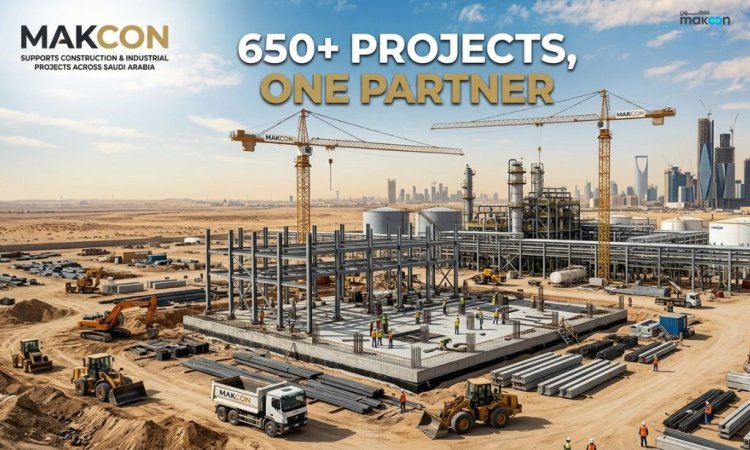
Makcon has supported over 650 construction and industrial projects across Saudi Arabia, delivering integrated equipment rental, manpower supply, material procurement, and industrial support services under single contracts for clients spanning oil and gas, petrochemical, construction, power, and infrastructure sectors.
Headquartered in Al Khobar in the Eastern Province, with operational reach across Riyadh and the Western Region, Makcon maintains:
- A fleet of cranes (10 T – 500 T), earthmoving equipment, generators (25 kVA – 2,000 kVA), forklifts, access platforms, compactors, and specialised units — all Aramco SAES-compliant and TUV-certified
- A pool of TUV-certified operators, AWS-qualified welders, NEBOSH-certified safety officers, and skilled tradespeople available for immediate deployment
- Established material supply chains for structural steel, cement, aggregates, piping, fasteners, and consumables
- Dedicated shutdown and turnaround teams for refinery and petrochemical plant maintenance
- 24/7 maintenance support with regional workshop facilities and OEM spare-parts inventory
The result is a single phone call, a single contract, a single safety system, and a single point of accountability from project mobilisation through to completion and site handover.
Contact Makcon to discuss how integrated construction support can simplify your next Saudi project — whether it is a 30-day Aramco shutdown or a 3-year mega-project build.
Frequently Asked Questions
What does "one partner for construction projects" actually mean?
It means sourcing your heavy equipment rental, certified operators, construction materials, and industrial support services from a single integrated company rather than managing separate vendors for each category. The practical benefit is unified coordination, consistent safety standards, single-invoice billing, and one accountable project manager covering all your site support needs.
How does an integrated partner reduce project costs?
Bundling multiple service categories under one contract typically reduces total project support costs by 10–20 per cent compared to sourcing each category separately. The savings come from eliminated coordination overhead, reduced mobilisation duplication (one transport instead of four), volume pricing across equipment categories, and fewer procurement cycles consuming project management time.
What equipment categories does Makcon cover under a single contract?
Makcon provides cranes (10 T – 500 T), excavators, bulldozers, wheel loaders, dump trucks, forklifts, telehandlers, boom lifts, scissor lifts, manlifts, diesel generators (25 kVA – 2,000 kVA), roller compactors, welding machines, backhoe loaders, and boom trucks. All units are Aramco SAES-compliant and TUV-certified.
Can Makcon supply both equipment and operators for Aramco projects?
Yes. Makcon provides wet-hire packages that include Aramco-badged, TUV-certified operators for every equipment category. Operators are trained on the specific units they operate, hold category-specific licences, and are covered under Makcon's HSE management system — meeting Aramco's Loss Prevention System requirements without requiring the contractor to manage operator qualifications independently.
Which regions in Saudi Arabia does Makcon serve?
Makcon serves all three major operational corridors: the Eastern Province (Dammam, Jubail, Al Khobar, Dhahran, Ras Al Khair, Tanajib), the Central Region (Riyadh, Sudair), and the Western Region (Jeddah, Makkah, Madinah, Yanbu). The company is headquartered in Al Khobar with regional operational capability across the Kingdom.
How quickly can Makcon mobilise equipment and manpower to a project site?
Standard mobilisation within the Eastern Province is 24–48 hours. Central and Western Region deployment typically takes 3–5 days depending on equipment type and fleet availability. Emergency mobilisation for shutdown support and urgent requirements can be arranged within 12–24 hours from regional depots. Mobilisation timelines are confirmed during contract negotiation.
Is Makcon suitable for both small projects and mega-projects?
Yes. Makcon supports projects ranging from short-term equipment rental for a single crane on a building site to full-scale integrated support for multi-year mega-projects requiring 50+ pieces of equipment, dozens of operators, and coordinated material supply. The fleet depth and manpower pool are sized to handle concurrent projects across multiple regions without resource conflicts.
What certifications does Makcon hold for industrial projects?
Makcon's equipment fleet carries Aramco SAES compliance, TUV certification, and Royal Commission approval. Operators hold TUV certification, Aramco safety-pass badges, and category-specific equipment licences. Welders are AWS and ASME qualified. Safety personnel are NEBOSH and IOSH certified. All certifications are maintained current and available for client audit upon request.
What's Your Reaction?