How to Choose the Right Construction Lift for Work at Height in Saudi Arabia
Construction lift rental Saudi Arabia: lift types, 7 selection factors, safety checks, rent vs buy, and typical daily rates, explained for contractors.
Construction lift rental Saudi Arabia decisions come down to matching working height, horizontal reach, ground conditions, platform capacity and project duration to the right equipment category, scissor lift, boom lift, manlift or telehandler, rather than defaulting to whichever unit is easiest to source. Getting this wrong usually means a second mobilisation once the wrong machine turns out unsuitable for the site.
Every construction site at height presents a different combination of factors: a warehouse fit-out needs a compact indoor lift, a facade project needs horizontal reach around scaffolding, and an unpaved industrial yard needs a machine rated for rough terrain. Choosing the wrong construction lift for the job doesn't just waste money, it can mean a machine that physically can't reach the work area, or one that isn't rated for the ground it's placed on.
This guide covers the common construction lift types used across Saudi Arabia, the seven factors that should drive the decision, safety basics, and when renting makes more sense than buying, with construction access equipment support from Makcon throughout. Makcon supplies scissor lifts, boom lifts and manlifts for construction, maintenance and industrial projects across the Eastern Province and beyond.
Common Types of Construction Lifts Used in Saudi Arabia
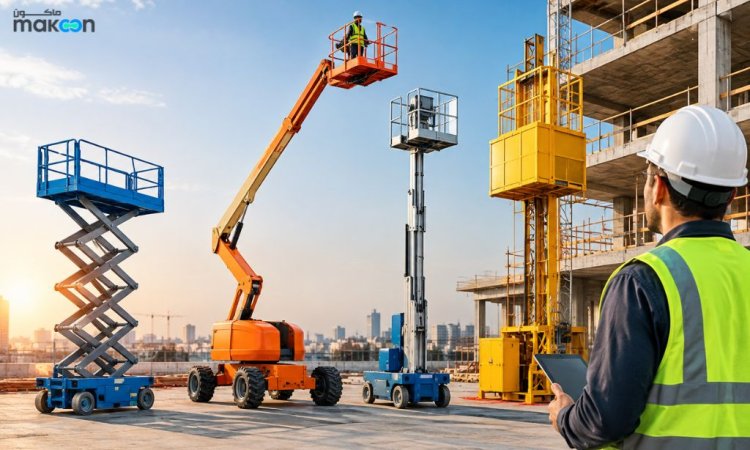
Four equipment categories cover most construction lift needs on Saudi sites, though not every rental company stocks all four:
|
Lift Type |
Typical Height/Reach |
Best Suited To |
|
Scissor lift |
Up to 14 m vertical |
Vertical access directly above the base, indoor or level outdoor ground |
|
Boom lift |
Up to 56 m, with horizontal reach |
Reaching around obstacles, facade work, plant maintenance |
|
Manlift / personnel lift |
Varies by sub-type |
General term covering scissor, boom and mast lifts used for personnel access |
|
Telehandler |
Varies by model, combines lift height with load handling |
Lifting and placing materials, pallets and blocks at height |
Scissor lifts and boom lifts cover the large majority of personnel-access work at height. Scissor lift rental in Saudi Arabia is typically the more affordable entry point for indoor and level-ground work, while boom lift rental in Saudi Arabia covers both articulating and telescopic models for tasks needing reach around obstacles. Manlift rental in Saudi Arabia is the broader umbrella term covering all three personnel-access categories together, scissor, boom and mast lifts, rather than a single distinct machine type.
Telehandlers sit in a different category, built primarily for lifting and placing materials rather than carrying a worker to a fixed platform, and are typically sourced through a materials-handling equipment specialist rather than an access equipment rental company; confirm availability directly for that specific category. Makcon's own construction lift rental Saudi Arabia fleet centres on scissor lifts, boom lifts and manlifts, with access equipment rental support covering the full range across the Eastern Province and beyond.
7 Factors to Consider When Choosing a Construction Lift
Matching the right lift to a project comes down to seven practical factors, in roughly this order of importance:
1. Required Working Height
Measure to the actual point of work, not the floor beneath it, and add a reasonable margin. Underestimating height means a second mobilisation once the first unit turns out short.
2. Horizontal Reach
Vertical height alone doesn't cover every task. Facade work, reaching over equipment, or working around scaffolding needs a boom lift's horizontal reach rather than a scissor lift's straight-up platform.
3. Ground and Terrain Conditions
Smooth concrete flooring suits standard tyres; gravel, sand or uneven ground needs rough-terrain capability. Slopes and soft ground affect stability limits, worth checking against the manufacturer's rated specification.
4. Platform Capacity
Confirm capacity for workers, tools and any materials carried up together, not just the number of people the platform is rated for.
5. Indoor or Outdoor Use
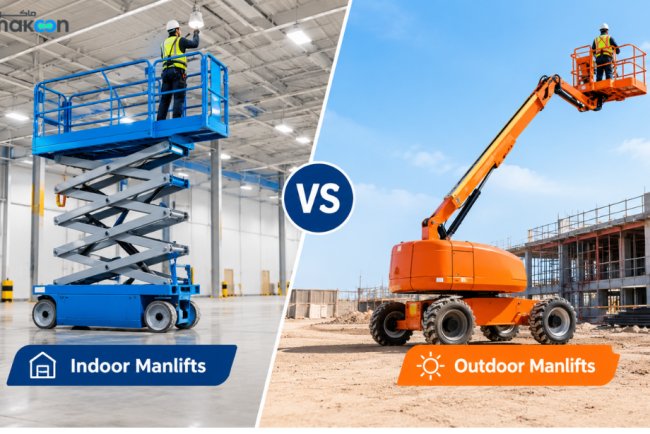
An electric indoor unit brought outdoors, or a diesel outdoor unit brought into an enclosed space, creates real safety and compliance problems, exhaust in a confined area, or a smooth-floor unit struggling for traction outside.
6. Project Duration
Short jobs and multi-month programmes are priced and scheduled differently. Sharing expected duration upfront avoids renegotiating rental terms partway through.
7. Access and Site Restrictions
Narrow doorways, low ceilings and tight aisles rule out wider outdoor-rated units regardless of how well they'd otherwise suit the task. Measuring access points before booking avoids a machine that can't physically reach the work area.
How to Match the Lift to Your Construction Application
Warehouse racking and indoor maintenance generally call for a compact electric scissor lift or vertical mast lift, since both are quiet, produce no exhaust, and fit through standard doorways. Facade, cladding and structural work on open construction sites usually needs a boom lift for its reach, particularly where scaffolding or existing structure would block a scissor lift's straight-up path. Oil, gas and industrial plant maintenance on unpaved yards typically needs an outdoor rough-terrain unit built for uneven ground and wind exposure rather than a standard electric model.
A single project can move through several of these categories in sequence: an outdoor boom lift for structural and facade work, followed later by indoor electric units once the building is enclosed for interior fit-out. Planning for that sequence upfront, rather than renting one machine type for the entire project, usually works out both cheaper and more practical than trying to make one lift cover every phase.
Safety Considerations When Using Construction Lifts
Confirm the operator is trained and certified for the specific lift type before use, not just experienced on lifts generally. Inspect controls, guardrails and the emergency lowering function on arrival, and confirm the ground can support the machine's rated load before positioning it. Platform capacity applies to workers, tools and materials combined, not headcount alone. For the fuller safety picture specific to manlifts, see Makcon's manlift safety requirements guide.
Renting vs Buying a Construction Lift
|
Factor |
Renting |
Buying |
|
Upfront cost |
Low, equipment rate only |
High, full purchase price |
|
Maintenance |
Handled by the rental company |
Contractor's own responsibility |
|
Equipment variety |
Different lift types across projects |
Fixed to whatever's owned |
|
Best suited to |
Project-based or variable equipment needs |
Continuous, long-term use of the same lift type |
Renting is the more practical option for most contractors, since project requirements change from site to site and few companies run the exact same lift type continuously enough to justify ownership. Buying can still make sense for a company running one lift type across many long-term sites without the equipment ever sitting idle between projects.
Why Equipment Rental Can Be Practical for Construction Projects
Beyond the upfront cost difference, renting avoids the storage, transport and depreciation of equipment that isn't in constant use, and gives access to a range of lift types matched to each project rather than one fixed machine used regardless of fit. It also shifts inspection, certification and maintenance obligations onto the rental company rather than the contractor's own team, which matters on regulated sites where an out-of-date inspection record can hold up a gate pass before work even starts.
For a contractor running several sites at once, renting also means each site can get the lift type it actually needs, a scissor lift on one, a boom lift on another, rather than sharing a single owned machine between locations and scheduling around its availability.
How Much Does It Cost to Rent a Construction Lift in Saudi Arabia?
As a planning range, electric scissor lifts typically run SAR 350 to SAR 600 per day, while boom lifts run SAR 700 to SAR 2,000 or more per day depending on reach; monthly rates work out significantly lower per day than short-term hire. These figures move with project specifics, so treat them as a starting point rather than a quote. For a fuller breakdown by machine type and rental term, see Makcon's manlift rental pricing guide.
Construction Lift Rental Saudi Arabia: Why Choose Makcon?
Makcon supplies electric and rough-terrain scissor lifts, articulating and telescopic boom lifts, and vertical mast and towable manlifts for construction access equipment needs across Saudi Arabia's Eastern Province and beyond. Equipment carries current third-party inspection certification and is approved for Aramco and SABIC sites, available as dry hire or with a certified operator. For Makcon's broader equipment and project-support capability beyond lifts specifically, see why contractors choose Makcon.
Choosing the Right Construction Lift
The right construction lift for a project comes from working height, reach, ground conditions, capacity, environment, duration and site access, in that order, rather than starting from whichever machine happens to be available. Getting the match right the first time avoids the cost and delay of a second mobilisation once the wrong unit turns out unsuitable for the site it was sent to.
|
Need the Right Lift for Your Project? Tell Makcon the height, reach, capacity and site conditions you're working with, and request a construction equipment rental quote. Call +966 56 849 1941, email sales@mak-con.com, or explore Makcon's access equipment range. |
Frequently Asked Questions
What type of construction lift is best for indoor work?
An electric scissor lift or vertical mast lift is generally best for indoor work, since both are compact, produce zero exhaust emissions, and are built for smooth, level flooring.
What is the difference between a boom lift and a scissor lift?
A scissor lift moves straight up and down and suits tasks directly above its base, while a boom lift can extend and articulate outward to reach around obstacles, making it better suited to tasks that need horizontal reach rather than vertical access alone.
How much does it cost to rent a construction lift in Saudi Arabia?
Daily rates typically range from around SAR 350 to SAR 600 for electric scissor lifts and SAR 700 to SAR 2,000 or more for boom lifts, depending on working height, reach, rental duration and whether an operator is included. Monthly rates work out significantly lower per day than short-term hire.
Should I rent or buy a construction lift?
Renting is generally more practical for most contractors, since it avoids the upfront capital cost, maintenance burden and storage of equipment used only for specific projects, and gives access to different lift types as project requirements change. Buying can make sense for a company running the same type of lift continuously across many long-term sites.
What safety checks are needed before using a construction lift?
Confirm the operator is trained and certified for the specific lift type, inspect controls, guardrails and emergency lowering functions before use, check that the ground can support the machine's rated load, and confirm the platform's rated capacity isn't exceeded by workers, tools and materials combined.
About the Author
Sheik Mohammed works in industrial support and equipment rental across Saudi Arabia, with hands-on experience in construction, oil and gas, and ARAMCO-related projects. He advises contractors on equipment selection, mobilisation, and site compliance in the Eastern Province and beyond.
Reviewed By
Mohammad Asif is a Senior SEO Executive at OneCity Technologies with experience in content strategy and digital marketing for construction, equipment rental, and B2B industrial sectors.
What's Your Reaction?